If you want to improve your golf swing, softball pitch, or tennis serve, the push-up is for you.
The push-up is a highly adaptable exercise that can be tailored to help individuals with specific needs, say a team of UWaterloo researchers who studied a modified push-up, called a ‘push-up plus.’
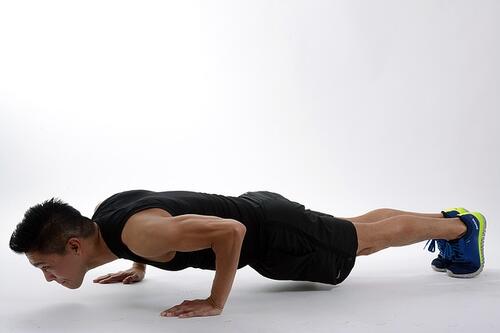
The push-up plus, which consists of adding a final step of actively separating the shoulder blades, is one of the most effective exercises for strengthening the serratus anterior, the muscle that connects the rib cage to the shoulder blade. A weak serratus can lead to poor control of the shoulder blade and result in fatigue and injury.
In the study, 20 healthy male subjects experimented with different hand positions and orientations to see which variations would strengthen it more. Kinesiology Professor Clark Dickerson said they were asking: “Can we change the muscles that are being recruited?” They found that all variations helped strengthen the serratus, but that some variations were better for activating and strengthening other muscle groups.
For example, using your knuckles instead of a flat hand position activated certain forearm muscles, which are used extensively when playing tennis, for example. Pointing your thumb toward your body instead of away helps activate the deltoids (shoulder muscles), the chest muscles, and lower trapezius (upper back), which can help increase strength and stabilize movements when playing softball or golf, for example.
“Physiotherapists, kinesiologists who prescribe exercise, and individuals who want to improve their athletic performance can all benefit from this knowledge,” said Dickerson. “The push-up is highly adaptable to achieve various training goals and has applications for rehabilitation, training, and overall health.”
The study, called “Examining upper extremity muscle demand during selected push-up variants,” was written by Andrew Ho, Alan Cudlip, Daniel Ribeiro and Clark Dickerson, and was published in The Journal of Electromyography and Kinesiology.