Space project with Waterloo connection enters victory lap
As the Herschel telescope sends its final images in the coming months, professor Michel Fich will be seeing stars.
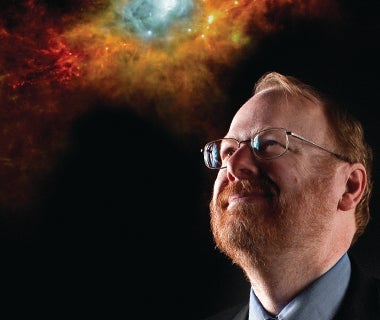
The Herschel Space Observatory, launched in May 2009 with technology from the University of Waterloo on board, is expected to take its last gulp of liquid helium some time in March. Helium super-cools instruments that enable the telescope to send back incredible information as it views space in the far-infrared to submillimetre frequencies for the first time.
The occasion might cast a shadow on the new year; but Fich, an astronomy professor at Waterloo, says the science world has been well served by Herschel.
“We had designed it to have a three-and-a-half-year lifetime, and that would have had it finishing now,” he says. “So, we’re getting an extra three or four months out of it.”
Fich’s research group developed a device to help the telescope tune across desired frequencies as it looks at dying stars, emerging planets and other distant events that occurred millions of years ago. COMDEV International built the tuner in Cambridge, Ontario.
Clues from a comet
Fich is the lead Canadian researcher on the Herschel project, a collaboration of agencies and academic institutions around the world operating under the European Space Agency.
Among Herschel’s startling discoveries: a comet of the right type and water composition to support a theory that comet collisions formed the Earth’s oceans. The information and images Herschel provides will keep scientists busy for years.
“It’s been terrific,’’ Fich says. “It’s amazing the stuff we’ve got out of it.
Through his group, Waterloo-developed innovation will advance the exploration of space long after Herschel sends its last dispatch. Fich is involved in the CCAT Observatory, a telescope to be built by the end of the decade in the Andes mountains in Chile.
And he is working on another project expected to head into space in 2035.
“I’ll be retired before it launches,’‘ he says. “Some things take a really long time.”