February 27, 2013
Saving the whales with mathematics
Waterloo professor hopes to support the endangered North Atlantic right whale with models that predict where plankton blooms will occur.
Waterloo professor hopes to support the endangered North Atlantic right whale with models that predict where plankton blooms will occur.
An applied math professor’s calculations of an ocean current in Cape Cod may help the highly endangered North Atlantic right whale to survive.
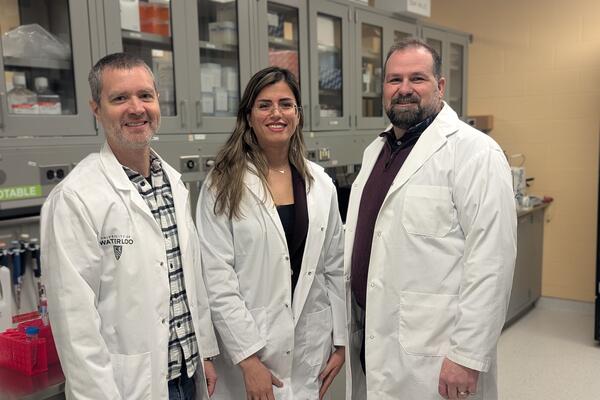
 Francis Poulin, Professor of Applied Mathematics, University of Waterloo
Breaching the boundaries between academic disciplines, Francis Poulin has waded into physics, chemistry, biology, and computer science in an effort to understand, predict, and describe the current through which the whales navigate each spring.
Poulin’s fascination with the Cape Cod Bay current goes back to his days as a grad student at MIT (Massachusetts Institute of Technology). Doing research at the nearby Woods Hole Oceanographic Institution, he became intrigued by the local current, which is influenced by such factors as tides and the topography of the ocean floor.
“When the flow is fast enough, the current becomes unstable and produces vortices,” says Poulin. That’s where whales enter the picture. “When a vortex separates, it takes with it colonies of plankton, important for the feeding cycle of the whale. Hunting whales need to find large colonies of plankton to survive."
“I’m trying to understand the structure of the current, using mathematical equations to describe basic physical properties, such as momentum.” To solve such complex equations, he writes computer programs, draws on his background in physics, and is learning more about biology. Some day he may be able to create models to predict when plankton blooms will occur.
As well, the research could lead to a greater understanding of other oscillating currents. Such currents are common in coastal waters, and have physical properties that are more complicated than currents flowing in one direction.
Poulin is working on a paper about the Cape Cod Bay current along with colleagues at MIT and Scripps Institution of Oceanography, on the U.S. west coast. Last year, he was a co-recipient of the France-Canada Research Fund and is currently in France studying the dynamics of the Bransfield Current System.