February 27, 2013
Engineering prof works to protect drinking water with software
James Craig helps regulators protect human and ecosystem health.
James Craig helps regulators protect human and ecosystem health.
James Craig aims to make our drinking water safer and heat our houses more environmentally. Although his research uses fairly theoretical applied mathematics, the practical is never far from his mind. “Ideally, all of my research ultimately ends up in the hands of practitioners,” says Craig.
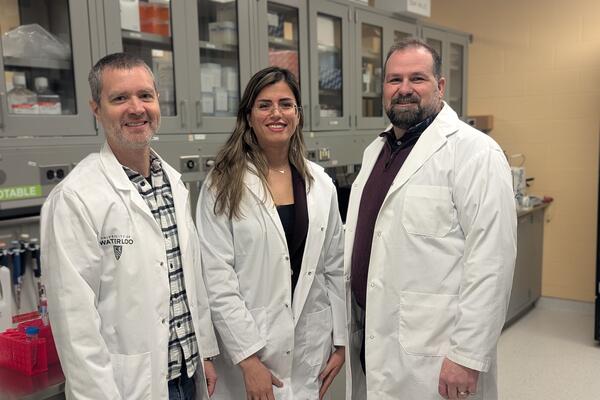
 James Craig (far right), Associate Professor in Civil and Environmental Engineering at the University of Waterloo
An associate professor in the Department of Civil and Environmental Engineering, Craig’s work was recently recognized with an Ontario Early Researcher Award.
While he works in several major areas, two long-term projects include the development of groundwater modelling software and improved design methods for geothermal exchange systems.
Making groundwater safe
In his focus on groundwater, Craig helps practitioners to predict the ultimate source of pumped aquifer water, so that local regulators can make informed decisions to protect both human and ecosystem health. While such simulation models exist, he is working to simplify the modelling process so it can be more easily applied in smaller rural centres.
With Craig’s solutions, consultants can make assessments that are more precise than those guided by manual calculations, but without requiring the complex software used in larger centres. “In the middle are the tools I develop, which are meant for systems where we don’t have as much data but we have enough information to get something more sophisticated than what we might do on pencil and paper.”
Refining an environmentally-friendly heating system
Another focus of Craig’s research involves refining geoexchange heating systems. In use for over thirty years in everything from rural farmhouses to city skyscrapers, geoexchange systems extract energy from the earth beneath our feet to heat homes in the winter and store it during the summer cooling season for later use.
Craig aims to refine such sustainable energy systems to make them more efficient and cost-effective.
At a local field site located behind an old farmhouse near Elora, Craig works with a team of two graduate students and a local energy firm called NextEnergy.
Craig says Waterloo has proved to be an excellent place to conduct his research, not least because there are so many experts working in the same field. “There are dozens of groundwater researchers here, so having people I can throw ideas off is very useful,” he says.