Researchers at the University of Waterloo have developed a new technology that could dramatically reduce the number of open-heart surgeries for people with pacemakers.
Professor Armaghan Salehian’s research group has developed wideband hybrid energy harvesters that use different types of smart materials to convert ambient vibrations into electricity. Used in pacemakers, the technology could mean that batteries last longer and patients will have to endure fewer open-heart surgeries.
“If a two-year-old child has to go through open heart surgery every seven or eight years that could translate into approximately ten surgeries in his or her life span to implant new pacemakers,” said Professor Salehian of Waterloo’s Department of Mechanical and Mechatronics Engineering. “The number may be reduced noticeably by harvesting energy through vibrations and human motion to prolong the battery life.”
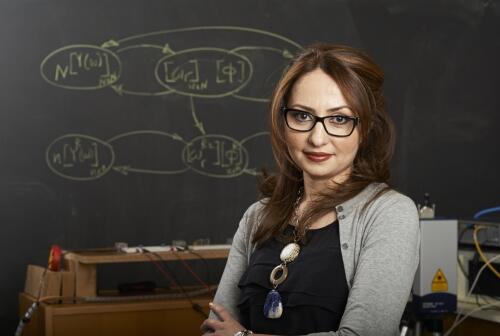
Professor Armaghan Salehian (Click here to download)
Salehian’s team, which includes graduate and undergraduate mechanical and mechatronics engineering students, completed a prototype for the new hybrid technology in August that has also shown potential for various wireless sensing applications.
There is strong demand for more energy-efficiency units in today’s technology thanks to the increased use of electronic devices ranging from mobile phones and wireless sensors to medical implants. Self-sustained systems that can harvest different forms of ambient energy have the potential to lower costs and the need for regular battery replacements in devices such as pacemakers.
While other researchers have undertaken similar work, the majority have developed devices designed for narrower ranges of vibration frequencies. For example, if an individual is moving at a certain pace, the device produces power but as soon as the rate of motion is changed or the frequencies are slightly different, the amount of power reduces significantly.
“The prototype we’ve developed uses a combination of smart materials so the amount of harvested energy can be increased at a wider range of frequencies,” said Professor Salehian. “This research could also be used to power wireless sensors that help detect cracks and damage to buildings.”
Professor Salehian is currently working to establish industrial partnerships with companies in North America.