Flying the environmentally friendly skies
Researcher Suzanne Kearns pioneers the Waterloo Institute for Sustainable Aeronautics
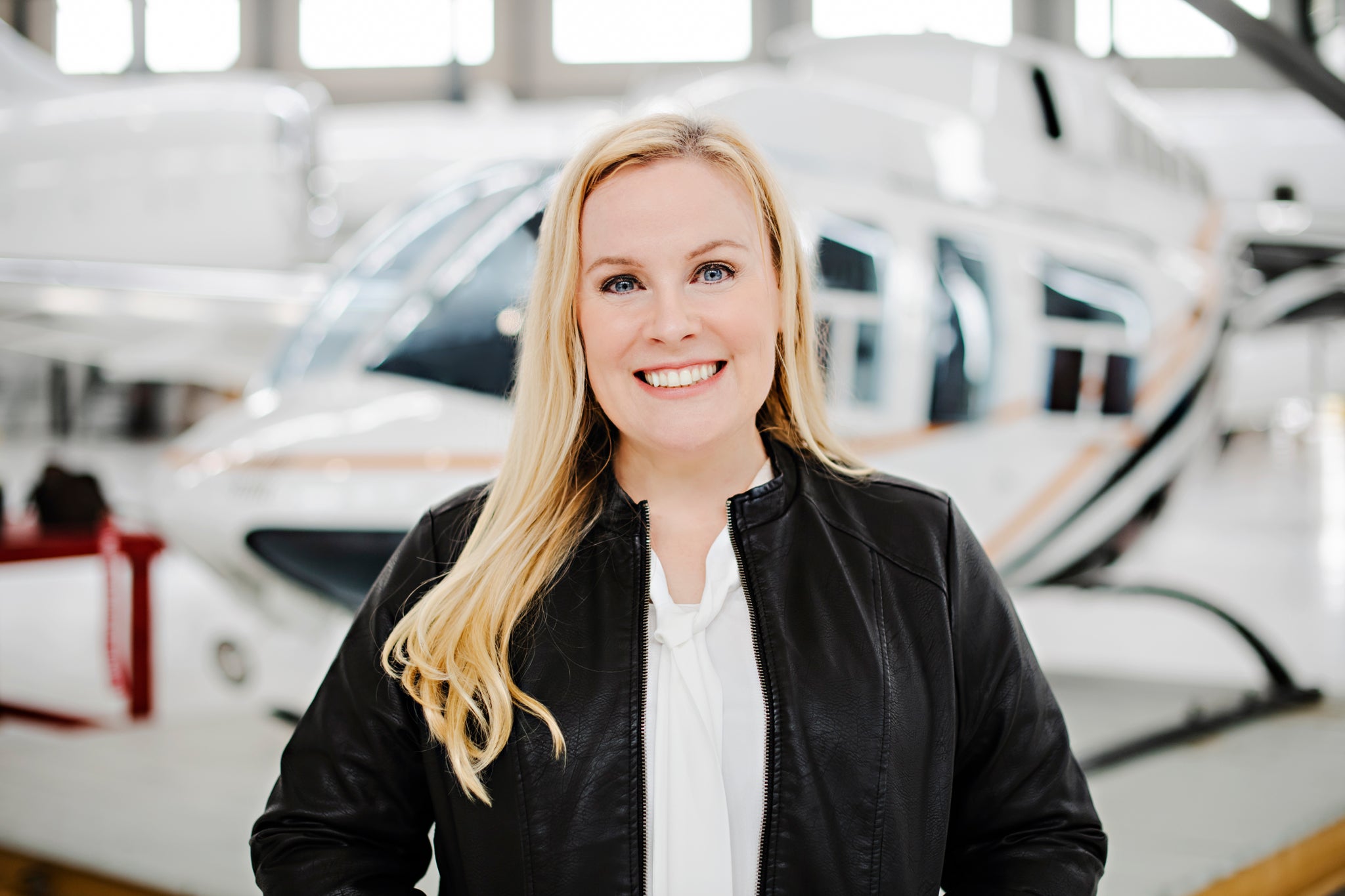
Suzanne Kearns
Professor, Faculty of Environment
> Director, Waterloo Institute for Sustainable Aeronautics
For as long as she can remember University of Waterloo Aviation professor Suzanne Kearns dreamed of flying, and at the age of 15, she began training for a career as a pilot. On her 16th birthday — the first day she could legally drive a car — she flew solo for the first time.
If it could fly, Kearns was determined to master it.
At 17 she slept for months in a Toronto hangar just to get her helicopter license,becoming awunderkindin her hometown ofWiarton, Ontario. The local paper joked, “Imagine that, flying helicopters and still wearing braces,” she says.
Back then Kearns couldnever haveimagined doubting her dream job. But as she, and the world,wokeup to the fact that air transport is a key contributor to climate change, an unsettling truth began to sink in.
“Given that relatively few people onEarth have the opportunity to fly, aviation’s outsized impact on the planet is unacceptable,” she says. “But, despite its drawbacks, I truly believe that aeronautics is a force for good. So, I have a new dream, and that’s to supportaviation'smovement towards sustainability.”
In fall 2021 that new dream came one step closer with the launch of theWaterloo Institute for Sustainable Aeronautics(WISA), making Waterloo, and Canada, a pioneer in reforming an industry currently accountingfor more than 2 per cent of global carbon emissions.
“Unlike the auto-industry,research being done around the globe on how we can reform the sustainability of the aeronautics sectoris still an emerging area,” Kearns says.
But what exactly is sustainable aeronautics?
Social Sustainability
“Sustainability goes beyond environmental considerations toincludesocial and economic factors,”saysKearns,whofirst began exploring how sustainability-related to aviation several years ago when she created an Aviation Sustainability course in Waterloo’s Faculty of Environment.
Social sustainability ispossible whenthe aviation industry hasa competent and efficient workforce – a challenge pre-pandemic as the sector was facing global shortages of pilots, air traffic controllers, and maintenance engineers. This shortage was exacerbated by the lack of diversity in the sector, with only aboutfiveper centof pilots being female and fewerPeople-of-Colour.
“I remember what it feels like to be the only woman in the classroom, and to feel like your dream profession doesn’t have a place for you,” Kearns says. “Supporting equity, diversity and a sense of belonginginthe industry is a critical sustainability consideration, supporting the viability of the future workforce.”
For Kearns, interdisciplinary collaboration is key to WISA “I have been continually inspired by the passion and talent of my academic colleagues, uniting across disciplines to identify impactful research.” WISA-affiliated researchers include social scientists and psychologists working in tandem with its engineers,technologistsand environmentalists.
“Social sustainability also includes professional competency which supports safe and efficient operations,” she says. “Today, 70-80per centof aviation accidents are caused by human error. WISA’s psychologists, vision scientists and kinesiologists examine factors, such as eyesight, fatigueanddecision-making to build a comprehensive foundation of interdisciplinary research with the goal of passenger safety.”
WISA brings together close to 75 researchers from all six University faculties. Its advisory committeeincludesChris Hadfield,decorated astronaut, author, and pilot and industry experts from organizations including Transport Canada, NAVBLUE, an Airbus company, and the National Research Council among others.
WISA researchers are targeting outcomes that apply the latest technology and social science in ways that will have an impact on policy,manufacturing,and training.
Economic Sustainability
Kearns went into teaching atthe age of24 when her career prospects as a commercial pilot evaporated following the 9/11 terrorist attacks.
“I know first-hand, amore financially resilient aeronautics sector is better for workers, and better for stabilizing global markets,” says Kearns, who points out that the air transport sector is responsible for close to $6 trillion in international trade.
Economic sustainability is more than solvency and job security.
“Additive manufacturing, better known as 3D printing, cancreatenew custom-designed plane parts made one at a time, any time and just in time,” she says. “This saves both timeandresources. This kind of work is already being done at Waterloo. What WISA does ismobilize that research towardsaeronautical challenges.”
Environmental Sustainability
“Iunderstandpeople feelingguilty about flying because of the climate impact,” Kearns says. “But the truthis, it’s a challenging sector to decarbonize and often there just isn’t a substitute to flying. Our delicate COVID-19 vaccines arrived by plane, as do trillions of dollars of goods. And in our now globalized world, air travel is the only feasible way to connect with our loved ones living overseas.”
With environmental interventions occurring in the auto, housing and manufacturing industries, aviation’s relative share of global emissions will only grow.
Waterloo’s Faculty of Environment, where WISA is housed, is Canada’s largest faculty devoted exclusively to sustainability. Its experts work at the intersection of nature, humanbehaviorand technology.
“Environmental sustainability is where WISA’s transdisciplinary DNA really shines,” Kearns says. “We have applied mathematicians using algorithms to improve logistics, engineers improving aerodynamics, and chemists innovating batteries and renewable fuels. All of this addsup to lower carbon emissions, which is a central goal of ours.”
Future focused
Justbeforethe COVID-19 pandemic the global aviation industry was surging — accounting for 87.7 million jobs worldwide, with $3.5 trillion in economic impact, and supporting 4.1 per cent of global GDP. As the pandemic spread across the globe, the aviation industry ground to a halt.
“As we emerge from closed borders and lockdowns, aviation is playing a critical role in reigniting the global economy by transporting goods, humanitarian aid and connecting us in person onceagain,” Kearns says.Additionally, the International Civil Aviation Organization’s Assembly recently committed to a new aspirational goal for international aviation of net-zero CO2 emissions by 2050.
Achieving this will require technologies, innovative practices and future leadership to drive environmental, economic and social prosperity. WISA is uniquely positioned to work in partnership with industry and government to addressthese global challenges.
Since launching, the WISA team has taken many steps towards this mission. They’ve developed a new approach to master’s and doctoral studies with the launch of the Collaborative Aeronautics Program that enables students to add a focus in air transportation research to their studies. They’ve also brought Canada’s first commercially available type-certified electric aircraft to Waterloo and hosted more than 200 industry, government, faculty and student attendees at the inaugural one-day Sustainable Aeronautics Summit to discuss sustainability innovations in aviation, aerospace and space.
“The big challenges facing the future of air transportation will require collaborative solutions. No single institution or field of study can address these issues alone. We must equip future leaders as experts in their chosen academic field with aeronautical training to catalyze innovative research – and foster industry and government partnerships towards impactful solutions.”
Meet Kearns at the Waterloo Innovation Summit
On April 21, the University of Waterloo, in partnership with MaRS Discovery District, will bring together some of the world’s leading experts on sustainable aeronautics, electric and autonomous vehicles, clean energy and urban planning to reimagine the future of local and global transportation.