April 2, 2026
Building a roadmap to a dream job
Architecture co-op student gains hands-on experience that embraces sustainable practices
Architecture co-op student gains hands-on experience that embraces sustainable practices
When Thomas Coleman walked into the Vancouver office of ZGF Architects, it was his first professional experience in an architectural context. He wasn’t entirely sure what he was getting himself into as an architectural student intern on several project teams but he knew he was eager to learn.
The work term offered a rare chance to see the scale and complexity of real-world architecture. “My work at ZGF exposed me to large scale construction projects and highlighted the level of coordination required to develop community-oriented spaces,” Coleman explains.
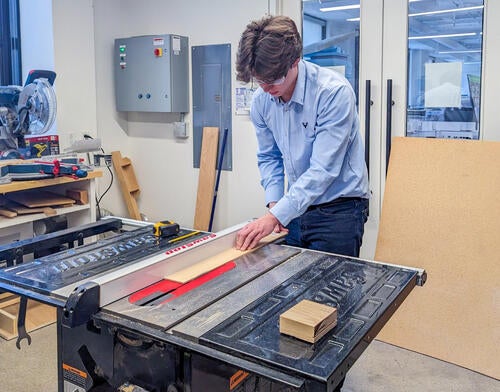
Coleman connected with ZGF through WaterlooWorks, the University’s recruitment platform, during his second year. “It all happened pretty quickly,” he says. “But once I interviewed with the team, I knew it would be an incredible opportunity.”
ZGF Architects is a design firm specializing in architecture, interior design and planning with a focus on sustainable materials and energy‑efficient design. Their work addresses climate challenges in complex building types such as hospitals, airports and large institutional facilities. Each year, they hire one or two University of Waterloo architecture co-op students to join their multidisciplinary teams.
“I was welcomed into the office culture immediately and was thrown right into doing some pretty interesting work early on,” Coleman says. “I was tasked with projects that aligned closely with my existing skills and others that pushed me to expand my technical and design capabilities.”
His early responsibilities included supporting an initiative evaluating the environmental impact of completed projects including looking at their carbon footprint, material usage and energy consumption. “From my first day at ZGF, I tried to absorb as much knowledge as possible about the industry’s sustainable design tools,” Coleman says. “As my work term continued, I was able to help develop an initiative to evaluate completed projects based on their environmental impact.”
His supervisor, Mesa Sherriff, noticed his work ethic and contributions early in his work term.
“During his co-op, Thomas was a valuable addition to our Vancouver team, quickly integrating into our fast-paced studio environment and making meaningful contributions to complex projects, including a large hospital and a social housing rezoning,” Sherriff says. “He brought a positive, methodical approach to his work, demonstrated rapid growth in both physical and digital design tools and showed a level of capability well beyond what is typically expected at this experience level.”
According to Sherriff, “Waterloo co-op provides a meaningful pathway for students to integrate their academic experience into professional practice. It enables students to contribute meaningfully to real projects while giving firms like ZGF a valuable opportunity to mentor emerging talent and strengthen the future of the profession.”
Throughout the term, mentorship played a central role in Coleman’s growth. “I received consistent guidance that helped me build confidence and deepen my contributions to the projects we were working on,” he says.
Coleman found that the concepts emphasized in his academic studies through designing thoughtfully for a preexisting site, understanding community impact and navigating the ambiguities of real environments. “You see it the moment you’re in design discussions with clients, engineers, landscape architects and your team of designers. My theoretical foundation became very real while working toward the actualization of physical buildings over several years.”
Over three years of studying architecture at Waterloo, Coleman has accumulated a range of co-op experiences across different areas of architecture. “In architecture, firms often develop specialized expertise within certain building types,” he says. “ZGF was focused on sustainability and excelled in health care, education, commercial, urban planning, aviation and more.”
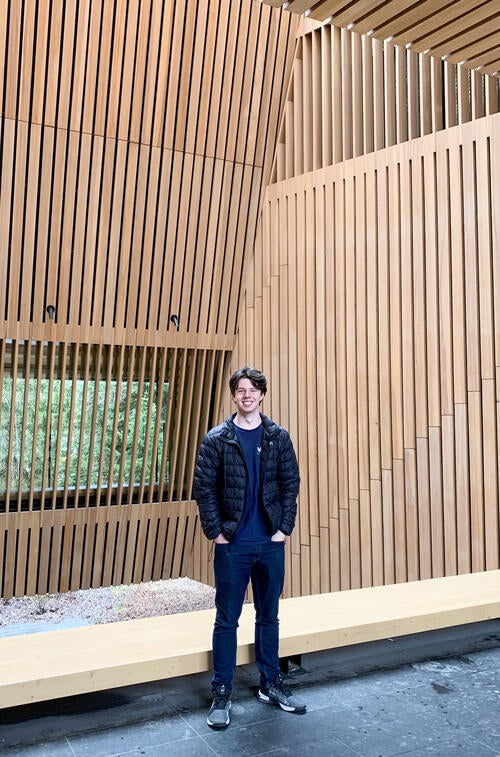
Coleman’s current work term is in Boston, so not only has he been exposed to a variety of employers but also to locales. “I’ve tried to broaden my exposure to other architectural typologies. I’ve learned from expertise in sports and athletics, entertainment and space making, cultural and performing arts, and even modelmaking. Each firm offers distinct perspectives, and I’ve benefited greatly from learning through these different approaches.”
At ZGF, his work centred on integrating sustainability considerations early in the design process to gain client support. He conducted material studies for both a multiunit residential project and a hospital project in Vancouver, including reviewing blueprints and researching reusable material alternatives to replace newly manufactured products.
“It was so exciting to put what I’ve learned in my courses into practice,” he says. “ZGF really supported me throughout my work term, and the network I’ve built through mentors and colleagues makes me feel confident as I prepare to graduate.”
Coleman is looking forward to an academic study term in Rome following his current co-op. After that, he’ll return to Canada for his final co-op and last academic term.
Though he isn’t entirely sure what the future holds, Coleman knows he’s ready for it. All thanks to the roadmap he’s been building, one co-op at a time.