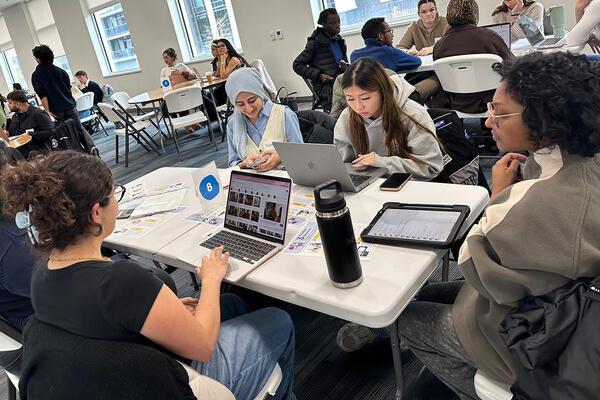
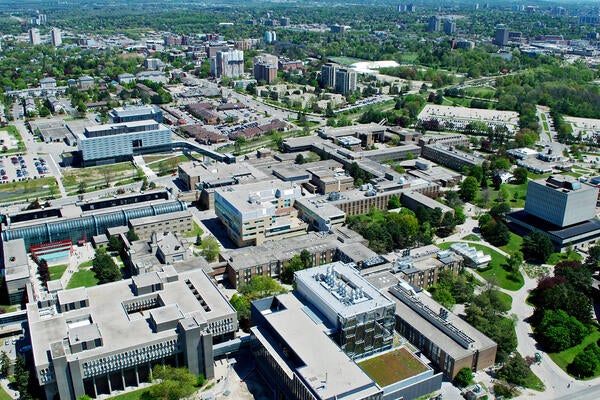
Two student teams are partnering with Princess Margaret Cancer Centre to improve how cancer care is delivered to patients. The work is being done as part of i-Capstone, the University of Waterloo's first interdisciplinary undergraduate capstone program. Part of Waterloo's growing capstone ecosystem, i-Capstone brings together students from every faculty to work alongside organizations on their most pressing challenges, for academic credit.
Two problems, one approach
When a CT scan slot becomes available at Princess Margaret, patient flow coordinators must work quickly to fill it. They connect with clinical sites by phone and email, often relying on manual processes to manage this time-sensitive work.
One Waterloo team, CT Optimizers, built a machine learning model paired with a set of dashboards that automates prioritization, keeps patient data locally housed and keeps a physician in the loop on every decision. "It reduces a lot of the administrative burden and allows them to focus on what's most important, helping patients”, says Chris Abey, a software engineering student on the team.
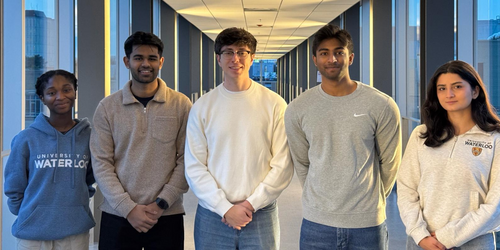
CT Optimizers built a dashboard prototype to help Princess Margaret improve scheduling efficiencies. From left to right: Elizabeth Agyei, Heet Shah, Adrian Gri, Chris Abey, Labkhand Maghamianzadeh.
The second team, We Dream in Voxels, is working on how cancer drugs reach their target. Treatment works best when it penetrates every cell in a tumour — but no two tumours are alike, making a clear picture of their internal structure essential to more precise care.
Dr. Catherine Coolens' lab at Princess Margaret had already built a two-dimensional model to map how blood, and with it, drugs, move through a tumour. The Waterloo team extended this model to three dimensions and rebuilt it in Python. The rebuilt code runs more than 100 times faster than the original, due to improved algorithms. Researchers now have a model that maps a tumour's internal structure in full, offering a potential tool to support personalized patient treatment.
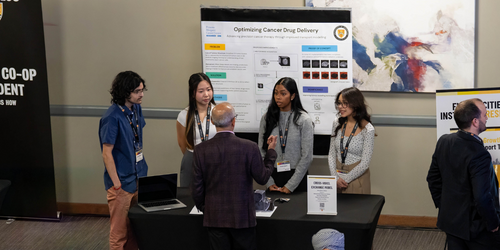
We Dream in Voxels presents their 3D tumour drug-mapping model at a University of Waterloo Global Futures event in January. From left to right: Saptarshi Battacherya, Nena Le, Ranmali Attapattu, Khushleen Bawa.
Both deliverables are designed with real-world application in mind. CT Optimizers' dashboards are built as a prototype for clinical use. We Dream in Voxels' model gives Dr. Coolens' lab results that will inform future research and, eventually, clinical practice.
What capstone builds
For Waterloo students, combining co-op and coursework builds intellectual depth and real-world instinct. Capstone is the final integration of those two things; where students apply everything Waterloo has taught them and become prepared for what comes next.
"During a work term, there is a safety net: a manager, a defined project, a structure already in place," says Heet Shah, a software engineering student on CT Optimizers. "Our project arrived as a rough idea, not a blueprint. We spent months figuring out what the real problem actually was before we could begin to solve it." That process, the students say, is the skill that will travel furthest.
It is a feeling shared across both teams. Ranmali Attapattu, a Faculty of Health student, found in i-Capstone a new kind of hands-on experience to bring to graduate school interviews. For Labkhand Maghamianzadeh, another health student, i-Capstone opened doors beyond the project itself, including a LinkedIn connection that led to a research collaboration she hadn't anticipated.
The paths these students are taking vary — graduate school, medical school, the workforce — but each of them is leaving with experience they are confident will help open the next door.
Both teams, CT Optimizers and We Dream in Voxels, will present their work at the i-Capstone symposium on April 2, 2026.
Part of something larger
Capstone is one part of a broader relationship between Waterloo and Princess Margaret; one that includes a formal agreement to collaborate on AI-driven work in disease detection, treatment and health systems integration. Projects like these are part of what that looks like in practice. For capstone at Waterloo, it’s also a model for what the program is working toward: more partnerships where the problems are real and both sides are invested in the outcomes.
For Princess Margaret, these collaborations with students continue to add value. “Waterloo students bring something that is genuinely hard to find — the technical depth to tackle a complex problem and the experience to understand how to integrate into a complex environment,” says Meena Merali, P.Eng (BASc ’07), senior director of strategy, transformation and foundation relations at Princess Margaret, and a Waterloo chemical engineering alum. “What has impressed us is not just the quality of work, but how quickly these teams orient themselves to our specific setting and start delivering.
They have given us new ways of seeing problems we have lived with for years, and new ideas for a pathway forward to better care.”
Get involved
Partners: Submit a capstone project and connect with student teams.
Students: Browse capstone opportunities and register.
Feature image: i-Capstone team members left to right: Elizabeth Agyei, Chris Abey, Heet Shah, Adrian Gri with Dr. Shima Deljoomanesh at Princess Margaret (centre). Absent: Labkhand Maghamianzadeh. Photo credit: University of Waterloo.