June 23, 2026
Going all in on what matters
Biomedical Engineering graduate pursues a research career in advanced AI in health care — and pays it forward to help other students achieve their ambitions
Biomedical Engineering graduate pursues a research career in advanced AI in health care — and pays it forward to help other students achieve their ambitions
In Grade 8, Jarett Dewbury grew six inches in roughly five months. His ligaments couldn’t keep up with the rapid bone growth and walking became difficult. No commercially available knee brace fit his frame, and months of failed attempts with physiotherapists left his legs bruised from ill-fitting devices. Eventually, he and his parents improvised a solution — a strap worn tightly below the kneecap. It worked.
From this frustrating and painful experience, Dewbury knew he wanted a career in which he could address gaps in health care. The obvious choice was to study medicine. But while looking into medical degrees, he stumbled across the Biomedical Engineering program at the University of Waterloo and was immediately hooked by its fusion of engineering design and problem-solving, with biology and medicine.
Now a graduate, having crossed the stage at convocation this month, Dewbury plans to build on his biomedical engineering degree with research that focuses on AI tools that make access to healthcare more equitable.
In recognition of his work to make advanced AI accessible, both in health care and within the student community at Waterloo, Dewbury is the 2026 recipient of the Pearl Sullivan Emerging Global Leaders Award, one of the Faculty of Engineering's highest student honours. "I’ve read and heard a lot about Pearl Sullivan, and what stands out for me is just how strong her conviction was in her ideas,” Dewbury says. “If she believed in something, she made it happen. I respect that.”
That same conviction — to go all in on an idea, even when no obvious path exists — characterizes Dewbury too.
Giving first- and second-year students access to AI
In his first year at Waterloo, Dewbury noticed that AI electives were not available to first- and second-year students, leaving them to teach themselves or wait. He chose another option and in his first co-op work term, co-founded WAT.ai — a student-led AI design team that started with 40 members and now, four years later, boasts 800 — to give earlier students access through hands-on, company-partnered projects.
The model is very successful. For example, a WAT.ai project team partnered with Open Climate Fix, a UK non-profit optimizing solar energy forecasting, won a global climate hackathon — winning $17,000 — and built tools now in active use by the organization. WAT.ai has since hosted its own hackathons with Open Climate Fix at Waterloo and across Ontario.
Dewbury’s vision and hard work have paid off. WAT.ai is part of the Sedra Student Design Centre and serves as the official undergraduate body of the Waterloo AI Institute. Its knowledge-transfer system is deliberately self-sustaining with year-long projects where experienced students lead, newer members participate, and everyone eventually cycles up to project lead and then director.
Making connections and solving problems
In addition to his studies, Dewbury was drawn to Waterloo for its co-op work program and a cohort model that moves students through nearly every course of their degree in the same groups. He credits this tight-knit structure for the strong Waterloo Engineering alumni network and mentorship culture that benefited him.
An upper-year student shared how they’d cold-called their way into a co-op work placement; something Dewbury had never even considered was possible. Inspired, he picked up the phone and did the same, securing a co-op placement at Harvard Medical School. That connection led to two work terms at the Massachusetts Institute of Technology (MIT) where he worked under Dr. Loza F. Tadesse, a professor whose practice of medicine in under-resourced environments informs their work in AI-powered clinical tools.
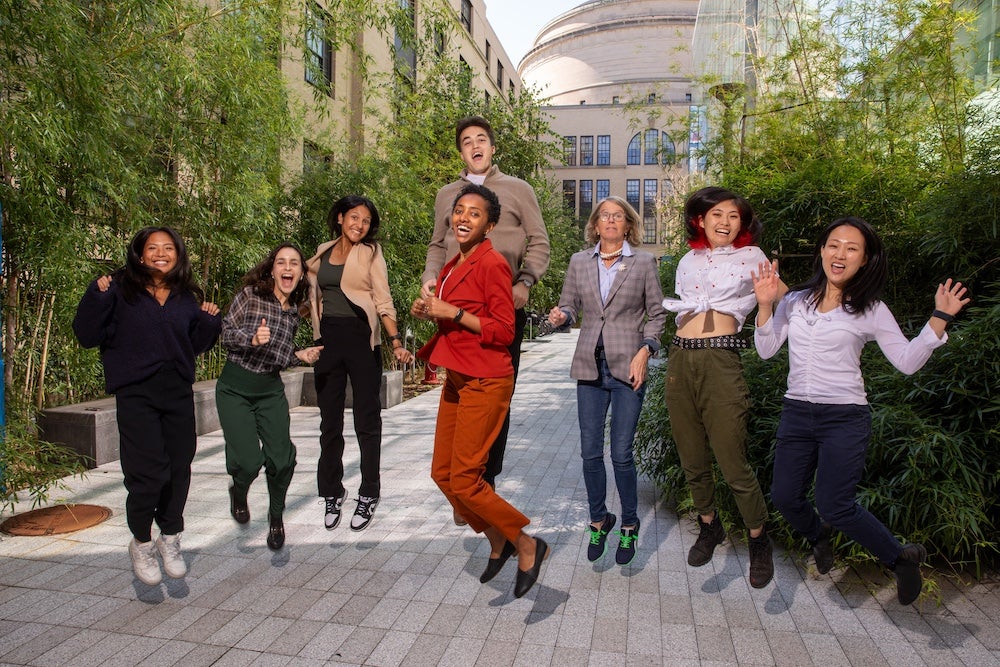 Jarett Dewbury with his MIT lab team led by Dr. Loza F. Tadesse (front and centre).
Dewbury was excited to join the team, but his first placement with MIT almost fell through when a grant cycle delay left no funding for him. Undeterred, Dewbury independently secured the Emergent Ventures Fellowship to cover his living costs and visa requirements in Boston.
During that first MIT term, while busy with his core lab work, he stepped in to help with a stalled project on AI diagnostics for resource-limited clinical settings. Originally scoped for a year, he and a master's student resolved it in roughly three months. This work earned him a first-author publication at the International Conference on Learning Representations (ICLR) and the 2024 Faculty of Engineering Co-op Student of the Year Award.
Pursuing what matters
Dewbury plans to use funds from his Pearl Sullivan Emerging Global Leaders Award to seed a scholarship that will help Waterloo Engineering students present their research at international conferences by covering costs such as travel and accommodation expenses. It’s still in the early-planning phase, but discussions with the Faculty are underway.
More fully established is his connection to the Harvard Medical School — what started as a cold call is now a hot opportunity for other students. Since Dewbury’s co-op placement, the lab has employed at least one Waterloo student every work term.
Now a graduate, Dewbury is heading back to his MIT lab to begin full-time research. Longer-term, he sees an opportunity to do industry research and perhaps, one day, start his own venture focused on AI diagnostics for underserved health systems globally.
Photography courtesy of Jarett Dewbury.