Restoring oil wells back to nature with moss
Researchers use moss in new method capable of restoring peatlands damaged by oil and gas exploration
In what could represent a milestone in ecological restoration, researchers have implemented a method capable of restoring peatlands at tens of thousands of oil and gas exploration sites in Western Canada.
Researchers from the University of Waterloo led the project that involves lowering the surface of these decommissioned sites, known as well pads, and transplanting native moss onto them to effectively recreate peatlands. This is the first time researchers have applied the method to scale on an entire well pad. The study found that the technique results in sufficient water for the growth of peatland moss across large portions of the study site.
Historically, restoration efforts involved planting trees or grasses to establish upland forests or grasslands. This new method returns a well pad to its condition before drilling occurred and supports the ongoing development of peatland restoration techniques. The discovery can help the oil and gas industry and its regulators better mitigate the long-term impact of resource extraction on Canadian peatland ecosystems.
“These results are the first to suggest that the re-establishment of peatland vegetation on full-scale lowered well pads is possible through peatlands, which can negatively affect the ecosystem in surrounding areas,” said Murdoch McKinnon, PhD candidate in the Faculty of Environment. “Well pads bury all of the native peatland vegetation under clay or sand, negatively impacting the ability of the peatland to sequester carbon and also reducing the availability of habitat for wildlife.”
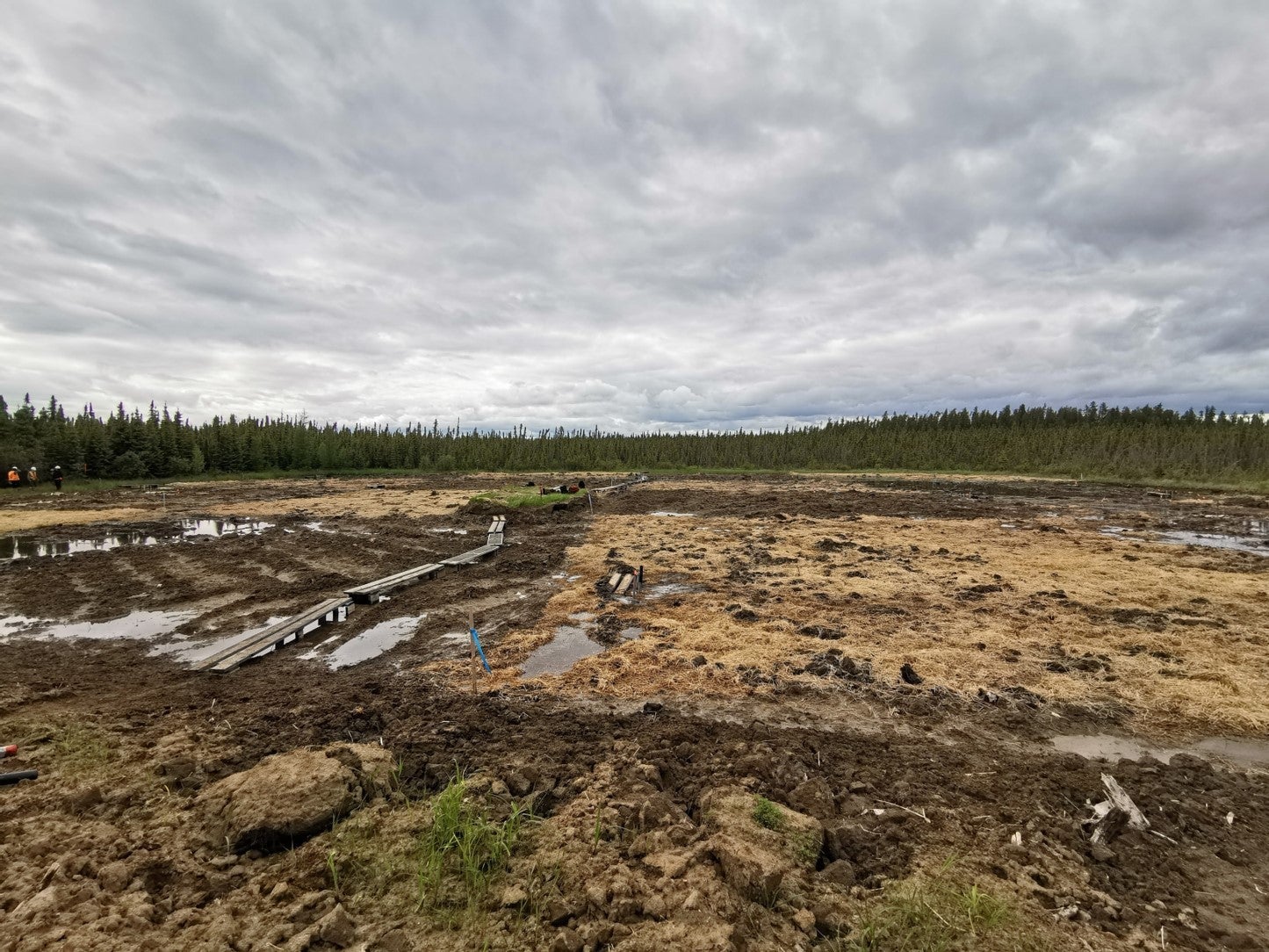
The well pad, located near the town of Slave Lake, Alberta, immediately after researchers introduced the moss, but before it started to establish. (University of Waterloo)
The researchers plan to continue monitoring ecosystem development on the tested well pads to confirm that the transplanted mosses will be self-sustaining over the coming decades. Partners at the Northern Alberta Institute of Technology’s Centre for Boreal Research are now applying some of the study’s recommendations at sites across northern Alberta.
“Preserving peatlands is critical because of the role they play storing and supplying water in the landscape,” said Dr. Richard Petrone, a professor in the Department of Geography and Environmental Management at Waterloo. “They are also our best choice for nature-based climate change solutions because of the vast amounts of carbon that they store.”
In the future, researchers will focus on increasing the amount of water that flows from surrounding natural peatlands into well pads to further optimize soil moisture. This will be an essential step given the sensitivity of the native mosses to drying out and might therefore improve regrowth.
Mount Royal University, the Northern Alberta Institute of Technology and Athabasca University also contributed to this work. The study, Hydrologic assessment of mineral substrate suitability for true moss initiation in a boreal peatland undergoing restoration, appears in Ecological Engineering.
(Photo credit for banner image: University of Waterloo)