Student rocketry fires up with an advanced engine design
Waterloo Engineering students design, build and test a reusable rocket engine that makes test launches easier and more affordable
A group of fourth-year students on the University of Waterloo’s Rocketry team designed, built and tested a fully reusable rocket engine for their Capstone Design project. It's one of the most complex student rocketry engines built in Canada.
Called Project Sisyphus, the engine uses regenerative cooling — circulating fuel through built-in channels to prevent the chamber from melting — and additively manufactured parts 3D printed in copper.
The Waterloo Rocketry team typically builds its engines with ablative liners. These thermal protection materials slowly erode as the engine burns to insulate the metal chamber and prevent structural failure. It’s much cheaper than buying a single-use commercial engine that costs around $3,000 — but an ablative engine also only works once. It needs to be remade after each use, which takes a full team and significant turnaround time.
On top of that, Canada currently has no permanent rocket launch sites. If you want to test your rocket in flight, you have to travel to the U.S., which is costly and complex. The result is that Waterloo Rocketry gets no time in the air outside of Launch Canada, the country’s largest student rocketry competition.
"The only time we get to test our rocket in flight is when we launch it at the competition,” says Joel Godard, a mechanical engineering student on the Project Sisyphus team. “This has been a thorn in our side for years — we can't fully test our parachute and active control systems on the ground, we just have to trust they'll work and that the rocket will break records."
Project Sisyphus gives Waterloo Rocketry an engine that makes it easier and more affordable for the team to test their rocket systems in-flight ahead of competitive launches.
Regeneratively-cooled, reusable engines have existed since the Apollo era in the 1960s. But organizations like NASA, SpaceX and United Launch Alliance keep a tight lid on their design and development.
“There are publicly available documents, but they give you the general architecture, not the specifics,” says Matthew Gordon, a mechanical engineering student and Project Sisyphus team member. “There’s no off-the-shelf instruction guide so we designed and built our engine from scratch.”
One of the project’s defining challenges was the distribution manifold — the component responsible for spreading fuel evenly across the engine’s 79 cooling channels. Uneven flow means uneven cooling, and uneven cooling means a melted engine. The team solved the problem in part by using the knowledge and skills they learned in their fourth-year computational fluid dynamics course.
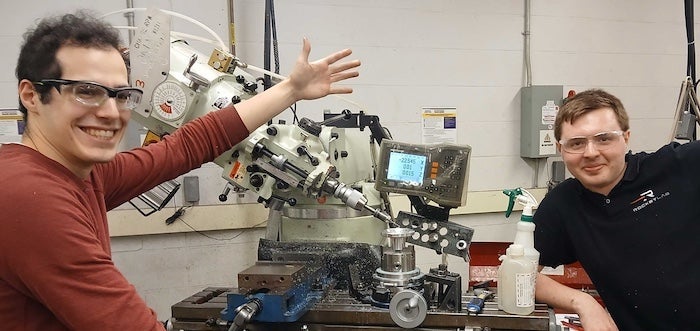
Being members of Waterloo Rocketry also gave them access to the Sedra Student Design Centre in the Faculty of Engineering — a facility so well-equipped it’s the envy of students at other universities. Andrew Milne, a professor of mechanical and mechatronics engineering and Faculty advisor, provided design guidance throughout the project. Les Ankucza and Ryan Cadeau, machine shop technicians and instructors, helped with machining, assembly and testing.
Dan Steinhaur (BASc ’80), an Electrical Engineering graduate, founder of Stein Industries Inc. and long-time Waterloo Rocketry supporter, helped cover the cost of the combustion chamber, actuators, propellant tank and electronic components — much of which will serve the Waterloo Rocketry team’s future work.
"I met the Waterloo Rocketry team at a class reunion in 2015 and was impressed by their ambition,” Dan says. “I offered them coaching and financial support, which led to helping them design their very first rocket engine. That work contributed to their first-place finish at the IREC competition in New Mexico in 2018. With continued coaching and sponsorship, the team has gone on to fill their shelf with trophies.
“As a Waterloo alum, it's genuinely inspiring to help the next generation reach their technical goals. Having designed, built and test-fired rocket engines myself, I can offer guidance that helps students avoid costly mistakes and test failures. I'm also a board member of Launch Canada. Anything I can do to promote and support Canada's future rocket scientists is good for this country — and that's a cause worth investing in."
The Project Sisyphus team graduates in the spring. Godard and Gordon both joined Waterloo Rocketry as first-year students and did co-op work terms at Rocket Lab in New Zealand — Godard worked on a spacecraft now on its way to Mars with his name engraved on it.
Their love of space exploration has been a constant throughout their academic journeys and now they get to build their careers doing it. Gordon is off to Starbase in Texas to work at SpaceX on its Starship spacecraft, and Godard is joining Canada Rocket Company, a Toronto-based aerospace startup developing Canada’s space launch capabilities.
Project Sisyphus won the best prototype award at the 2026 Mechanical Engineering Capstone Design symposium, selected from among 42 teams.
Watch Sisyphus pass the static fire test!
Feature image, from left to right: Stefan Arroyo-Cottier, Xavier Rayes, Matthew Gordon (back), Joel Godard (front), Joe Dolina & Dan Steinhaur. Credit: Sam Chen, University of Waterloo