
Canadian aviation history was made as three generations of e-planes took to the skies above the Fraser River on 6 August 2025 to fly in formation. The trio consisted of the first Pipistrel Alpha Electro in Canada, Sealand Flight’s Pipistrel Velis Electro and Harbour Air’s retrofitted eBeaver. This illustrates the successful electrification of an advanced ultralight, a two-seat trainer and a small regional passenger plane, respectively.
The event was hosted at the Pitt Meadows regional airport (YPK) by the Aero Club of BC. The Aero Club noted their history of leading aviation innovation as they were the first aero club in the British Commonwealth. Now they are eager to promote electric aviation.
Pitt Meadows is the home base of Canada’s first Pipistrel Alpha Electro. It was purchased privately and imported in 2017 as a way to fly carbon free locally or to cruise up the Fraser Valley to Hope. The light weight carbon composite material and efficient aerodynamic design enabled a battery system to provide all the power required for propulsion. Pipistrel had started making electric gliders in 2007 and the Alpha Electro was the next step toward larger aircraft.
The air-cooled design of the Alpha Electro battery pack was replaced with a liquid cooled battery pack and propulsion system in the next generation Velis Electro. This provides more uniform temperature control and is expected to increase component life expectancy.
The Pipistrel Velis Electro was promoted as Pipistrel’s internationally certified aircraft designed to support electric flight training for pilots. In 2022 Transport Canada announced a pilot project to evaluate the suitability of aircraft classified as Light Sport Aircraft in Europe (e.g. the Pipistrel Velis Electro) for flight training. The Waterloo Institute for Sustainable Aeronautics (WISA) partnered with the Waterloo Wellington Flight Centre (WWFC) to bring the first Velis Electro to Canada in 2022 and were the first approved to fly under the pilot project. Sealand Flight soon became the second flight school approved to fly the Velis Electro. Together, they provide valuable insights from over 400 flights under diverse conditions in Ontario and BC. In July 2025 Transport Canada modified the Canadian Aviation Regulations and Standards (CARS) to permit flight training in e-planes.
The eBeaver represents Harbour Air’s commitment to sustainable aviation and the electrification of local flight services. Instead of a new design or materials for the airframe, they are using a well established and robust foundation, the DHC-2 de Havilland Beaver. The propulsion system is being changed to electric but, it is hoped that using the existing airframe will simplify the certification process by requiring only a supplemental type certificate (STC). The durability of the airframe is illustrated by the demo eBeaver having been built in 1956. Its first electric powered flight was in 2019. The initial battery system has been upgraded to a second generation system with more energy to support longer flights. Component selection and system design are being finalized with certification expected in 2027.
By changing to electric propulsion, the new streamlined engine nacelle reduced the Beaver’s aerodynamic drag while the four blade composite propellor increased efficiency. The result was that the minimum power required to maintain level flight dropped from 62 percent of maximum power in the conventional Beaver to 41 percent of power in the eBeaver. The benefit is increased flight duration for a given battery configuration.
Habour Air operates North America’s largest fleet of seaplanes with 50 aircraft servicing communities along the BC coast and on Vancouver Island. Their scheduled flights are typically less than 30 minutes and they also offer sightseeing flights that are typically 20 minutes long. The short duration of these flights provides an ideal opportunity to be an early adopter of electric propulsion. They are starting with their smallest plane, the Beaver, but expect to transition the entire fleet over time. An order has been placed with their partner magniX, for 50 electric engines. Once the retrofitted eBeaver is certified, Harbour Air plans to convert the rest of their fleet of 12 Beavers and to offer the conversion service to other operators who would like to switch their Beavers to electric power. Quebec based Bel-Air Aviation has already signed a letter of intent (LOI) to convert three of its Beavers to eBeavers for electric sightseeing flights.
The sky above Pitt Meadow showcased three different electric planes to meet the demands of early adopters: local private flying, pilot training, local sightseeing, and regional flight services. This is just the beginning for electric aviation. It will be exciting to see how quickly the certification proceeds and enables an increased range of users in Canada.
Banner photo taken by Tobyn Burton.
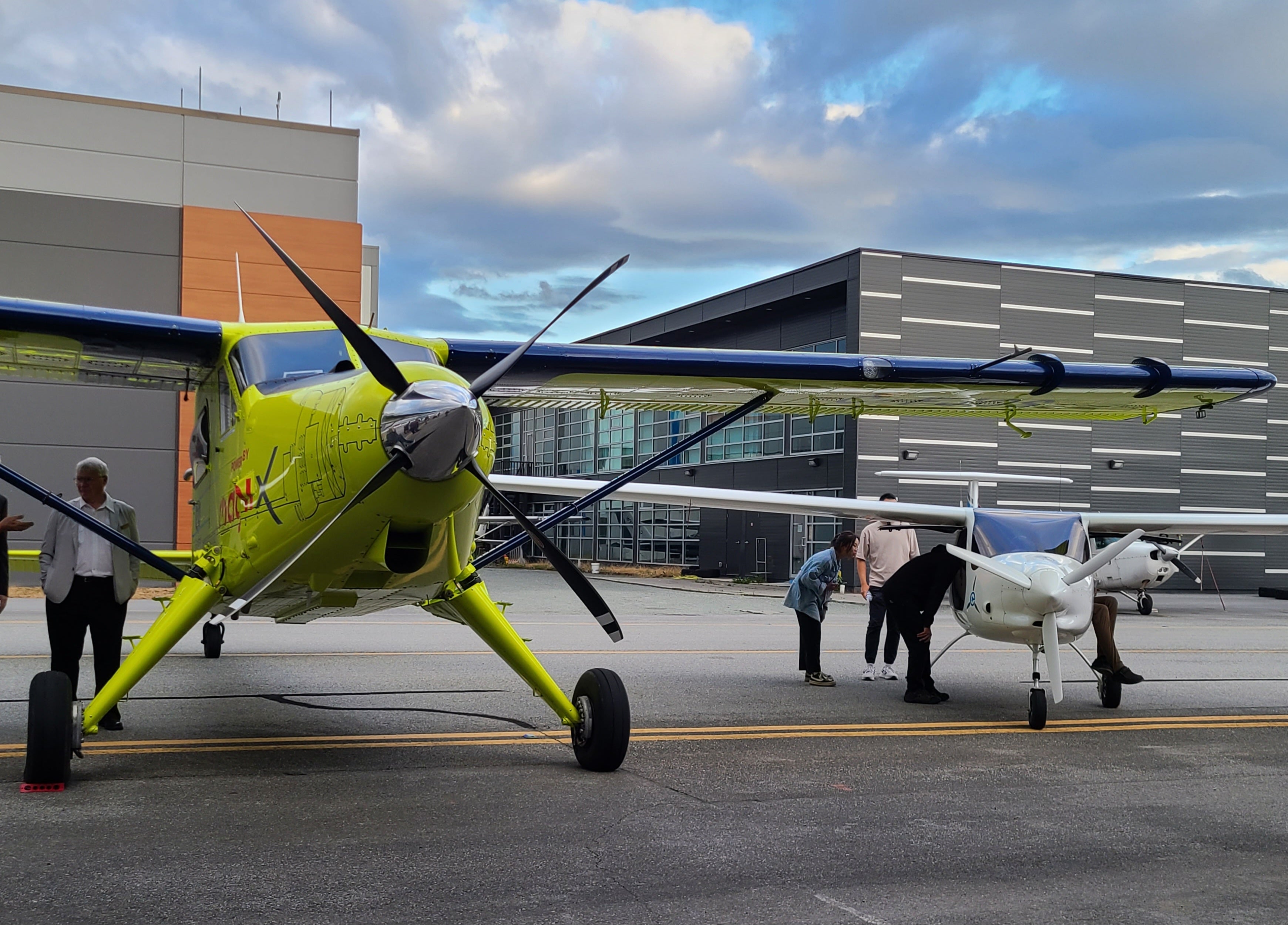
Streamlined nose of the eBeaver and Alpha Electro