
Climate Competencies
The curriculum work we are undertaking as part of the ACE project is very much aligned with professional associations’ evolving competency development work as they too grapple with the necessity of integrating sustainability and climate considerations into accreditation requirements for professionals. One of the key resources for this competency work is the Design by Resilience Lab’s Canadian Climate Action Competency Framework (CACF V2).
The framework was developed in response to the need for guidance to help a broad range of professionals integrate climate action principles and practices into their work. The framework is organised under 6 domains: working together, leadership, capacity building, risk assessment, solution design, and effecting change. The competencies and associated performance indicators provide an excellent basis for developing climate change learning outcomes for professional degree programs.

Climate Pedagogy
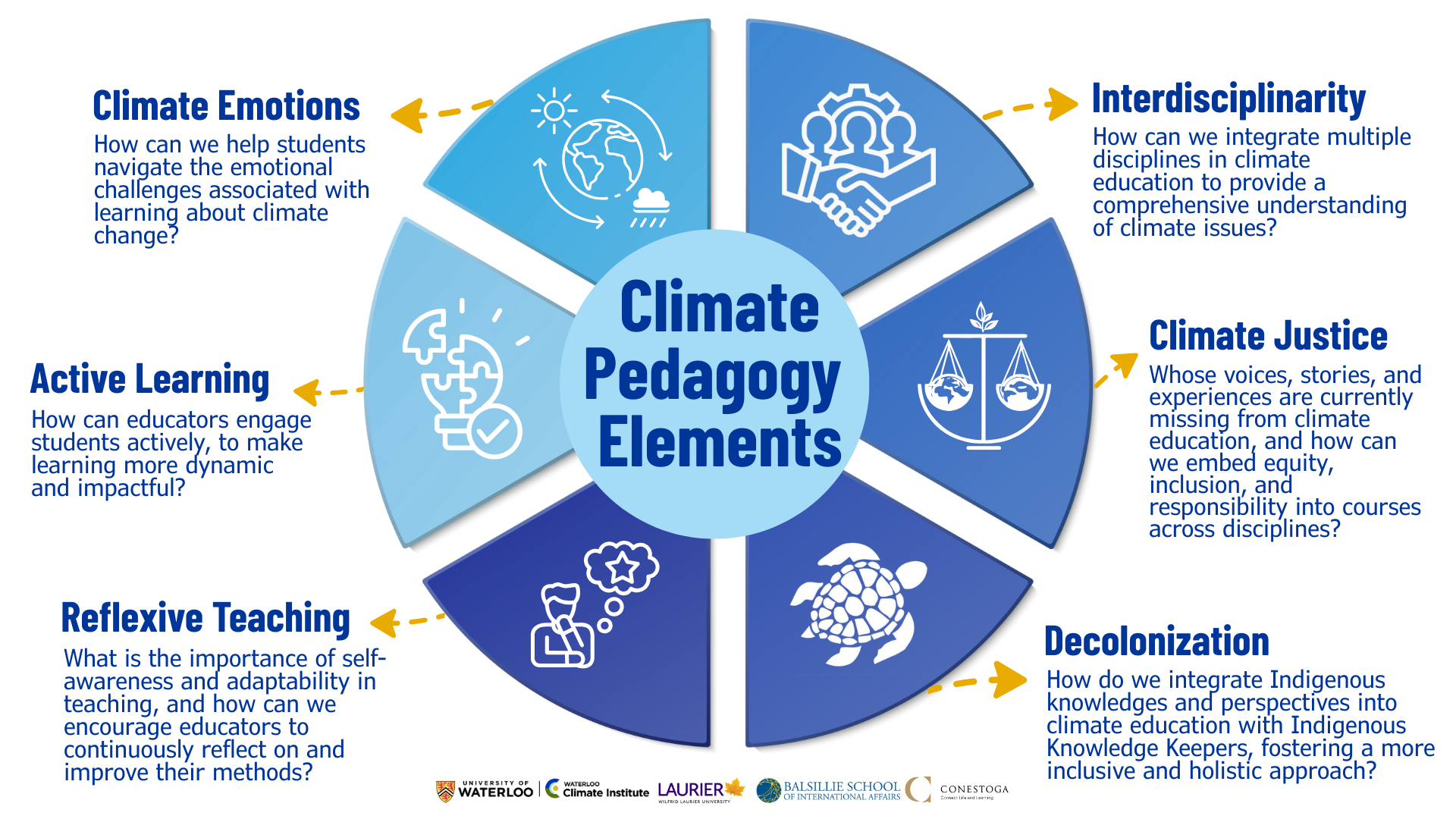
Teaching/learning about climate change may require particular instructional strategies to inspire hope and support students as they grapple with climate emotions. Climate adaptation curriculum work also provides opportunities to rethink how to incorporate Indigenous perspectives and equity and justice considerations into the curriculum as they relate to climate change, biodiversity loss and other issues.
The diagram below reflects some of the themes and questions related to climate pedagogy that emerged from a Climate Pedagogy Symposium hosted by the Climate Institute in 2024.
In the 2026/2027 school year, the ACE project will be offering some PD opportunities to help post-secondary instructors gain confidence and skills for climate education alongside their peers.
Guidance for integrating climate in the curriculum (Curriculum briefs)
The Waterloo Climate Institute has developed a series of curriculum briefs that include a rationale for integrating climate change into professional degree programs (in accounting, architecture, engineering, and planning). Each brief includes a list of suggested competencies derived from the Climate Action Competency Framework (CACFv2), a reading list, plus resources for teaching and learning for each of these disciplines.
Download the climate change curriculum briefs here:
Climate change in the curriculum at UWaterloo
With support from the ACE project, climate change is being integrated into the curriculum of University of Waterloo’s professional degree programs, including Accounting, Architecture, Civil and Environmental Engineering, Systems Design Engineering and Planning. These programs all have rigid curriculum and competency requirements defined by their professional accreditation bodies. As members of the ACE project steering committee, faculty members from each of these programs help to plan and implement ACE activities, including initiatives to support cross-professional learning and collaboration among faculty members and students from UWaterloo and across Canada.
Led by faculty members and supported by student research assistants, participating ACE programs have undertaken an audit of existing climate content in courses and mapped out opportunities to introduce new courses and/or enhance existing courses with climate adaptation topics, case studies and extra-curricular events. Now, in year three of the project, the programs are implementing and documenting the curriculum changes.
Below is an overview of this work.
SCHOOL OF ACCOUNTING AND FINANCE (SAF)
SCHOOL OF ARCHITECTURE
The University of Waterloo School of Architecture (UWSA) is a nationally and internationally recognized leader in design education, known for its cutting-edge research and teaching in construction, development, built heritage, green architecture, visualization, prototyping, and computer-assisted design.
As architecture in Canada rises to meet the climate challenge, UWSA—supported by the ACE Project—is taking bold steps to embed climate knowledge and skills across its curriculum. This includes enhancing existing courses and exploring innovative new topics such as Climate Resilient Buildings and Climate Stories.
Engagement has been central to this work. In March 2025, UWSA brought together students, staff, and faculty for a collaborative workshop to pinpoint where climate adaptation and architectural education intersect. Discussions centred on five key priorities for the school:
-
Embedding climate-centred learning objectives across all courses
-
Reinforcing the role of ecosystems as integral to “cultural history”
-
Advancing Indigenous, decolonial, and land-based learning
-
Linking materiality, decarbonization, and just transitions
-
Strengthening interdisciplinarity and community partnerships
Building on these insights, UWSA is now partnering with professors of core courses to revise syllabi and ensure stronger alignment with these climate priorities—positioning graduates to lead in a rapidly changing world.
UWSA is also hosting a lecture series focused on climate adaptation and events so far have included talks on adaptive landscapes, climate and Indigenous science and architecture in the climate crisis . You can find recordings of all of the lectures here. Stay tuned for information about upcoming lectures in the 2025-26 school year.
For more information about climate adaptation curriculum work being done in UWSA, contact Professor Jane Mah-Hutton.


UWSA curriculum consultation workshop on March 20, 2025
CIVIL AND ENVIRONMENTAL ENGINEERING
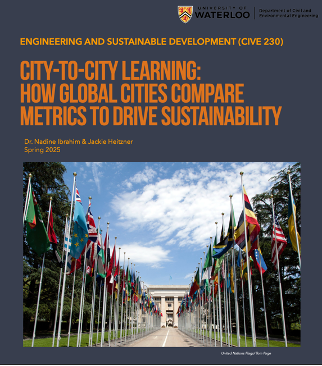
The University of Waterloo’s Department of Civil and Environmental Engineering (CEE) is home to one of Canada’s largest and most respected engineering programs. Offering undergraduate and graduate degrees in architectural, civil, environmental, and geological engineering, CEE blends theoretical learning with hands-on experience through co-op, capstone projects, and innovative courses. A standout example is CIVE 230: Engineering and Sustainable Development, where second-year students investigate topics of interest to them and compile their findings into an e-book—most recently, City-to-City Learning: How Global Cities Compare Metrics to Drive Sustainability.
Civil and environmental engineers are identified in Canada’s National Adaptation Strategy as a key professional group to advance climate adaptation nationwide. With support from the ACE Project, CEE has reviewed its undergraduate curriculum to identify gaps and opportunities for integrating climate adaptation, and published an account of this mapping process in the paper Accelerating Climate Change Adaptation (CCA) Education for the Next Generation of Engineering Professionals.
CEE’s climate integration strategy includes:
- Consulting with faculty members to identify ways to embed climate adaptation and sustainability in their courses
- Developing a new second-year design course to give environmental engineering students a strong foundation in climate and sustainability
- Creating a series of modules aligned with Engineers Canada’s principles of climate adaptation , to supplement existing courses and project work.
- Exploring the redesign of a classroom space to support hands-on, indoor/outdoor climate and sustainability learning
Through these initiatives, CEE is preparing the next generation of engineers to address the climate challenges of tomorrow.
For more information about climate adaptation curriculum work being done in CEE, contact Professor Bruce MacVicar , Chair of the Department of Civil and Environmental Engineering.
SYSTEMS DESIGN ENGINEERING
PLANNING
The University of Waterloo’s School of Planning is Canada’s largest and one of its longest-established planning schools, known since its inception in 1969 for combining conceptually rich education with applied experience through co-op jobs, internships, and community-based projects. Strong connections with the planning profession ensure that the School’s undergraduate and graduate Planning programs—including the BES, MA, and MES—meet the highest standards, with accreditation from the Canadian Institute of Planners. The PhD (Planning) program offers opportunities for advanced research in an interdisciplinary learning environment.
Recognizing climate change as one of the most pressing challenges facing the profession, the School of Planning is committed to integrating climate considerations across all levels of study, alongside other urgent societal priorities such as affordable housing, environmental conservation, active transportation, and equity.
A decade ago, the School introduced PLAN 652 Climate Change and Community Planning at the graduate level. Now, with support from the ACE Project, it is embedding targeted climate adaptation knowledge and skills more deeply into the curriculum, including a new compulsory undergraduate course, PLAN 348: Planning to Confront Climate Change and updates to PLAN 210 (Community Design Fundamentals).
Graduate students have been supporting this work by investigating key competencies needed for future planners and developing/identifying teaching resources to strengthen climate adaptation content in Planning courses—equipping future planners to navigate a rapidly changing world.
Professor Mark Seasons, the Director of the School of Planning is looking beyond the boundaries of UWaterloo to understand how Planning schools across the country are addressing climate change. Access his recent article co-authored with Elisabeth Infield and Ward Lyles, “Teaching climate change planning: fostering hope while building capacity”.
For more information about climate adaptation curriculum work being done in the School of Planning, contact Professor Mark Seasons.


Planning students participated in a climate in the curriculum consultation exercise in January 2025 to identify what they are learning, what they would like to learn, and how.
SCHOOL OF PHARMACY
The University of Waterloo’s School of Pharmacy is shaping the future of healthcare through experiential learning, impact-driven research, entrepreneurial culture, community partnerships, and academic excellence.

In 2025, the School received a grant from the University’s Sustainability Office to enhance the integration of sustainability and climate change into the PharmD curriculum—part of a broader national conversation among pharmacy schools in Canada. Using this funding, the School hosted a faculty and staff training workshop in July 2025 to explore how best to embed planetary health and climate topics in pharmacy education.
The workshop was facilitated by Randilynne Urslak and Shellyza Sajwani from the University of Ottawa, who are leading research on pharmacy education and planetary health. Their recent publication, A Scoping Review of Planetary Health Education in Pharmacy Curricula, provided context for the session. Through presentations, case study discussions, and interactive activities, participants examined how climate change intersects with pharmacy practice, exploring both mitigation strategies and adaptation approaches.
This “train-the-trainer” workshop came at a pivotal time, aligning perfectly with the start of the School’s curriculum renewal cycle and laying the groundwork for integrating planetary health and climate change concepts into PharmD courses in the years ahead.
For more information about climate curriculum work being done in the School of Pharmacy, contact Professor Allison Slater.