Southern Racemose Goldenrod
Solidago arenicola Keener & Kral is very rare in sandy alluvial soils near streams in northern Alabama, north central Tennessee and adjacent Kentucky. See Semple & Cook (2006 FNA) for a detailed description. The species has tall involucres (7–12 mm) for S. subsect. Humiles and these are somewhat resinous. Solidago arenicola is similar to S. racemosa, which usually has hairier cypselae and whose ranges extends from Kentucky to Québec, and S. austrocaroliniana, which has smaller involucres and blooms in spring. The species is less likely to be confused with S. kralii from fields and sandy soils in Georgia and S. plumosa from a single population on rocks along the Yadkin R. in North Carolina.
Solidago arenicola is tetraploid (2n=36; Peirson et al. 2012).
Semple et al. (2019) presented a multivariate analysis of all 13 species of S. subsect. Humiles as delimited at the time. Solidago arenicola was included in the analyses of 12 and 11 species (92% and 92% correct placement a posteriori), in the analysis of 4 species native to the southeastern US (92% correct placement a posteriori), and in the analysis comparing just S. arenicola and S. racemosa (100% correct placement a posteriori including specimens from Kentucky and Tennessee). The Alabama plants all have glabrous cypselae, while the Tennessee samples have either glabrous or slightly hairy fruit bodies similar to fruits of S. racemosa.
Peirson, J.A., A.A. Reznicek, & J.C. Semple. 2012. Polyploidy, speciation, and infraspecific cytotype variation in goldenrods: the cytogeography of Solidago subsection Humiles (Asteraceae: Astereae) in North America. Taxon: 61: 197-210.
Semple, J.C., K. Kornobis, A. Mazzorato, G.S. Ringius, and J.A. Peirson. 2019. A multivariate morphometric analysis of Solidago subsect. Humiles (Asteraceae: Astereae). Phytoneuron 2019-25: 1–61.
Last revised 18 May 2025 by J.C. Semple
© 2025 J.C. Semple, including all photographs unless otherwise indicate


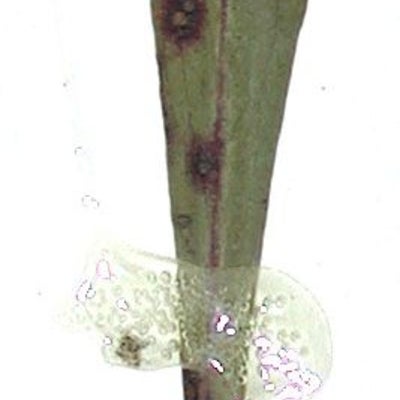


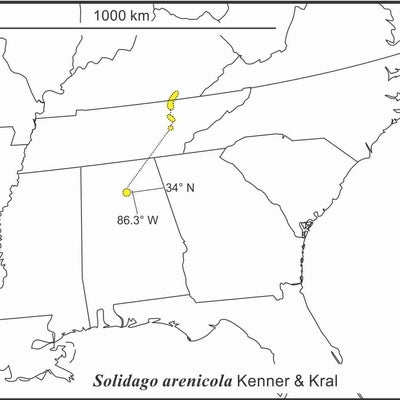


1-6. Solidago arenicola. 1. Habitat and shoots, Semple 11191, Blount Co., Alabama. 2. Robust shoots, S 11191. 3. Lower stem leaf, Churchill 86277 VDB. 4. Inflorescence branch and head, S 11191. 5. Heads and fruit, Semple et al. (2019) Fig. 2. 6. Range map.