Fieldwork is underway for the Can-Peat team! This summer, we have five students working to meet Objectives 2 and 3 of the research proposal, building a national database on peatland carbon stocks, greenhouse gas exchange, and supporting environmental data across Canada. Their research will also advance models of peatland carbon cycling and help evaluate how peatlands respond to climate change and disturbances. Specifically:
Akshara Withanage (pictured far right), a PhD candidate at UWaterloo, is working in Peace River, Alberta, measuring greenhouse gas exchange, hydrology, and peat properties at different levels of agricultural disturbance. This data will improve our fundamental understanding of GHG emissions from peatlands affected by agricultural practices, addressing key knowledge gaps on how decades of agricultural use have altered peatland properties and carbon dynamics. Ultimately, the results will be an important step toward establishing emission factors specific to Canadian peatlands used for agriculture.

Melanie Bird, a PhD candidate at UWaterloo, is compiling data on peatland greenhouse gas responses to restoration and reclamation. While much of the compiled data was already collected in the past, Mel is working this summer to collect additional data from a 15-year-old restored site in Peace River, Alberta. Her project will improve estimates of greenhouse gas emission reductions and timing of the return to carbon sink status at previously disturbed peatlands, informing the national peatland greenhouse gas inventory, emission factors for Nature Smart Climate Solutions projects, and models being developed in Can-Peat.

From left to right: Melanie Bird (PhD candidate), Lauren DeCotiis (Co-op Student), and Akshara Withanange (PhD candidate).
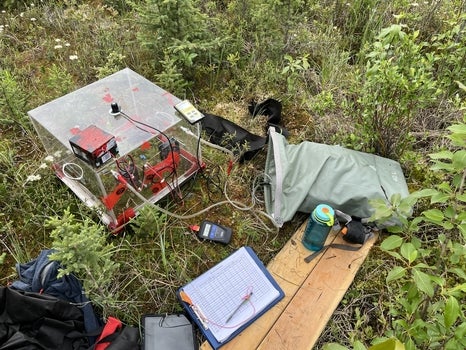
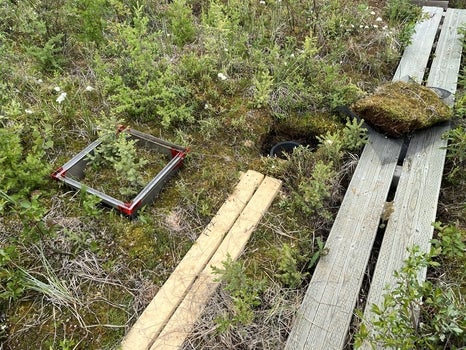
The closed chamber method of measuring greenhouse gas fluxes.
Fiona Kurylowicz (pictured right), PhD candidate at UAlberta, has eddy covariance towers set up in Slavey Creek and Lutose, Alberta, for continuous measurements of site-level carbon emissions. This summer, Finn is adding additional instruments to study redox conditions and document lateral carbon transport into and out of the wetlands to develop an improved carbon balance. Her overall goal is to investigate drivers of carbon cycling in a marsh and fen in a region where rapidly thawing permafrost is changing hydrology at the landscape scale.

Yousef Olfatmiri and Yueyue Xing, PhD candidates at Memorial University, are out east in Robinson, Newfoundland, collecting data to improve the water table simulation in the McGill Wetland Model. In addition to improving this model, their research will investigate the impact of climate change and human disturbance on peatland hydrology and greenhouse gas emissions. This work will strengthen our ability to predict how Canadian peatlands may respond to future environmental change.

Open-top-chambers used for climate control when measuring greenhouse gas fluxes.