By Savanna Cherry
Peatlands store vast amounts of carbon, making them critical for mitigating climate change. However, their ability to act as carbon sinks depends on a delicate balance between carbon uptake and loss. As climate conditions shift and land use pressures increase, particularly in western Canada, there is growing uncertainty around whether these systems will continue to store carbon or begin releasing it. Understanding how peatlands respond to disturbance and hydrological change is essential for predicting their future role in the global carbon cycle and informing sustainable land management.
This research was conducted in a montane fen in Kananaskis Valley, Alberta, located on lands stewarded by the Stoney Nakoda Nation. Sibbald Fen research site provided a unique opportunity to study carbon transport at a site with surrounding land-use disturbance. Unlike more commonly studied boreal peatlands, montane peatland systems experience dynamic water table fluctuations driven by snowmelt, rainfall, and topography.
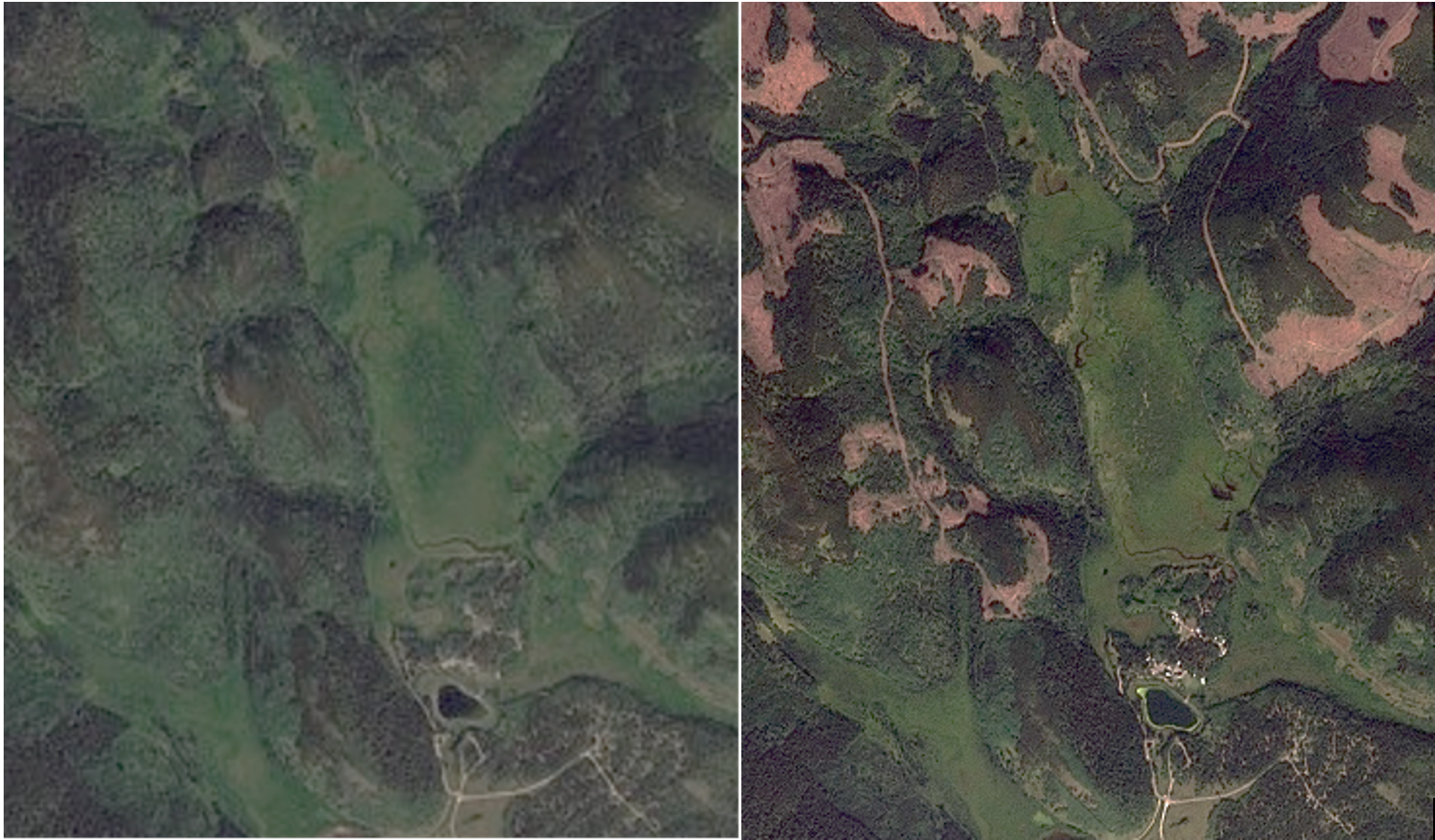
Aerial photographs of Sibbald Fen showing unharvested areas (left; 08/15/2023) and partially harvested areas (right; 09/13/2024).
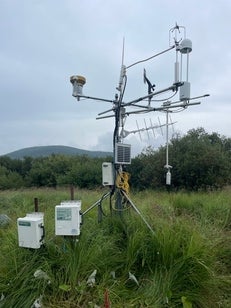
Eddy covariance tower at Sibbald Fen used to measure atmospheric carbon fluxes (CO₂ and CH₄). Photograph taken facing northeast, showing tower instrumentation and surrounding vegetation.
To understand how carbon moves through the montane peatland, researchers measured both vertical and lateral carbon pathways. Vertical fluxes included carbon dioxide (CO₂) exchange through photosynthesis and respiration, as well as methane (CH₄) emissions to the atmosphere. At the same time, this study quantified lateral carbon losses through water in the form of dissolved organic carbon (DOC) and dissolved inorganic carbon (DIC). By quantifying both atmospheric and hydrological pathways, this study provides a more complete picture of the net ecosystem carbon balance (NECB) than approaches that focus on a single pathway alone.
Our results show that during the 2025 growing season, the montane peatland functioned as a net carbon source rather than a sink. Carbon losses were dominated by vertical fluxes, with carbon dioxide and methane accounting for approximately 98% of total carbon exchange. Lateral carbon losses through dissolved organic carbon (DOC) and dissolved inorganic carbon (DIC) made up a much smaller portion, around 2% of the total net ecosystem carbon balance (NECB). While this imbalance highlights the importance of atmospheric processes, it also raises important questions about how environmental conditions are influencing carbon dynamics in this system.
Although lateral carbon losses represented a small fraction of the overall carbon budget, they were not evenly distributed through time. Instead, carbon export occurred in short, intense pulses associated with hydrological events. A small number of high-flow periods, representing less than 5% of the growing season, accounted for a substantial portion of total DOC and DIC export. These findings highlight the importance of hydrological connectivity, where rising water tables and increased discharge rapidly transport carbon from the montane peatland into downstream aquatic systems.
These findings have important implications for both climate regulation and water quality. If peatlands shift toward becoming net carbon sources, their ability to offset greenhouse gas emissions is reduced. At the same time, carbon exported through water does not disappear; it is transported into streams and rivers, where it can influence water chemistry, contribute to brownification processes, and fuel downstream carbon emissions. As climate change is expected to increase the frequency and intensity of precipitation events, understanding these pulse-driven export processes becomes increasingly important.
This study contributes to a growing body of research showing that montane peatland carbon dynamics are more complex than previously understood. By integrating both vertical and lateral carbon pathways, it highlights the importance of considering the full NECB when assessing ecosystem function. It also provides rare insight into montane peatlands, which remain underrepresented in research literature despite their sensitivity to hydrological change and disturbance.