When winter breathes carbon back into the atmosphere, how secure are peatlands as carbon sinks? New research suggests the answer depends not only on summer growth, but also on what happens during the cold, often overlooked months.
Peatlands, wetland ecosystems that accumulate deep layers of organic matter, store up to one-third of the world’s soil carbon despite covering just 3% of global land. They are widely recognized as critical long-term carbon sinks. However, their annual carbon balance remains uncertain, particularly during the non-growing season, when harsh winter conditions limit direct measurement.
To address this gap, this study conducted by Can-Peat researcher Katie Hettinga, evaluated the data from the Soil Moisture Active Passive Level 4 Global Daily EASE-Grid Carbon Net Ecosystem Exchange product (SMAP-NEE), developed by the National Aeronautics and Space Administration (NASA), against ground-based eddy covariance net ecosystem exchange measurements (EC-NEE) at five Canadian peatland sites from 2015 to 2023.
The findings reveal systematic biases in the satellite-derived dataset. During the growing season, SMAP-NEE consistently overestimated carbon uptake, suggesting a stronger carbon sink than observed by EC-NEE. In contrast, during the non-growing season, SMAP-NEE underestimated carbon emissions, portraying peatlands as weaker carbon sources than they actually are. These discrepancies likely reflect both the absence of peatlands in the model’s calibration as a distinct plant functional type and the coarse spatial resolution of the satellite data, which blends multiple ecosystem types within a single grid cell.
To improve accuracy, the researchers applied a site- and season-specific correction based on the relationship between SMAP-NEE and EC-NEE. This “Corrected-SMAP-NEE” dataset significantly reduced error and produced more reliable estimates of seasonal and annual carbon dioxide (CO₂) exchange. Importantly, the corrected dataset revealed that non-growing season emissions play a far greater role in peatland carbon balance than previously recognized. Correcting the dataset is contingent on the availability of EC-NEE data and this method may only be applicable in regions where these data exist.

Boxplots of Corrected-SMAP-NEE (g C m-2 period-1) throughout the study period (2015-2023). The fluxes are divided into the growing season (GS) (green), non-growing season (NGS) (blue), and annual (purple). The white points represent the mean, which deviates from median values. The red line across 0 represents the CO2 sink or source line.
Across the five sites, non-growing season carbon losses ranged from 33% to 256% of growing season carbon uptake. In some cases, winter emissions not only offset summer carbon gains but exceeded them, turning expected annual carbon sinks into net carbon sources. This wide variability highlights the dynamic and site-specific nature of peatland carbon cycling.
Overall, this study demonstrates that excluding non-growing season dynamics or relying on uncorrected satellite products can lead to significant misrepresentation of peatland carbon budgets. Improving remote sensing models and incorporating year-round measurements are essential for accurately assessing the future role of peatlands in the global carbon cycle, especially as northern regions experience disproportionate winter warming.
Looking ahead, given the vast carbon stocks stored in these ecosystems, even small miscalculations in their annual balance could significantly influence projections of future atmospheric carbon dioxide concentrations and climate change trajectories. Therefore, more research is needed to understand and calibrate carbon budgets of peatlands.
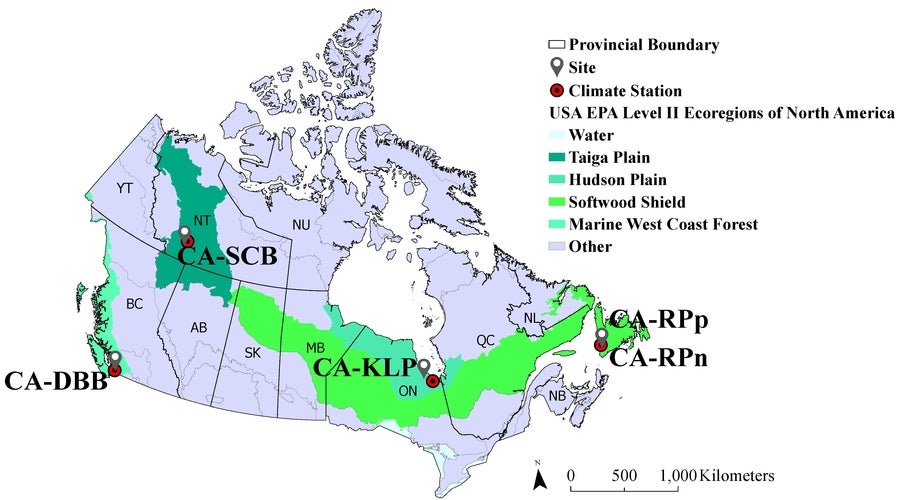
Map of five peatland sites located in Canada and associated climate stations within Ecoregions of Canada. The five peatland sites are included: Delta Burns Bog (CA-DBB), Kinoje Lake Peatland (CA-KLP), Robinsons Natural Bog (CA-RPn), Robinsons Peatland Pasture (CA-RPp), Scotty Creek Bog (CA-SCB).
Read the full journal article: Hettinga EK, Rezanezhad F, Persaud BD, Slowinski S, Strack M, Liu H, Lennartz B, Humphreys E, Wu J, Skeeter J, Knox SH, Alcock H, Sonnentag O, Detto M and Van Cappellen P (2026) Comparing modeled and measured carbon dioxide data at five canadian peatlands revealed highly variable non-growing season fluxes. Front. Environ. Sci. 14:1838949. doi: 10.3389/fenvs.2026.1838949
Contact Katie Hettinga for more information or questions regarding this research