Editor:
Brandon Sweet
University Communications
bulletin@uwaterloo.ca
Navigating Rupture: One year on, regional leadership takes shape amid global upheaval
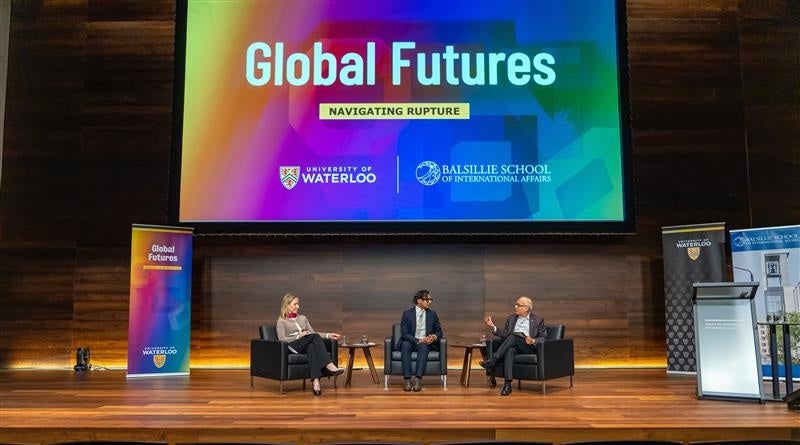
Dr. Ann Fitz-Gerald, Hamza Abdulbasit, and Dr. Vivek Goel in conversation at the Navigating Rupture event. Photograph by Sam Charles.
A message from the Global Futures Office.
One year after the University of Waterloo convened regional leaders for the CEO Challenge, the pace of global change has accelerated even faster than many anticipated. On April 7, many of those same leaders gathered again for Navigating Rupture—a public forum that explored how Canada, Ontario, and Waterloo Region can respond to widening geopolitical instability, technological disruption, and economic reordering.
Co‑hosted by the University’s Global Futures Office and the Balsillie School of International Affairs, the event brought together a cross‑section of regional leadership, including Regional Chair Karen Redman; Dorothy McCabe, Mayor of the City of Waterloo, and Scott Davey, Acting Mayor of the City of Kitchener, among the more than 100 attendees across business, government, academia and community.
The discussion was intentionally framed as a continuation of the 2025 CEO Challenge. The global fault lines explored then have only since intensified. Geopolitical tensions have become more fractured and competition over artificial intelligence, data, and supply chains more explicit. However, a key theme throughout the evening’s discussion focused on the importance of collaboration in these turbulent times.
In opening remarks, Dr. Richard Florizone, Special Advisor to the President and Provost on Global Futures, emphasized Waterloo Region’s capacity to respond collectively in moments of disruption.
“What has always distinguished this region is not just what we do well individually, but how we work together,” Dr. Florizone said.
President Vivek Goel echoed that sentiment, noting that “this region has long been defined by its ability to anticipate change and to lead through it.”
“It's not enough to react to change,” he continued. “We must help shape what comes next.”
He reflected that since the CEO Challenge, that spirit of collaboration has translated into tangible progress locally, most notably through initiatives like the Waterloo Region AI Coalition.
“It's about more than just developing AI tools to help local companies, local platforms, the healthcare system,” Dr. Goel said. “It's about developing the capacity--the talent—and creating the opportunity for that talent to see that they can grow their careers here in this region.”
Expert speakers Hamza Abdulbasit, Fellow at the Balsillie School of International Affairs (BSIA), and Dr. Ann Fitz-Gerald, Director of BSIA, offered perspectives on a range of topics including supply chains, AI, standards, trade diversification, defence, cybersecurity, and the importance of growing Canadian firms and talent. Their remarks focused on how Canada, as a middle power, can navigate global change by strengthening domestic capacity while working with international partners. Dr. Fitz-Gerald noted that Canada has an opportunity to work with other middle powers to lead on setting standards rather than passive “rule taking.”
A moderated discussion with the speakers, led by President Goel, expanded on these themes, examining interprovincial barriers, data governance, sustainability, and the role regions can play in national renewal. One key observation throughout the talk was that Canada’s future competitiveness will depend on moving beyond resource extraction toward value‑added production—and on strengthening home‑grown firms, talent pipelines, and trusted AI capacity.
Despite the current turbulence, the evening closed on a hopeful note. Looking ahead to a year from now, speakers expressed hope and optimism that momentum would continue: internationally, through stronger cooperation among middle powers, and locally, by building on the region’s collaborative approach.
As President Goel observed “In a moment of global rupture, collaboration is not just aspirational—its essential.”
Canada’s first CREATE biomedical graduate training program to put needs before solutions delivered transformative results
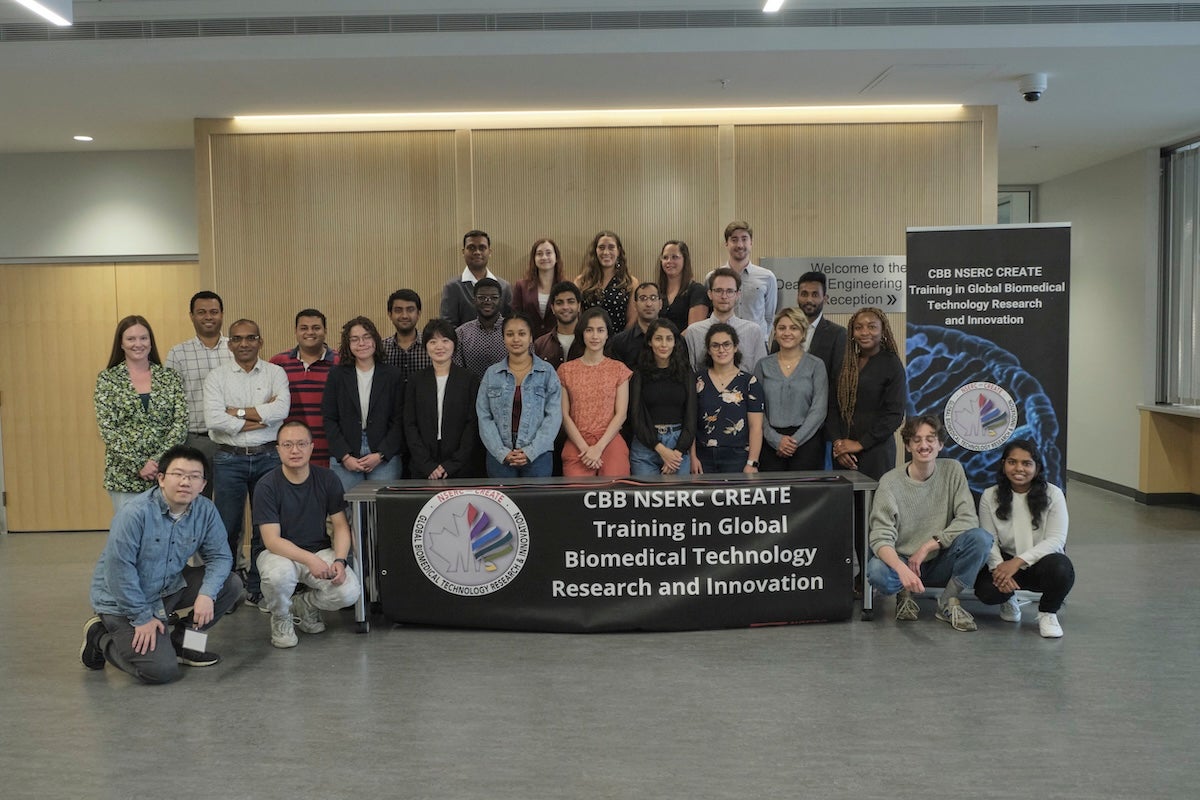
NSERC CREATE program trainees and coordinators during the 2022 Annual Summer School Bio hackathon and Design challenge.
By Daniel Dapaah.
In 2018, the University of Waterloo launched the NSERC Collaborative Research and Training Experience (CREATE) program in global biomedical technology research and innovation. Led by Dr. Catherine Burns, a professor of Systems Design Engineering and the Canada Research Chair in Human Factors in Healthcare Systems, the program was established to provide graduate students in the healthcare, medical and biotechnology fields with opportunities to directly interact with end users and stakeholders. As Canada’s first “needs first” graduate training program, it enabled students to identify unmet clinical and industry needs before developing technological solutions.
Inspired by conversations with her departmental colleagues Dr. Maud Gorbet, a professor and the Biomedical Engineering Program Director, and Dr. Thomas Willet, a professor of biomedical engineering, Burns secured $2.34 million in funding from NSERC and University of Waterloo to bring the program to life.
“We had many discussions about how to educate a biomedical engineer,” Burns said. “Someone who is at their core a great engineer, but also savvy about how healthcare works, understands how to identify important problems and navigate those needs to practical, adopted solutions. The NSERC CREATE program provided an opportunity to test-drive those ideas and develop content and opportunities.”
The program concluded in 2025 becoming the University’s most successful CREATE initiative. Over seven years, the program trained 73 PhD and master’s degree students in engineering and the health sciences. The program delivered more than 270 training sessions — including lectures, workshops, seminars, and biohackathons — focused on biomedical device and technological design, commercialization of these new devices and professional skill development.
The trainees also gained hands-on experience through industry internships, academic exchanges, and an international summer school organized in collaboration with the University of Technology of Compiègne in France.
Participants describe the program as transformative. Dr. Piyush Garg, now enrolled in the Master of Business, Entrepreneurship and Technology (MBET) program at the University’s Conrad School of Entrepreneurship and Business, highlighted the value of interdisciplinary connections and his internship with the National Research Council.
“This program brought experiences beyond my PhD that set me apart from others with a similar degree,” Garg said. “It also taught me that I can do multiple things at the same time.”
PhD candidate Arya Amiri echoed this sentiment, emphasizing the importance of his internship at Grand River Hospital. “It gave me a better sense of how hospitals work,” Amiri said. “CREATE provided exciting experiences to learn about industries, hospitals and to travel — experiences that would have otherwise made my PhD boring.”
Reflecting on the program’s impact, Burns emphasized the importance of rethinking graduate education. “The NSERC CREATE program is a unique opportunity to design a training experience for graduate students. Sometimes we don’t put enough effort or thought into our graduate school experiences and forget that graduate degrees are increasingly critical in some fields, especially deep tech and high-tech fields. Developing well-trained, employment- or innovation-ready graduates means combining worldclass research with field specific knowledge and skills.”
Student facilitators sought for Athletics inclusion statement focus groups
A message from the Equity, Diversity, Inclusion and Anti-Racism Office (EDI-R).
Interested in helping Athletics put inclusion into action? We’re looking for 5 student facilitators to lead focus groups that will help to develop an Inclusion Statement for Athletics. The statement should reflect Athletics’ commitment to a fair, respectful, and inclusive sports environment, shaped by diverse student voices, ensuring everyone feels seen, supported, and able to fully participate in programs, spaces, and experiences.
Student facilitators will receive compensation for attending training and for leading the focus groups.
No prior facilitation experience is required, just a willingness to learn, listen, and create space for meaningful conversations.
This is a chance to gain hands-on experience, build valuable skills, and make a real impact on inclusion in Athletics.
Visit the EDI-R website to learn more and to register!
Math 4's crane removal will lead to closures on Wednesday
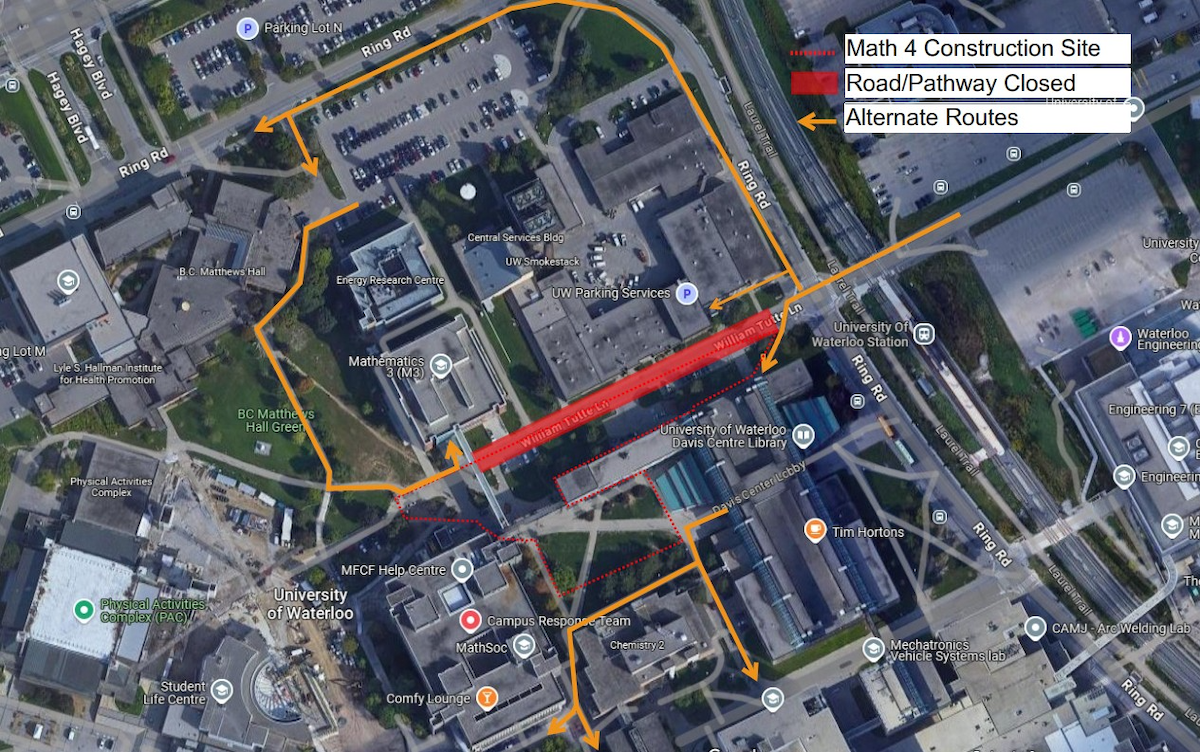
Speaking of navigating rupture, the Mathematics 4 (M4) construction project is about to reach another major milestone with the dismantling of the tower crane now that the structure of the building is complete, according to a note from Plant Operations. "In order to dismantle the tower crane in a safe manner, William Tutte Way will be closed on Wednesday, April 15, from 7:00 a.m. to 5:00 p.m.," says Plant Ops. "Due to this dismantling, all adjacent pedestrian pathways will need to be closed for safety."

The tower crane currently, er, towering over the Math 4 construction site.
There will be no pedestrian access down William Tutte Way from Ring Road to the Math 3 building during the dismantling operation. The pathway from L-Lot to William Tutte Way and the General Services Complex (GSC) will have no access to the front doors of M3. M3 itself will remain open, with the main entrance accessible via the BMH Green. The General Services Complex will remain open via the doors at the corner of Ring Road.
For more information about the closure, consult the Service Interruption Notice website.
Interesting in more information about Math 4? Check out the Faculty of Math's Mathematics 4 website.
Upcoming system outages
The Catering and Event Services online ordering and room booking system will be unavailable due to scheduled maintenance from Monday, April 13 at 5:00 p.m. to Tuesday, April 14 at 12 noon. Users are encouraged to check back shortly once maintenance is complete.
Link of the day
Homer Simpson song covers take over Soulseek
When and where
The Campus Wellness Student Medical Clinic offers healthcare visits with Physicians and Nurse Practitioners to current undergraduate and graduate students. Services include: vaccinations, immunity testing, naturopathic services and more. Counselling Services offers appointments with counsellors in person as well as via phone and video. Students can book appointments for these services by calling Campus Wellness at 519-888-4096.
The privately-run Student Health Pharmacy (located in the lower level of the Student Life Centre) is now offering new COVID booster shots and flu shots. Covid booster shots are available by appointment only – please call ext. 33784 or 519-746-4500. The Student Health Pharmacy’s summer hours are Monday to Friday, 9:30 a.m. to 4:30 p.m. Naloxone kits are still available – pick them up in the pharmacy at no charge.
The Waterloo Eye Institute optometry clinics in Waterloo and downtown Kitchener offer comprehensive eye exams and eyewear, including glasses and contact lenses, with the Waterloo location offering various specialized services including urgent eye care. Discounts apply for University of Waterloo students and employees. The Waterloo Clinic is at a nearby interim location, 419C Phillip St, during construction at the School of Optometry and Vision Science. The Kitchener Clinic remains at the Health Sciences Campus, 10B Victoria St. S. Book online or by phone at 519-888-4062.
Warriors Summer Youth Camps, registration is now open for multi-sport and games, baseball, basketball, eSports, football and hockey camps for boys and girls ages 5 to 18. Register today!
Final examination period, Thursday, April 9 to Thursday, April 23.
"The English Does Not Tilt": A conversation about identity, linguistic justice, and academic writing, Monday, April 13, 2:00 p.m. to 4:00 p.m., DP 323 or online via Teams.
WIN-BME Joint Seminar: "Beyond Static Imaging: Structural and Functional Insights through X-ray microCT" with Marketa Kaiser and Jakub Salplachta, Tuesday, April 14, 12 noon to 1:30 p.m., PSE 2317.
GenAI in Teaching Material Development - In Person (CTE7553), Tuesday, April 14, 1:00 p.m. to 2:30 p.m., MC 2036.
Board of Governors meeting, Tuesday, April 14, 1:30 p.m., Stratford Campus and online via YouTube. Please note the correct location.
Cooperathon powered by Desjardins: registration AMA, Wednesday, April 15, 12 noon to 12:30 p.m., online.
Master of Taxation virtual information session, Wednesday, April 15, 12 noon.
Anti-Racism Reads Series: Algorithms of Oppression, Thursday, April 16, 12 noon to 1:00 p.m., Dana Porter Library Room 338.
Rock Your Thesis 3: Revise and Submit, Thursday, April 16, 1:00 p.m. to 4:00 p.m., SLC 3216 (Grad Lounge).
Performance Development Program information session - virtual, Wednesday, April 15, 2:00 p.m. to 3:00 p.m. via MS Teams.
Performance Development Program information session - in-person, Thursday, April 16, 1:00 p.m. to 2:00 p.m., EC5 1111.
Assessment Redesign and Generative Artificial Intelligence (GenAI) - (CTE7556) – Part One, Tuesday, April 21, 9:30 a.m. to 12:30 p.m., MC 2036.
UW Administrative Professionals Community of Practice Event, Wednesday, April 22. Register by Friday, April 10.
W3+Presents Holding It Together, Wednesday, April 22, 12 noon to 1:30 p.m., Grad House (upper floor).
WISE Public Lecture, “Architected Porous Media in Electrochemical Energy Systems” by Dr. Maxime van Der Heijden, Assistant Professor, University of Waterloo, Wednesday, April 22, 1:30 p.m. to 2:30 p.m., DC 1302 and on Zoom. Register today!
Vision Science Graduate Student Conference registration deadline, Thursday, April 23.
Assessment Redesign and Generative Artificial Intelligence (GenAI) - (CTE7556) – Part Two, Thursday, April 23, 9:30 a.m. to 12:30 p.m., MC 2036.
CPI Talk: Intimate Images, Deep Fakes and the Law, Thursday, April 23, 2:30 p.m. to 4:00 p.m., EC5-1101/1111.
PhD oral defences
Mechanical and Mechatronics Engineering. Yu Zeng, “Dual-scale Finite Element and Machine Learning Framework for Predicting Effective Inelastic Deformation of Unidirectional Non-Crimp Fabric Composites Considering Manufacturing Induced Defects.” Supervisor, Dr. John Montesano. Thesis available via SharePoint – email eng.phd@uwaterloo.ca to request a viewing link. Oral defence Tuesday, April 21, 9:00 a.m., EC4-1159.
Chemical Engineering. Lanting Qian, “Halide and Sulfide Solid Electrolytes for All Solid-State Batteries: Structures and Interface Engineering.” Supervisors, Dr. Linda Nazar, Dr. Michael Pope. Thesis available via SharePoint – email eng.phd@uwaterloo.ca to request a viewing link. Oral defence Thursday, April 23, 1:30 p.m., QNC C2-361.
School of Public Health Sciences. Emily Kocsis, "Migration, Gendered Translocality, and Rural Wellbeing in the Western Highlands of Guatemala." Supervisor, Dr. Warren Dodd. Email Health Graduate Administration for a copy. Oral defence Friday, April 24, 12 noon, hybrid.
English Language and Literature. Ayesha Altaher, “Inherited Scripts and Contested Narratives: Arab and Muslim Identity in 18th and 19th Century America.” Supervisor, Dr. Jennifer Harris. Available upon request from the Faculty of Arts, Graduate Studies and Research Officer. Oral defence Tuesday, April 28, 1:00 p.m., PAS 2464 and hybrid.
Upcoming service interruptions
Stay up to date on service interruptions, campus construction, and other operational changes on the Plant Operations website. Upcoming service interruptions include:
-
Engineering 2 and 3, Davis Centre, Math & Computer fire alarm testing, Monday, April 13, 6:30 a.m. to 8:15 a.m.
-
Earth Sciences & Chemistry low pressure steam shutdown, Monday, April 13, 12 midnight to April 14, 5:00 p.m., ESC will be without perimeter heating for the day, please dress accordingly.
-
Carl Pollock Hall, Douglas Wright Engineering, South Campus Hall, Rod Coutts Hall, Grad House fire alarm testing, Wednesday, April 15, 6:30 a.m. to 8:15 a.m.
-
Math 4 crane dismantling, Wednesday, April 15, 7:00 a.m. to 5:00 p.m. (rain day April 16), William Tutte Way between Ring Road and M3 road closure, all adjacent pedestrian pathways will be closed for safety. M3 will remain open and accessed via BMH Green, GSC will remain open and accessed by main doors at the corner of Ring Road.
-
General Services Complex, Commissary, Central Plant fire alarm testing, Thursday, April 16, 6:30 a.m. to 8:15 a.m.
-
School of Architecture fire alarm testing, Friday, April 17, 6:30 a.m. to 8:15 a.m.
-
Aberfoyle - BioRem fire alarm testing, Friday, April 17, 10:00 a.m. to 11:00 a.m.
-
Digital Media Stratford fire alarm testing, Friday, April 17, 12 noon to 1:00 p.m.
-
Fire Research Facility fire alarm testing, Friday, April 17, 1:00 p.m. to 2:00 p.m.