Submit content for the Daily Bulletin through the Daily Bulletin intake form.
For all other requests, please contact communications@uwaterloo.ca.
New schools in Arts collaborate on transformative research
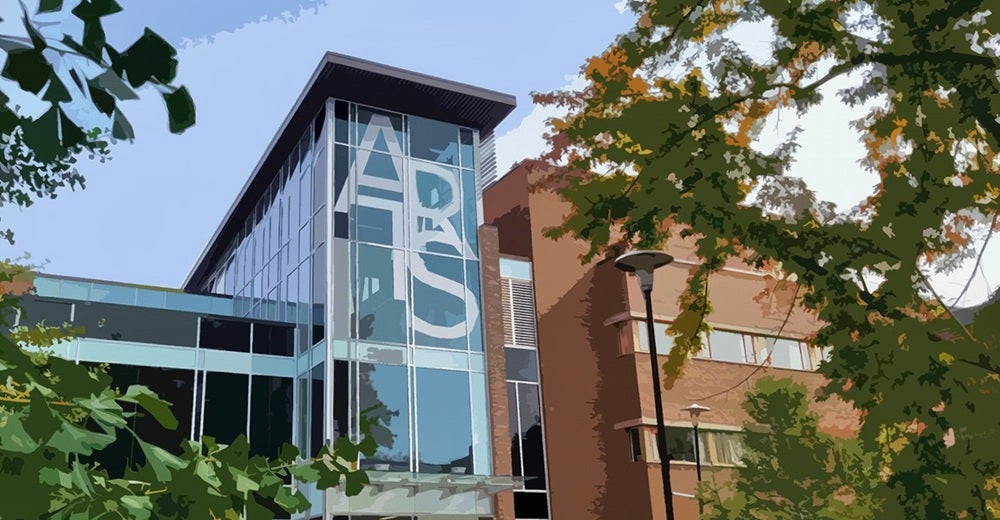
A message from the Faculty of Arts.
Five interdisciplinary research projects addressing societal issues have been selected for funding through the Emerging Schools Interdisciplinary Research Projects program – a new initiative in the Faculty of Arts with support from the Office of Research.
The research program marks the recent launch of the School of Critical and Creative Humanities (SCCH) and the School of Social, Political and Historical Research (SSPHR), along with the six-school structure of the Faculty of Arts.
“The goal is to build new research partnerships, develop interdisciplinary projects, and position them to compete for future external funding,” said Ana Ferrer, Associate Dean, Research. “This initiative creates opportunities for faculty and graduate students to engage in transformative research that pushes traditional disciplinary boundaries.”
The five projects and teams are:
-
Contested Expertise: Medical Advocacy in Polarized Publics, Smita Misra-Latty, Communication Studies, SCCH; Heather Love, English, SCCH; Jennifer Liu, Anthropology, SSPHR
-
The Politics of Naming: Place Names in Southwest Ontario, Grit Liebscher, German, SCCH; Andrew McMurry, English, SCCH; Susan Roy, History, SSPHR
-
Wampum as Living Archive: Interdisciplinary Material Knowledge and Rematriation, Talena Atfield, History, SSPHR; Logan MacDonald, Fine Arts, SCCH; and collaborators
-
Freebirth and the Limits of Reproductive Autonomy, Alana Cattapan, Political Science, SSPHR; Katy Fulfer, Philosophy, SSPHR; Jennifer Liu, Anthropology, SSPHR
-
Sites of Enslavement, Sites of Re(PAIR): Toward an Integrated Methodology for Diasporic Research, Christopher Taylor, History, SSPHR; Jasmin Habib, Political Science, SSPHR, Naila Keleta-Mae, Theatre and Performance, SCCH; and team
Led by Alexie Tcheuyap, Dean, and developed Ferrer, this seed program is generously funded by Waterloo’s Vice-President Research and International. Read the project summaries in the Arts News story.
Q&A with Professor Dan Brown: Exploring societal, ethical and legal questions surrounding generative AI
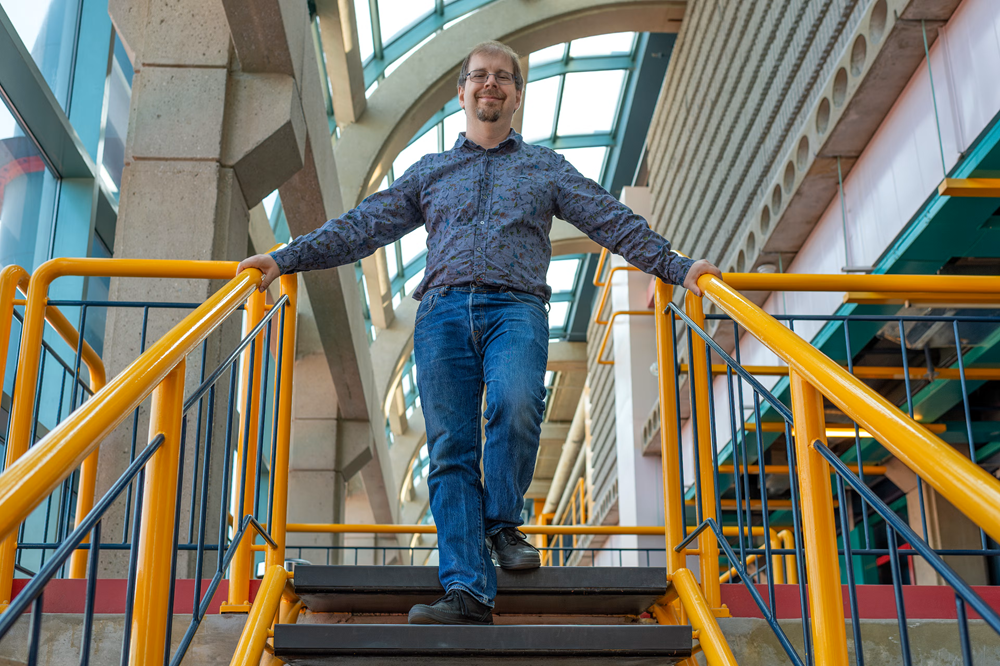
This article was originally published on the Cheriton School of Computer Science's website.
In spring 2026, Professor Dan Brown appeared before the Senate of Canada’s Standing Committee on Transport and Communications to discuss intellectual property and safety concerns raised by the rise of generative AI. He highlighted concerns about the use of copyrighted works to train generative AI systems and the potential impact of these technologies on creative professionals, particularly writers and creators from minoritized communities.
Professor Brown has been a faculty member at the Cheriton School of Computer Science since 2000. His research spans computational creativity, music information retrieval and bioinformatics. He holds a PhD in Computer Science from Cornell University and an S.B. in Mathematics and Computer Science from MIT.
Since 2015, Professor Brown’s research has focused primarily on computational creativity, a field that explores how AI systems can generate works that, if created by humans, would be considered creative. Although the field of computational creativity has existed for decades, the rapid emergence of large language models, vision language models and other generative AI technologies has brought ethical, legal and societal concerns to the forefront.
In this Q&A, Professor Brown discusses the opportunities and limitations of generative AI and explores the ethical, legal and societal questions these technologies raise about creativity, copyright, and the future of creative work.
Are generative AI systems genuinely creative?
Why don’t you start with the easy ones first?
To be more serious, this is a question that scholars have been arguing about for a long time. Some maintain that software can’t be creative: the creativity comes from the software’s programmers. In a more contemporary system like a generative AI system, they’d tend to assign the creativity to some combination of the human programmers and users and the humans who created the creative objects on which the model was trained.
Others look at the outputs of these systems that appear creative (that is, outputs that are surprising, good-quality examples of a category of object), and they say that it’s hard to draw the connection between the initial model design, the training data for a generative AI system, and how the user interacted with the system, and say that the model itself is responsible for its outputs and hence is considered creative.
I’ve spent most of the last decade trying not to take a position in this argument, but at this point I think the camp that says the models are themselves creative is probably the easier position to take. It also legitimately lets users off the hook when the model makes terrible outputs that they didn’t ask for, which I’ll talk about later.
One thing that AI systems crucially lack is a creative drive. People create for lots of reasons, but one of them is a genuine desire to see their ideas made more tangible, more real. AI systems obviously don’t have that, and for some scholars the debate ends there.
What copyright and intellectual property challenges do generative AI systems pose?
There are a few important ones.
First, does uncompensated use of copyrighted materials to train AI violate copyright law, and if so, what do we do about that violation? Who should be compensated, and how?
In Canada, this question has to be answered by looking at the “fair dealing” exemptions in the Copyright Act. None of current exemptions clearly applies to model training, and since generative AI models often create objects that compete with the objects in their training data (such as visual art “in the style of” a famous painter, or AI-generated news stories that result in people not reading human-authored newspaper articles,) it’s likely that, in Canada, this training would be considered infringement.
That said, lawsuits around the world have been filed on this very question. Here in Canada, the federal government is running a series of consultations and processes, including a review about AI and copyright, the outcome of which might make the answer clearer. My testimony before the Senate’s Standing Committee on Transport and Communications is part of a different process, and there is also the federal government’s AI Strategy Taskforce. Moving from these into a coherent legislative and policy framework will likely be challenging.
Second, can the products of these systems themselves receive any intellectual property protection, particularly when the systems themselves are the result of intellectual property infringement? This second question is especially important. A creator might be using a variety of generative AI tools in the creation, say, of an advertising design, and if they didn’t have copyright over the product of their creative process that would pose a real problem.
Read the full Q & A with Professor Dan Brown.
Made by Waterloo: Why the future of robotics is being built in Waterloo
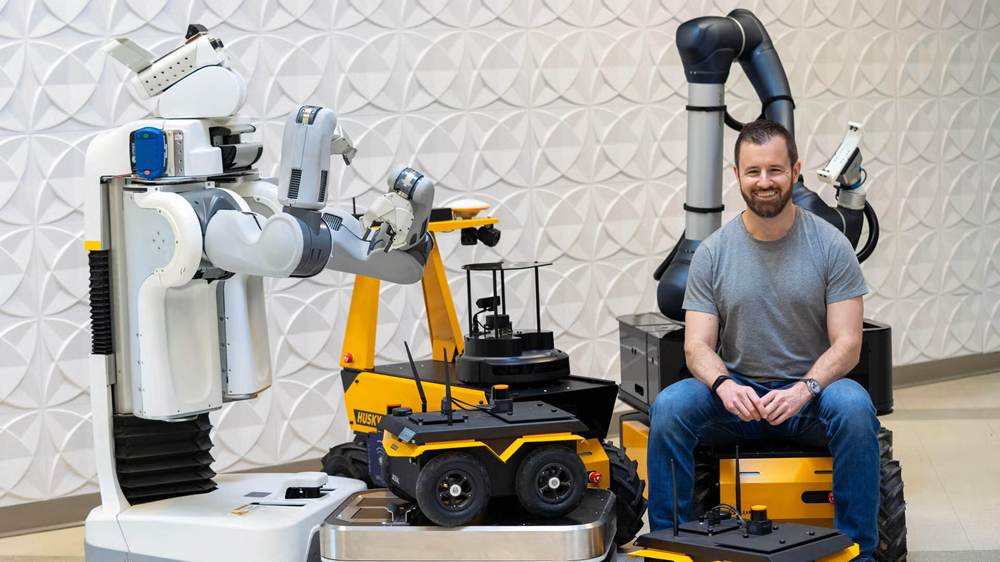
This article was originally published on Waterloo News.
When Ryan Gariepy (BASc ’09, MASc ’12) arrived at the University of Waterloo, Canada’s robotics industry was still finding its footing. There was no clear career path and few examples of Canadian startups successfully taking physical robotics technology from the lab to the global market.
Today, as co-founder of Clearpath Robotics, now part of Rockwell Automation, Gariepy represents a generation of Waterloo alumni who helped turn that early promise into a globally recognized, made in Canada success. In the process, they have become advocates for building, scaling and governing advanced robotics from Canada.
Gariepy and his co-founders launched Clearpath immediately after graduating, with degrees in engineering from Waterloo, choosing a hardware startup path that was far from guaranteed. Their initial idea was simple but ambitious, give researchers better tools to experiment with real robots operating in real environments.
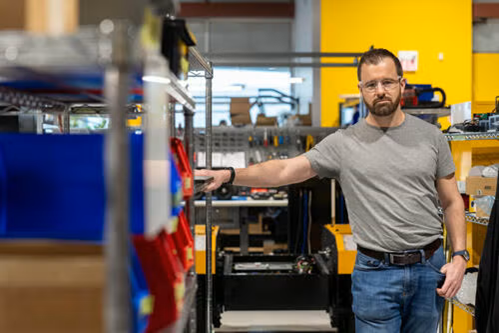
Being rooted near the University of Waterloo proved critical. Proximity to campus allowed Clearpath to draw on interdisciplinary expertise, test ideas quickly and maintain close relationships with researchers and students. Early user feedback directly shaped the company’s first platforms, ensuring the technology reflected real world needs.
“Robotics is inherently interdisciplinary,” Gariepy says. “You need mechanical engineering, software, electrical systems and systems thinking all working together. Waterloo was one of the few places where that mix was already happening.”
Clearpath grew alongside Waterloo’s emerging robotics and entrepreneurial ecosystem, and have supported spaces such as RoboHub and Velocity. These environments act as workspaces and gathering points where students, faculty and founders learn to collaborate across disciplines and translate theory into functioning systems.
When and Where
The Campus Wellness Student Medical Clinic offers healthcare visits with Physicians and Nurse Practitioners to current undergraduate and graduate students. Services include: vaccinations, immunity testing, naturopathic services and more. Counselling Services offers appointments with counsellors in person as well as via phone and video. Students can book appointments for these services by calling Campus Wellness at 519-888-4096.
The privately-run Student Health Pharmacy (located in the lower level of the Student Life Centre) is now offering new COVID booster shots and flu shots. Covid booster shots are available by appointment only – please call ext. 33784 or 519-746-4500. The Student Health Pharmacy’s summer hours are Monday to Friday, 9:30 a.m. to 4:30 p.m. Naloxone kits are still available – pick them up in the pharmacy at no charge.
The Waterloo Eye Institute optometry clinics in Waterloo and downtown Kitchener offer comprehensive eye exams and eyewear, including glasses and contact lenses, with the Waterloo location offering various specialized services including urgent eye care. Discounts apply for University of Waterloo students and employees. The Waterloo Clinic is at a nearby interim location, 419C Phillip St, during construction at the School of Optometry and Vision Science. The Kitchener Clinic remains at the Health Sciences Campus, 10B Victoria St. S. Book online or by phone at 519-888-4062.
Warriors Youth Swim Lessons, registration is now open for LTS Child/Youth Preschool 1 – Swimmer 9. Group and private lessons available. Register today!
Warriors Summer Youth Camps, registration is now open for multi-sport and games, baseball, basketball, eSports, football and hockey camps for boys and girls ages 5 to 18. Register today!
Project 529 Bike Registry Registration Rallies: Tuesday, July 21, 11:30 a.m. to 1:30 p.m. and Wednesday, July 22, 8:30 a.m. to 10:30 a.m. at CPH/Ring Road (weather dependent). Let’s end bike theft. Bring your bike to register it and get a free 529 shield.
The Co-op Workplace Simulation by Velocity, Tuesday, July 21, 4:45 to 7 p.m, 2nd floor IDEAs clinic, PSE.
Assessment Redesign and Generative Artificial Intelligence (GenAI) - (CTE7556), Monday, July 20 and Wednesday, July 22, 1 to 4 p.m., PHY 235.
Virtual Reality in the Classroom: An Introduction for Instructors – In-Person (TII 5020), Tuesday, July 21, 2 to 3 p.m., LIB 329 (Tech Sandbox)
WaterTalk | Hydrobiogeochemistry and health risks of geogenic contaminants in groundwater systems, presented by Yanxin Wang, China University of Geosciences. Tuesday, July 21, 9 a.m., online via MS Teams.
Jazz on a Summer Afternoon, UW Jazz Ensemble, Saturday, July 25, 2 p.m., Great Hall, Conrad Grebel University College
Instrumental Chamber Ensembles Concert, Saturday, July 25, 7:30 p.m., Chapel, Conrad Grebel University College
Beethoven, Mozart & Some Other Guy, Orchestra@UWaterloo concert, Sunday, July 26, 7:30pm, Knox Presbyterian Church, 50 Erb St. Waterloo
Capturing and converting photons at molecular photoelectrode and perovskite nanocrystal interfaces, Monday, July 27, 10 a.m., C2-361 (Reading Room). Host: Vivek Maheshwari
Computer Museum Open House: Re-Creations, Clones and Copies, Tuesday, July 28, 11 a.m. to 4 p.m., DC Fishbowl.
Your Voice Starts Here: The Staff Role in Decision-Making at UW, July 30, 12 to 1 p.m., EIT.
New Faculty Teaching Days Spring 2026, Tuesday, August 11 to Friday, August 14, 8:30 a.m. to 4:30 p.m., MC 2036
Who are our Learners (CTE9910), Tuesday, August 11, 10 to 11:30 a.m., MC 2036
Course Dynamics and Engagement (CTE9906), Tuesday, August 11, 1 to 3 p.m., MC 2036
What Our Community Is Saying About Health and Well-being, Wednesday, August 12, 11 to 11:45 a.m. on Teams.
Course Design Foundations (CTE6642), Wednesday, August 12, 9:30 a.m. to 3:30 p.m., MC 2036
Assessment as Learning (CTE9912), Thursday, August 13, 10 a.m. to 12 p.m., MC 2036
Course Outline Builder (CTE9916), Thursday, August 13, 1 to 2:30 p.m., MC 2036
Working Effectively with TAs (CTE7017), Friday, August 14, 10 to 11:30 a.m., MC 2036
Upcoming service interruptions
Stay up to date on service interruptions, campus construction, and other operational changes on the Plant Operations website.