- University of Waterloo researchers secure more than $8 million in SSHRC funding
- Dr. Brian Ingalls appointed Assistant Vice-President GSPA and Assistant Provost, Graduate Students
- Q and A with the experts: What Ontario’s wildfire smoke means for your health
- Laughter, valour and merriment: Alumni Family Day at Medieval Times
Submit content for the Daily Bulletin through the Daily Bulletin intake form.
For all other requests, please contact communications@uwaterloo.ca.
University of Waterloo researchers secure more than $8 million in SSHRC funding
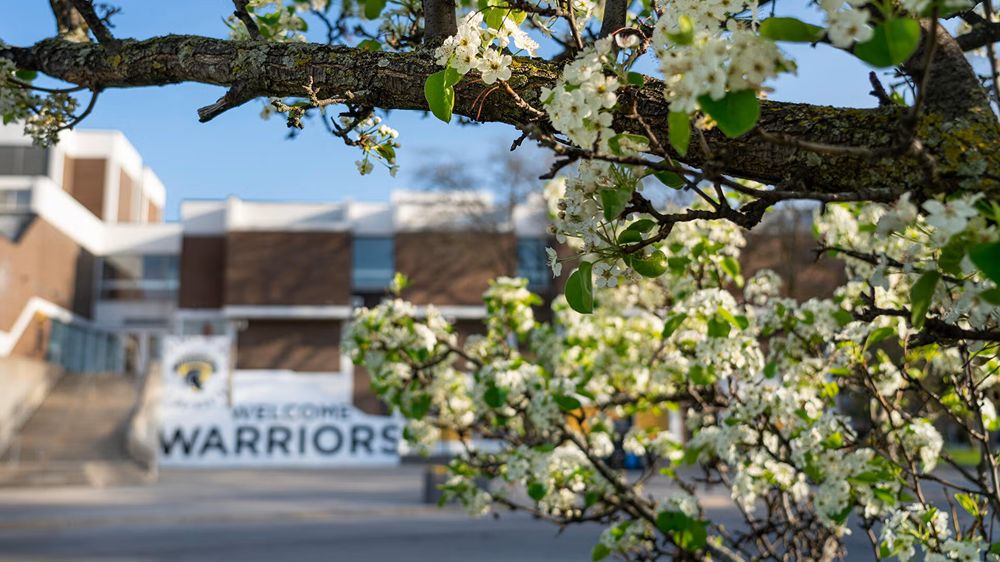
This is an excerpt from an article that was originally published on Waterloo News.
From helping municipalities advance toward net-zero emissions to improving homelessness policy, understanding the societal impacts of artificial intelligence and building more resilient communities, University of Waterloo researchers have secured more than $8 million in new funding through Social Sciences and Humanities Research Council of Canada (SSHRC) competitions.
The funding supports projects across the University's six faculties and reflects Waterloo's strengths in uncovering solutions to address complex local and global challenges.

Among this year's recipients is Dr. Amelia Clarke, a Professor in the School of Environment, Enterprise and Development, who earned a $2.5 million SSHRC Partnership Grant to lead one of Canada's largest municipal climate action research collaborations supporting Canadian municipalities to accelerate climate action and achieve net-zero goals by 2050.
Building on an existing national research partnership, Clarke's project will work with 38 partner and collaborator organizations and approximately 250 municipalities to identify, measure and accelerate effective local climate action.
The six-year initiative will help municipalities improve climate-related measurement, budgeting and financial disclosure, while generating new evidence on what works in reducing emissions and building local capacity. The project will also create extensive training opportunities for students and municipal practitioners, helping communities across Canada advance toward national net-zero goals.
Beyond Clarke's Partnership Grant, Waterloo researchers received funding through SSHRC's Insight Grant, Insight Development Grant and Partnership Development Grant programs, supporting projects focused on climate resilience, health, public policy, innovation and the societal impacts of artificial intelligence.
Read the full story on Waterloo News.
Dr. Brian Ingalls appointed Assistant Vice-President, GSPA and Assistant Provost, Graduate Students

A message from Justin Wan, Associate Vice-President, Graduate Studies and Postdoctoral Affairs.
Graduate Studies and Postdoctoral Affairs (GSPA) is pleased to announce the appointment of Dr. Brian Ingalls as Assistant Vice-President, GSPA and Assistant Provost, Graduate Students, effective September 1, 2026, for a two-year term. This appointment follows the recent organizational review of GSPA, which consolidated the previous two Assistant Vice-President positions into a single role.
Brian is a Professor in the Department of Applied Mathematics and has been a faculty member since 2002. Throughout his career, he has demonstrated a deep commitment to graduate education, student success, and academic leadership. He has served as Associate Chair, Graduate and Undergraduate Studies in Applied Mathematics for seven years and for the past two years, has served as Associate Dean, Graduate Studies and Postdoctoral Affairs in the Faculty of Mathematics.
Brian will support excellence in graduate education, thriving communities for graduate students and postdoctoral scholars, and initiatives that advance the University's strategic priorities. Responsibilities span a broad range of activities, including enhancing the graduate student and postdoctoral experience, strengthening partnerships across the University, facilitating experiential learning and interdisciplinary opportunities, cultivating a strong and inclusive graduate community, and ensuring effective and efficient graduate processes.
Reflecting the expanded scope of the role, Brian will also serve as Assistant Provost, Graduate Students, working closely with Chris Read, Associate Provost, Students, and partners across Chris’ portfolio to enhance the graduate student experience and strengthen coordination of services and supports for graduate students. A key priority during Brian's term will be leading a university-wide review of graduate student onboarding and transition programming, including Grad Ready and the Graduate Academic Integrity Module (Grad AIM), to ensure incoming graduate students are well supported as they begin their academic and research journeys at Waterloo.
Q and A with the experts: What Ontario’s wildfire smoke means for your health

This article was originally published on Waterloo News.
As drifting smoke from wildfires in northern Ontario turns skies in southern Ontario and beyond an eerie, orange colour in the middle of a heatwave, an air quality expert at the University of Waterloo is renewing warnings for residents to take some simple steps to help protect themselves from potential harm to their health.
Dr. Rebecca Saari, a professor of civil and environmental engineering and Tier 2 Canada Research Chair in Global Change, Atmosphere and Health, studies the immediate and long-term health consequences of climate change, climate policies and major contributors to poor air quality such as wildfires.
What are the immediate health risks to people in Canada and the U.S. experiencing poor air quality due to the current wildfires in northern Ontario?
People may experience various symptoms, including irritation of the nose and throat, coughing and headaches. Numerous studies have shown specific links between smoke from wildfires and respiratory symptoms. People with underlying health issues, especially respiratory and cardiovascular illness, are at higher risk for more serious outcomes, like asthma attacks that may require hospitalization, as are children and older adults.
Why are built-up areas quite far from the actual fires seeing such obvious effects and evidence of smoke in the air?
Wind patterns can carry smoke directly from the fires to populated regions. Fires emit smoke particles and other harmful pollutants that can form haze or smog. Particles in the air settle to the ground depending on their size, with large particles settling quickly and small, submicron particles remaining suspended in the air for several weeks unless they are removed by other processes, such as rain. This means fires can affect air quality both locally and across continents. These hot, sunny, dry days are conducive to fires, haze and smog.
What long-term health risks are associated with prolonged or repeated exposure to poor air quality caused by wildfires?
Evidence suggests the long-term risks are serious, with Health Canada estimating that 17,000 Canadians die prematurely each year due to exposure to air pollution, along with more than 35 million person-days of acute respiratory symptoms annually. The current estimated economic burden of air pollution in Canada is more than $140 billion per year. Wildfires are the largest contributor to particulate matter, the pollutant that causes the greatest harm to public health. One recent study estimated that wildfire smoke causes annual health damages ranging from about $500 million to more than $6 billion in Canada.
What steps can people take to protect themselves during the summer fire season?
It is important to pay attention to air quality alerts and follow the guidance provided by the Air Quality Health Index. This typically means reducing exposure by limiting time outdoors during severe pollution episodes, especially for vigorous physical activity. When indoors, keep doors and windows closed and use filtration, such as a central HVAC system with an air filter or an indoor air purifier. If you cannot otherwise avoid exposure, consider wearing a well-fitting N95 mask that provides protection from smoke particles.
Laughter, valour and merriment: Alumni Family Day at Medieval Times


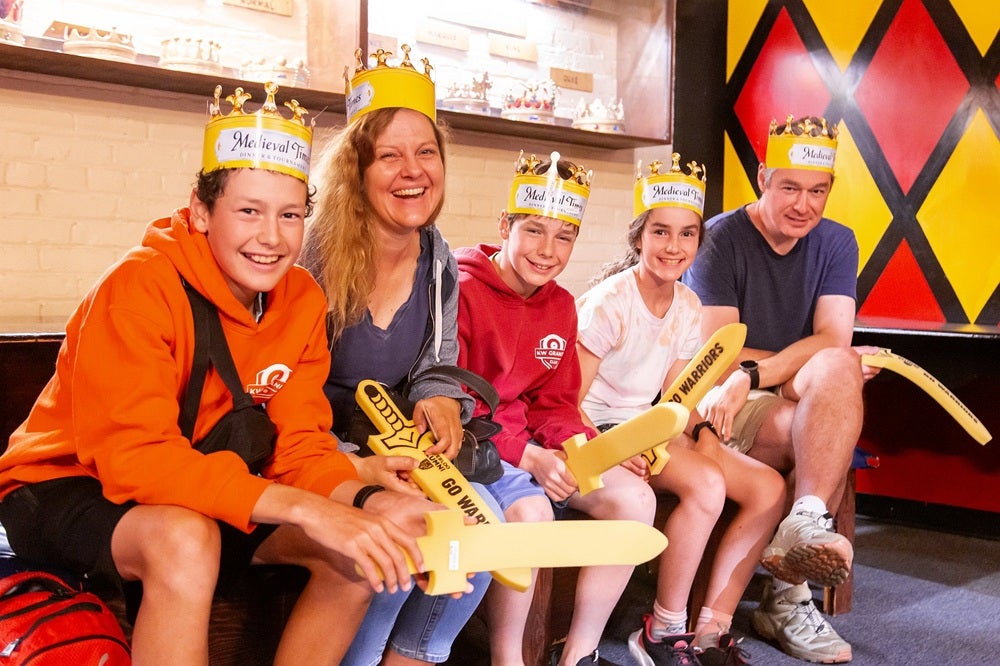

A message from Alumni Relations.
This past weekend, the halls of the Toronto Castle rang with laughter and cheers as Waterloo alumni gathered with their families for a grand Alumni Family Day at Medieval Times. Alumni journeyed from near and far to meet fellow Warriors and join the merriment.
It was a day truly worthy of a king's celebration! 💛🖤
When and Where
The Campus Wellness Student Medical Clinic offers healthcare visits with Physicians and Nurse Practitioners to current undergraduate and graduate students. Services include: vaccinations, immunity testing, naturopathic services and more. Counselling Services offers appointments with counsellors in person as well as via phone and video. Students can book appointments for these services by calling Campus Wellness at 519-888-4096.
The privately-run Student Health Pharmacy (located in the lower level of the Student Life Centre) is now offering new COVID booster shots and flu shots. Covid booster shots are available by appointment only – please call ext. 33784 or 519-746-4500. The Student Health Pharmacy’s summer hours are Monday to Friday, 9:30 a.m. to 4:30 p.m. Naloxone kits are still available – pick them up in the pharmacy at no charge.
The Waterloo Eye Institute optometry clinics in Waterloo and downtown Kitchener offer comprehensive eye exams and eyewear, including glasses and contact lenses, with the Waterloo location offering various specialized services including urgent eye care. Discounts apply for University of Waterloo students and employees. The Waterloo Clinic is at a nearby interim location, 419C Phillip St, during construction at the School of Optometry and Vision Science. The Kitchener Clinic remains at the Health Sciences Campus, 10B Victoria St. S. Book online or by phone at 519-888-4062.
Warriors Youth Swim Lessons, registration is now open for LTS Child/Youth Preschool 1 – Swimmer 9. Group and private lessons available. Register today!
Warriors Summer Youth Camps, registration is now open for multi-sport and games, baseball, basketball, eSports, football and hockey camps for boys and girls ages 5 to 18. Register today!
Jazz on a Summer Afternoon, UW Jazz Ensemble, Saturday, July 25, 2 p.m., Great Hall, Conrad Grebel University College
Instrumental Chamber Ensembles Concert, Saturday, July 25, 7:30 p.m., Chapel, Conrad Grebel University College
Beethoven, Mozart & Some Other Guy, Orchestra@UWaterloo concert, Sunday, July 26, 7:30pm, Knox Presbyterian Church, 50 Erb St. Waterloo
Capturing and converting photons at molecular photoelectrode and perovskite nanocrystal interfaces, Monday, July 27, 10 a.m., C2-361 (Reading Room). Host: Vivek Maheshwari
Computer Museum Open House: Re-Creations, Clones and Copies, Tuesday, July 28, 11 a.m. to 4 p.m., DC Fishbowl.
Your Voice Starts Here: The Staff Role in Decision-Making at UW, July 30, 12 to 1 p.m., EIT.
New Faculty Teaching Days Spring 2026, Tuesday, August 11 to Friday, August 14, 8:30 a.m. to 4:30 p.m., MC 2036
Who are our Learners (CTE9910), Tuesday, August 11, 10 to 11:30 a.m., MC 2036
Course Dynamics and Engagement (CTE9906), Tuesday, August 11, 1 to 3 p.m., MC 2036
What Our Community Is Saying About Health and Well-being, Wednesday, August 12, 11 to 11:45 a.m. on Teams.
Course Design Foundations (CTE6642), Wednesday, August 12, 9:30 a.m. to 3:30 p.m., MC 2036
Assessment as Learning (CTE9912), Thursday, August 13, 10 a.m. to 12 p.m., MC 2036
Course Outline Builder (CTE9916), Thursday, August 13, 1 to 2:30 p.m., MC 2036
Working Effectively with TAs (CTE7017), Friday, August 14, 10 to 11:30 a.m., MC 2036
Upcoming service interruptions
Stay up to date on service interruptions, campus construction, and other operational changes on the Plant Operations website.