Submit content for the Daily Bulletin through the Daily Bulletin intake form.
For all other requests, please contact communications@uwaterloo.ca.
A career dedicated to innovation: Scott Inwood
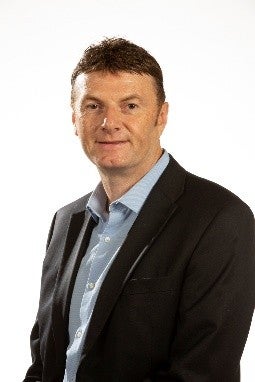
A message from the Office of the Vice-President, Research and International.
Scott Inwood's career has been driven by a natural curiosity for scientific discovery and a passion for transforming innovative ideas into real-world impact. Before joining the University, he built a diverse professional foundation through technical and business development roles in the chemical and water treatment sectors, developed and delivered training programs connecting the Ontario government and college network, and co-founded a clean technology start-up company. These experiences gave him a firsthand appreciation for the journey from idea to impact and set the stage for the work that would define his career.
It was that combination of scientific curiosity and hard-won commercial instinct that made Scott a natural fit for technology transfer. Scott joined the University of Waterloo in 1997 and assumed the role of Director, Commercialization of the Waterloo Commercialization Office (WatCo) in 2007. Over his nearly 3 decade career, he has managed all facets of the University’s investment in research-derived intellectual property assets, negotiated hundreds of commercial deals, supported the launch of start-up companies, and built a network of private sector relationships all channeled to translate world-class Waterloo research discoveries towards economic and societal impact both in Canada and around the world.
Scott has earned international recognition as a thought leader in technology management. His expertise has been sought across North America, Europe, Asia, and Oceania, including the Conference Board of Canada, the Association of University Technology Managers (AUTM), the OECD, and the US State Department - Hollings Centre. He has also served as an expert witness before the Canadian Parliamentary Standing Committee on Industry, Science and Technology and has supported the next generation of innovation leaders through teaching and mentorship in collaboration with the Intellectual Property Institute of Canada (IPIC).
While Scott is retiring from his role at the University, his passion for supporting innovators will continue. In retirement, he plans to pursue consulting and voluntary roles to continue sharing his experience with aspiring innovators and knowledge transfer organizations.
Please join us in celebrating Scott and thanking him for nearly three decades of exceptional leadership, service, and lasting contributions to the University of Waterloo's innovation ecosystem. We wish him all the best in his new journey.
Waterloo computer scientists receive more than $1.3 million in federal funding
This article was originally published on the Cheriton School of Computer Science's website.
Twenty-one researchers at the Cheriton School of Computer Science have secured a combined $1,331,500 in funding through the Natural Sciences and Engineering Research Council of Canada.
This year, NSERC is investing $630 million to foster discovery research, training and talent development in Canada. The funding will empower researchers to tackle pressing problems and strengthen Canada’s position as a global innovation hub.
More than 100 researchers at the University of Waterloo are part of this funding announcement.
“Canada’s greatest competitive advantage is our people,” says the Honourable Mélanie Joly, Minister of Industry and Minister responsible for Canada Economic Development for Quebec Regions. “By investing in our world-class researchers and innovators right here at home, we are helping turn Canadian discoveries into new technologies, growing companies, and good jobs. At a time of rapid global change we are backing Canadian talent, strengthening our economy, and ensuring Canada remains a global leader in innovation, competitiveness, and resilience.”
At the centre of this investment is NSERC’s Discovery Grants (DG) program, one of Canada’s most competitive and prestigious research funding programs. Unlike project-specific funding, Discovery Grants give researchers the flexibility to follow promising discoveries wherever they lead, creating space for breakthrough ideas that may not fit within traditional research boundaries.
Researchers in the early stages of their academic careers can also receive additional support through the Discovery Launch Supplements (DLS) program, helping them build research teams, attract students and establish momentum in their fields. The Research Tools and Instruments (RTI) grants program ensures researchers have access to the advanced tools, equipment and lab infrastructure needed to strengthen research capacity, accelerate discovery and transform ideas into solutions.
Researchers at the Cheriton School of Computer Science are advancing a wide range of projects spanning medicine, sustainable computing, software systems, data science and artificial intelligence, including efforts to improve the accountability and trustworthiness of AI systems.
Q & A with the Experts: Drowning prevention

Each year, approximately 50 people drown in the Great Lakes due to waves and currents. National Drowning Prevention Week and World Drowning Prevention Day raise awareness about safety risks in and around water, and share actions that people can take to stay safe (Getty Images/Benedek).
This article was originally published on Waterloo News.
Dr. Chris Houser, Dean of the Faculty of Science at the University of Waterloo, studies Canada’s coastlines and contributes to efforts to reduce the incidence of drowning and emergency rescues. He shares safety tips as part of National Drowning Prevention Week.
What are the leading causes of drowning in the Great Lakes?
Important contributing factors in the Great Lakes include breaking waves and dangerous currents, sudden drop-offs, cold water, fatigue, limited swimming ability, alcohol use, inadequate supervision and failure to wear a lifejacket while boating or paddling. Piers, breakwalls, river mouths and other structures can create especially dangerous currents.
What are the dangerous conditions in the Great Lakes?
The waves are closely spaced and can repeatedly strike a swimmer, providing little time to recover and exhausting even a capable swimmer. Rip currents form when waves push water toward the shore and that accumulated water flows back toward deeper water through a narrow channel.
How do rip currents cause drowning?
A rip current carries the swimmer away from shore. The danger begins when a person panics and tries to swim directly against the current. Even strong swimmers can become exhausted. The current can also move someone suddenly into deeper water. People sometimes choose the calm-looking gap between breaking waves because it appears safer, but it may be where water is flowing most strongly away from shore.
What do you do if you are caught in a rip current?
The simple message is flip, float and follow. Flip or lean back and float. Follow the current temporarily rather than fighting it. Most rip currents weaken beyond the breaking waves or as they spread out. Swim across the current, generally parallel to the shoreline, when you can do so. If you cannot escape, continue floating or treading water and wave an arm or call for help.
What else can people do to prevent drowning?
Check the beach and marine forecast before leaving home and again on site. Swim at a lifeguarded beach and within the designated swimming area. Stay out of the water when waves are high or a red flag is flying. Avoid swimming beside piers, breakwalls and river outlets. Never swim alone. Keep children within arm’s reach and designate an undistracted adult watcher. Wear a properly fitted lifejacket while boating, paddling or fishing, and whenever swimming ability or conditions are uncertain. Avoid alcohol and cannabis before or during aquatic activities. Learn CPR and basic rescue techniques that do not require entering the water.
When and Where
The Campus Wellness Student Medical Clinic offers healthcare visits with Physicians and Nurse Practitioners to current undergraduate and graduate students. Services include: vaccinations, immunity testing, naturopathic services and more. Counselling Services offers appointments with counsellors in person as well as via phone and video. Students can book appointments for these services by calling Campus Wellness at 519-888-4096.
The privately-run Student Health Pharmacy (located in the lower level of the Student Life Centre) is now offering new COVID booster shots and flu shots. Covid booster shots are available by appointment only – please call ext. 33784 or 519-746-4500. The Student Health Pharmacy’s summer hours are Monday to Friday, 9:30 a.m. to 4:30 p.m. Naloxone kits are still available – pick them up in the pharmacy at no charge.
The Waterloo Eye Institute optometry clinics in Waterloo and downtown Kitchener offer comprehensive eye exams and eyewear, including glasses and contact lenses, with the Waterloo location offering various specialized services including urgent eye care. Discounts apply for University of Waterloo students and employees. The Waterloo Clinic is at a nearby interim location, 419C Phillip St, during construction at the School of Optometry and Vision Science. The Kitchener Clinic remains at the Health Sciences Campus, 10B Victoria St. S. Book online or by phone at 519-888-4062.
Warriors Youth Swim Lessons, registration is now open for LTS Child/Youth Preschool 1 – Swimmer 9. Group and private lessons available. Register today!
Warriors Summer Youth Camps, registration is now open for multi-sport and games, baseball, basketball, eSports, football and hockey camps for boys and girls ages 5 to 18. Register today!
Jazz on a Summer Afternoon, UW Jazz Ensemble, Saturday, July 25, 2 p.m., Great Hall, Conrad Grebel University College
Instrumental Chamber Ensembles Concert, Saturday, July 25, 7:30 p.m., Chapel, Conrad Grebel University College
Beethoven, Mozart & Some Other Guy, Orchestra@UWaterloo concert, Sunday, July 26, 7:30 p.m., Knox Presbyterian Church, 50 Erb St. Waterloo
NEW - Project 529 Bike Registry Registration Rallies: Monday, July 27 and Tuesday, July 28, 8 to 10:30 a.m., QNC/MC bike racks (by the overpass - weather dependent). Let's end bike theft. Bring your bike to register it and get a free 529 shield.
Capturing and converting photons at molecular photoelectrode and perovskite nanocrystal interfaces, Monday, July 27, 10 a.m., C2-361 (Reading Room). Host: Vivek Maheshwari
Computer Museum Open House: Re-Creations, Clones and Copies, Tuesday, July 28, 11 a.m. to 4 p.m., DC Fishbowl.
Your Voice Starts Here: The Staff Role in Decision-Making at UW, July 30, noon to 1 p.m., EIT.
New Faculty Teaching Days Spring 2026, Tuesday, August 11 to Friday, August 14, 8:30 a.m. to 4:30 p.m., MC 2036
Who are our Learners (CTE9910), Tuesday, August 11, 10 to 11:30 a.m., MC 2036
Course Dynamics and Engagement (CTE9906), Tuesday, August 11, 1 to 3 p.m., MC 2036
What Our Community Is Saying About Health and Well-being, Wednesday, August 12, 11 to 11:45 a.m. on Teams.
Course Design Foundations (CTE6642), Wednesday, August 12, 9:30 a.m. to 3:30 p.m., MC 2036
Assessment as Learning (CTE9912), Thursday, August 13, 10 a.m. to noon., MC 2036
Course Outline Builder (CTE9916), Thursday, August 13, 1 to 2:30 p.m., MC 2036
Working Effectively with TAs (CTE7017), Friday, August 14, 10 to 11:30 a.m., MC 2036
Upcoming service interruptions
Stay up to date on service interruptions, campus construction, and other operational changes on the Plant Operations website.