News

Filter by:

Limit to news where the title matches:
Limit to items where the date of the news item:
Date range
Limit to news items tagged with one or more of:
Limit to news items where the audience is one or more of:
Limit to news items where the faculty or school is one or more of:

Manasa Kaniselvan (BASc ’19) is embarking on a journey as an incoming Assistant Professor at the Massachusetts Institute of Technology (MIT) with a shared appointment through the Schwarzman College of Computing in the departments of Materials Science and Engineering (DMSE) and Electrical Engineering and Computer Science (EECS).

At MIT, Kaniselvan will establish a research group focused on computational materials simulation and semiconductor device modelling. Her work uses machine learning to bridge length and time scales between materials behaviour and device performance.

Kaniselvan began her academic career in the Nanotechnology Engineering (NE) Program at the University of Waterloo and remained at Waterloo for a master’s in electrical and computer engineering. She is currently a PhD at ETH Zurich, in the Computational Nanoelectronics Group.

Nanotechnology technology engineering professor Dr. Nasser Mohieddin Abukhdeir is collaborating with government and academic partners to improve agricultural production in Ontario’s greenhouse industry.

In controlled greenhouse environments, growers can manage temperature, humidity, CO₂, and nutrients far more precisely than in open fields, extending productivity well beyond the outdoor season, but greenhouses also intensify the stakes.

Dense plant populations and precisely controlled conditions mean that when disease or pests take hold, they can spread quickly. Current monitoring relies on human scouts who walk the rows every couple of days, but sometimes less frequently, which leaves gaps in response times that can turn into significant losses.

“We are combining computer vision with metabolic models, so each plant gets checked far more frequently than a human scout walking the rows every couple of days,” says Abukhdeir.

Nanotechnology Engineering professor, Juewen Liu has been awarded an $872,000 grant from the Canadian Institutes of Health Research (CIHR) to develop a more effective treatment for dry eye disease (DED).

Dry eye disease (DED) affects over a billion people each year and an estimated 30 percent of Canadians. The chronic condition occurs when people’s eyes do not produce enough tears to keep their eyes properly lubricated, leading to discomfort, irritation and potential vision problems.

Current treatments rely on eye drops that must be used multiple times a day at high doses. Much of the medication is quickly washed away, reducing its effectiveness and irritating healthy eye tissue. Liu’s research group aims to develop a longer lasting drug delivery system that could improve how DED is treated.

Nanotechnology engineering students Edward Hong and Micahel Ali were part of an interdisciplinary research group that has created a new tissue‑like hydrogel that can act as "muscles" for soft robotics.

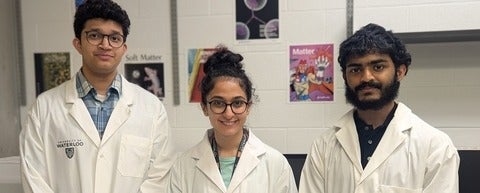
The project was led by PhD candidate Negin Bouzari. Her supervisor, Hamed Shahsavan, a chemical engineering professor hired four undergraduate co-op students to assist Bouzari in her research. The team included Melanie Bouzanne, Nrushanth Suthaharan, Ali and Hong. Their collaboration embodies Waterloo’s mission to involve undergraduates directly in high‑impact, interdisciplinary research.

Shahsavan calls the work a powerful example of what students can accomplish when they’re trusted with ambitious challenges.

“Complex problems rarely fit inside one discipline. Interdisciplinary research brings complementary tools and viewpoints together, leading to creative, high-impact solutions,” says Hong. “Beyond innovation, working across disciplines improves communication skills and adaptability; abilities that are invaluable in both industry and academia.”

A nanotechnology engineering team won first place at the Ontario Engineering Competition (OEC) in Ottawa for their Capstone Project called IISense. The team designed a prototype to monitor chronic kidney disease (CKD).

The competition was fierce at the OEC which was held in Ottawa this year. Teammates Flora Wu, San Basnet, and Divhleen Ruprai entered the innovative design category at the event.

“The best part of OEC was that for the innovative design competition, we had to do a public opening. We displayed our poster and prototype, and people approached us and asked questions about our project. It was really cool to hear people’s perspectives on our product.” says Ruprai.  “They provided feedback on things that we had not considered, which could improve our project to make it easier to use and accessible to different groups of people that we weren't aware of before.”

CKD is a silent disease that can have no obvious symptoms until a late stage and lead to the need for dialysis or, in some cases a kidney transplant. It can be more prevalent in people who have pre-existing health issues like diabetes or hypertension.