AI, art and impact: MFA student pushes creative boundaries
James Malzahn explores AI, surveillance and human perception through immersive art to challenge audiences to question truth, authorship and the impact of emerging technologies
For James Malzahn, art is not just something to observe — it’s something to experience, question and even feel unsettled by. As an MFA student at the University of Waterloo, his work explores the evolving relationship between humans and technology, using artificial intelligence (AI), surveillance systems and immersive environments to challenge how we understand truth,authorship and control.
“My goal is to create an experience that informs and prompts questions in the viewer,” Malzahn says. “Experiencing information is quite different than simply reading information… My primary goal is not to provide answers or solutions; it is to promote thought and knowledge, inviting people into this complex conversation.”
A lifelong connection to technology
Malzahn’s journey is rooted in a deep, lifelong affinity for technology. As a teenager, he operated a bulletin board system - an early form of online communication — before building a career in computer systems, network design and data forensics. Even when he shifted to fine arts, that connection remained central.
“I came to terms with the fact that technology was part of who I am,” he says.
That realization gained urgency following the 2013 revelations from Edward Snowden about global surveillance practices. “I felt that this was personal and something that people should be made aware of,” Malzahn says. “I decided to reclaim our technology and create art that was impactful and memorable.”
Exploring AI, misinformation and perception
Today, Malzahn’s research focuses on AI as both a creative nonhuman collaborator and interlocutor.
“AI has the potential to impact humanity — positively and negatively — in unimaginable ways,” he says. “An enemy to being ‘properly informed’ is propaganda and misinformation… [AI] can create information that can fool your senses and blur the line between fact and fiction.”
His work brings these concerns into physical space through immersive installations that make invisible systems, like surveillance and data collection, visible and immediate.
“I make it the focal point,” he explains. “I do this by situating the viewer within the system while making the technology's function and capabilities visible. The goal is to awaken the viewers’ senses to the techno-environment we live in.”
His thesis — The Victory Box — is designed to move audiences through moments of recognition and doubt, challenging viewers to reconsider what they see and trust.
“As you reach the end of the experience, you should start questioning,” he says. “My hope is some people will be going back [through the installation] to see where their senses have deceived them.”
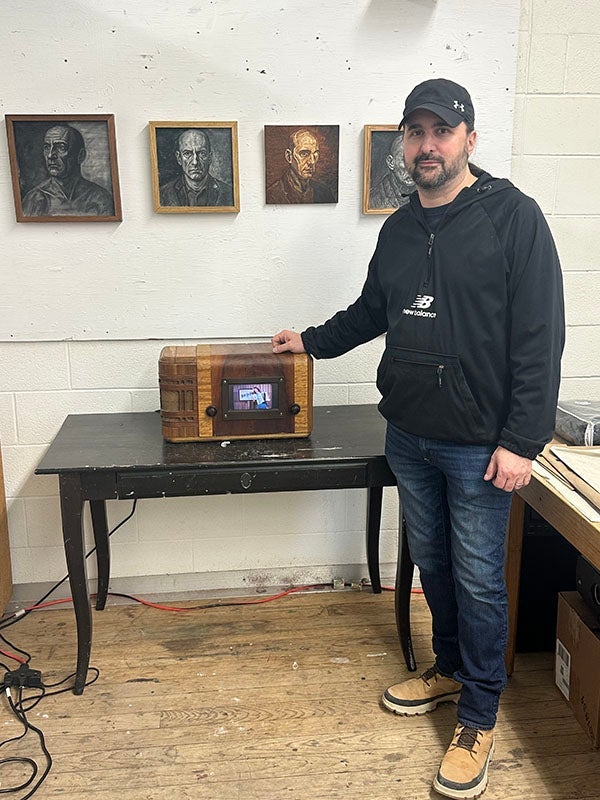
James Malzahn stands with The Victory Box, the centre piece of the art installation for his MFA thesis, which explores AI, perception and the boundaries between truth and illusion.
A graduate experience built on opportunity and support
At Waterloo, Malzahn found an environment that supports both the technical and conceptual dimensions of his work. Drawn by the University’s strengths in artificial intelligence, as well as its smaller cohort and funding model, he says the program and his supervisors,ProfessorsMatthew Carver and Xuan Ye,have enabled him to fully focus on his practice.
“My experience here has been fantastic, and I am very thankful I chose to come here,” he says. “Both the funding and the people – educators, peers, artists – have created a supportive environment in which my practice has evolved.”
That support has translated into meaningful opportunities beyond campus. Through Fine Arts’ Shantz Research Scholarship, Malzahn spent six weeks working with internationally recognized artist David Rokeby, gaining hands-on experience in technology-based art. “That was an incredibly beneficial experience,” he says.
During that time, he also contributed to a live performance at an AI symposium through the BMO lab at the University of Toronto, creating AI-generated visuals as part of a collaborative production. “I was hired to create an AI-generated video for a portion of the live play,” he says. “That was a fantastic experience.”
These experiences reflect the program’s emphasis on interdisciplinary collaboration and real-world application, encouraging students to experiment across fields and engage with broader artistic and research communities.
Along with teaching opportunities, Malzahn also values the culture of dialogue at Waterloo, where engaging with faculty, peers and researchers across disciplines has strengthened his work.
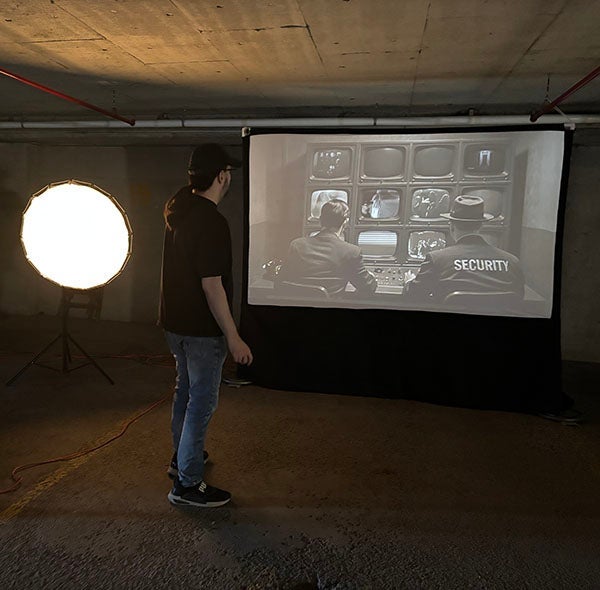
James Malzahn’s installation Harmony Through Obedience, presented by the Student Art Innovation Lab (S.A.I.L.) at the University of Waterloo, on display at Lumen Festival in the underground parking lot of Waterloo City Hall.
Looking ahead: shaping conversations through art
As artificial intelligence continues to evolve, Malzahn sees his work as part of an ongoing and necessary conversation.
“It’s a critically important area of study because it is evolving so quickly and offers many layers to explore and examine,” he says.
Looking ahead, he plans to continue exploring human-machine collaboration and the evolving boundaries of creativity and authorship. At its core, his work remains focused on helping people better understand the technologies shaping their lives.
“I encourage all artists to use their skills and voices to positively impact the societies we live in,” he says. “Everyone brings a unique perspective and lived experience that can be shared with others.”
Feature image credit: James Malzahn. A carefully staged AI Generated Protype of 1950s-style living room immerses viewers in a familiar yet unsettling environment that draws them into the experience of The Victory Box installation.
Watch for Malzahn’s thesis exhibition coming soon to the University of Waterloo Art Gallery.