Commemorating the victims of the Montreal Massacre
The Waterloo community comes together to remember, reflect and respond to gender-based violence
December 6 marks Canada’s National Day of Remembrance and Action on Violence Against Women. The day commemorates the 14 women, mostly engineering students, who were killed at École Polytechnique de Montréal (now Polytechnique Montréal) in 1989 by a lone gunman — because they were women.
The day is part of the 16 Days of Activism Against Gender-Based Violence – an organizing strategy used to call for the prevention and elimination of violence against women and girls. For the University of Waterloo’s Faculty of Engineering, December 6 is an opportunity to gather and remember, to reflect and to respond to the scourge of gender-based violence and society’s collective responsibility to eradicate it.
Dr. Mary Wells, dean of Waterloo Engineering, says the Montreal Massacre continues to resonate deeply within engineering education and the profession.
“Something really broke in all of us that day — our collective innocence, our belief that progress was certain and equality inevitable,” Wells says. “But as survivor Nathalie Provost reminds us, strength can rise from adversity. Remembering the women we lost compels us to be strong, to bear witness and build a country where everyone can pursue their dreams without fear.”
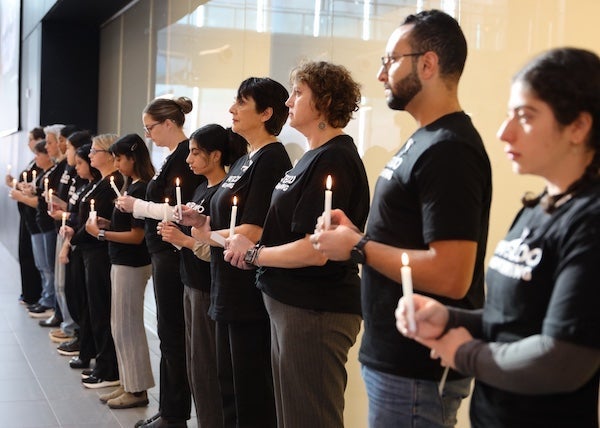
Remember
Dr. Maud Gorbet, director of Waterloo’s Biomedical Engineering undergraduate program, was an engineering student in France when she heard about the massacre.
“I remember wondering what had happened, but no one really talked about it,” she says. “It wasn’t until I came to Canada that I fully understood its meaning — that these women were targeted because they were women studying engineering.”
Gorbet revisits the details of that day — the last day of classes in 1989 — when 14 young women were killed in less than 20 minutes.
“They were murdered because of their gender,” she says. “It took decades for that truth to be fully acknowledged. Remembering them means naming them and how they were killed. Remembering them means remembering that gender-based violence continues to take many forms today and will not stop without society taking active resistance.”
Reflect
For Victoria Swanson, a biomedical engineering student, reflection begins with gratitude — and with honesty about how much work still needs to be done.
“I’m proud to be both a gender minority and an engineering student,” Swanson says. “At Waterloo, I’ve always felt supported, but in my co-op experiences I realized that’s not always true everywhere. There were times I didn’t feel seen or valued because of my gender.”
She describes moments of exclusion and harassment during a co-op term that she hesitated to report.
“No matter how strong company policies may seem, they don’t mean much if people don’t feel safe speaking up,” she says. “That’s why it’s so important to build workplaces where women — and all underrepresented groups — can be heard and respected.”
Swanson says programs like Women in Engineering helped her find belonging and confidence in her studies.
"Reflection means looking critically at our environments and asking if everyone feels safe,” she adds. “That’s how we make progress.”
Respond
Dr. Marc Aucoin, a professor in the Department of Chemical Engineering, completed his PhD at École Polytechnique de Montréal.
For Aucoin, responding is about taking active responsibility— it’s about the everyday choices and decisions that make the world around us more equitable, just and inclusive.
“Leadership isn’t defined by authority,” he says. “It’s defined by who feels welcome, heard and safe because of what we do with our positions and our influence.”
He points to the importance of protecting equity, diversity and inclusion initiatives, especially as they face increasing criticism.
“Equity is not a danger. Diversity is not a deficit. Inclusion doesn’t weaken engineering — it strengthens it,” he says. “Responding means using our voices and our courage to ensure what happened in 1989 is never forgotten and never repeated.”
Polytechnique Montréal’ established the Order of the White Rose program in 2014 to pay tribute to the 14 women killed on December 6, 1989. Each year it awards scholarships to Canadian female engineering students entering a master’s or doctoral degree. This year, the program awarded 14 scholarships of $50,000 each. Among the 2025 recipients are Waterloo alum Megan Chang (BASc ‘’25) and Waterloo PhD candidate Angéline Lafleur.
Feature image photo credit: Samuel Chen.