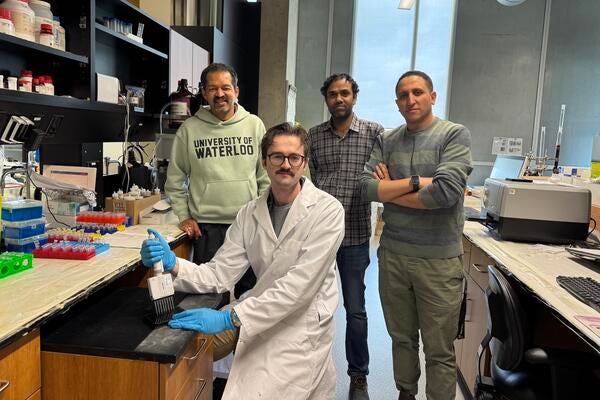
An innovative method that uses modified versions of a bacterial virus effective at delivering treatments to human cells shows promise as a more inexpensive and efficient way to treat some deadly genetic diseases.
Researchers from the School of Pharmacy at the University of Waterloo use a modified version of a bacterial virus called M13 to target specific human cells while carrying only the genes they want delivered, with no unwanted virus or bacteria. Scientists can fine-tune the modified M13 to deliver different therapeutic genes for the treatment of many different diseases.
About one person in 25 has an inherited disease. Despite the need, many conditions lack accessible treatments and do not have a cure. The Waterloo researchers expect the method can be used for many different types of genetic disorders, some of which are inherited, but others that may develop, such as cancer.
“There is a real need for customizable gene therapies to address the gap in treatments,” said Dr. Roderick Slavcev, a professor in Waterloo’s School of Pharmacy and the principal investigator of the study. "What’s exciting about M13 is that it is very simple genetically and structurally, a single-stranded DNA phage. This simplicity allows for a cost-effective, efficient, and controllable approach to gene therapy that may represent a step towards personalized gene therapy.”
Scientists already use gene therapy to successfully treat certain diseases of the eye and immune system. They used modified versions of viruses that are good at delivering treatments to human cells to either replace, turn off, or fix damaged genes to produce functional proteins and restore the cells back to good health.
Although effective, these methods are costly to produce and can trigger toxic side effects, including unintentional immune reactions, limiting them to a single use per patient. And non-viral gene therapy, while generally safer and cheaper to produce, tends to be less efficient at delivering genetic material to target cells.
“At scale, this platform can lead to treatments that could cost as low as one-millionth the cost of current viral gene therapies,” Slavcev said. “Genetic medicine is poised to be the most powerful curative approach for our global future, and we hope this technology is a move in that direction.”
Slavcev is a part of Team iNeuron, currently working on applying the new system as a potential treatment to replace damaged or dead neurons, as in the case of stroke or Alzheimer’s disease.
The study appears in Molecular Therapy Nucleic Acids.
This work is supported by the Government of Canada’s New Frontiers in Research Fund.