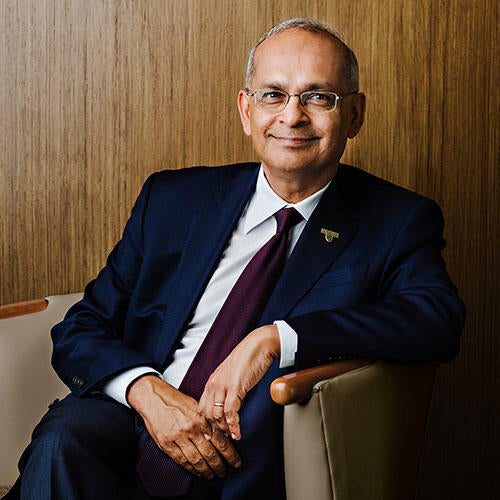
Dr. Vivek Goel
President and vice-chancellor, University of Waterloo
At the University of Waterloo, we ask bold questions and embrace risks. Our unconventional spirit fosters innovation and seeks solutions to the world’s most pressing challenges.
By imagining new Global Futures, we are aligning our academic and research strengths with five interconnected futures for humanity. Our faculty, staff, students and alumni are developing solutions that cut across society, health, the environment, technology and the economy. These futures guide our work and inspire collaboration across disciplines and industries, enabling us to make meaningful, sustainable impact.
Waterloo has bold ambitions for the impact we will make in the world based on excellence in foundational research and basic science. Whether it’s building the world’s first open-source quantum computer, leading climate and AI research and policies for Canada or nurturing the next generation of health and STEM leaders, Waterloo is challenging the status quo.
I invite you to read these inspiring stories of the Waterloo researchers, entrepreneurs and changemakers who are defying convention and leading innovation to shape our global futures.