As climate change intensifies, managing water systems from extreme floods and droughts to groundwater sustainability has become one of the most urgent environmental challenges facing communities worldwide, with direct consequences for public safety, food systems and economic stability. Meeting these challenges require tools that can predict how water moves through landscapes long before impacts are felt.
That forward-looking approach is the focus of Aquanty Inc., a University of Waterloo spin-off translating decades of Waterloo-based research into advanced hydrologic modelling and real-time forecasting technologies used by governments, researchers and industry locally and globally. Designed to support water and climate resilience, Aquanty’s tools help communities move from reactive response to proactive planning by turning complex data into real-time decision support.
From research roots to real-time resilience with machine-learning
Aquanty grew out of the development of HydroGeoSphere, a fully integrated surface and subsurface water modelling computer program created by Dr. Edward Sudicky (BASc ’77, MSc ’79, PhD ’83), professor emeritus of earth and environmental sciences, in collaboration with Dr. Peter Forsyth, professor emeritus in the Cheriton School of Computer Science and Dr. Rene Therrien (PhD ’92), professor in the Department of Geology and Geological Engineering at the University of Laval. The platform allows scientists to simulate the entire terrestrial water cycle in three-dimension using a physics-based approach, capturing how water moves both above and below ground.
While many traditional hydrologic models focus on either groundwater or surface water, HydroGeoSphere integrates both, an approach that was conceptualized decades ago, but only became practical as computing power advanced.
“The framework for fully integrated modelling existed before it was feasible at a larger scale,” says Brayden McNeill (BASc ’12, MSc ‘16), Technical Sales and Marketing Lead at Aquanty. “It took time for technology to catch up. That research became the foundation of Aquanty and helped push the industry forward.”
 Today, the company has evolved beyond its origins as an environmental consulting firm. With more than 30 per cent of its staff made up of PhD-level researchers, the company continues to innovate — most recently with HydroSphereAI, a highly scalable, machine-learning-driven streamflow forecasting system.
“Our mission since day one has been to deliver best-in-class hydrologic software solutions that address real-world problems. Central to achieving this has been our strong ties with the University of Waterloo and many universities across Canada, allowing us to hire the best and brightest in the field as we’ve grown,” says Dr. Steven Berg (BSc ’05, MSc ’07, PhD ‘11), General Manager at Aquanty
Aquanty was acquired by Rocscience in 2025, a Toronto-based company with global reach specialising in 2D and 3D numerical modelling software for civil, mining and geotechnical engineers. However, Aquanty’s leadership team, many of whom are Waterloo alumni or long-time faculty collaborators, continue to maintain close ties to Waterloo. Aquanty continues to engage Waterloo researchers, employ graduates and co-op students, and collaborate across disciplines, demonstrating how academic research can translate into tools with meaningful global impact.

Aquanty has published research on hydro-climatic modelling of Canadian river basins, including the Grand River watershed (pictured), predicting watershed hydrologic response under a range of climate change scenarios. Photo credit: Aquanty
Seeing water risks before they become emergencies
Building on HydroGeoSphere, Aquanty developed HydroClimateSight, an ecosystem of web services designed to transform models into engines for real-time decision making. Updated daily, the platform processes large volumes of weather and climate data from sources such as Environment and Climate Change Canada, the Meteorological Service of Canada and the European Centre for Medium-Range Weather Forecasts.
“Too often, models are built to answer a single question and then shelved,” McNeill explains. “We’re working to change that by giving clients a framework to turn their models into engines for ongoing, real‑time decision making — treating models not as disposable tools, but as long‑term assets that support informed decisions.”
Rather than relying on a single forecast, the system orchestrates thousands of model simulations each day, capturing uncertainty across multiple weather scenarios. Users can visualize watershed-scale processes, such as groundwater depth, streamflow and water loss within drainage systems, while also accessing highly localized forecasts at individual monitoring stations across Canada.
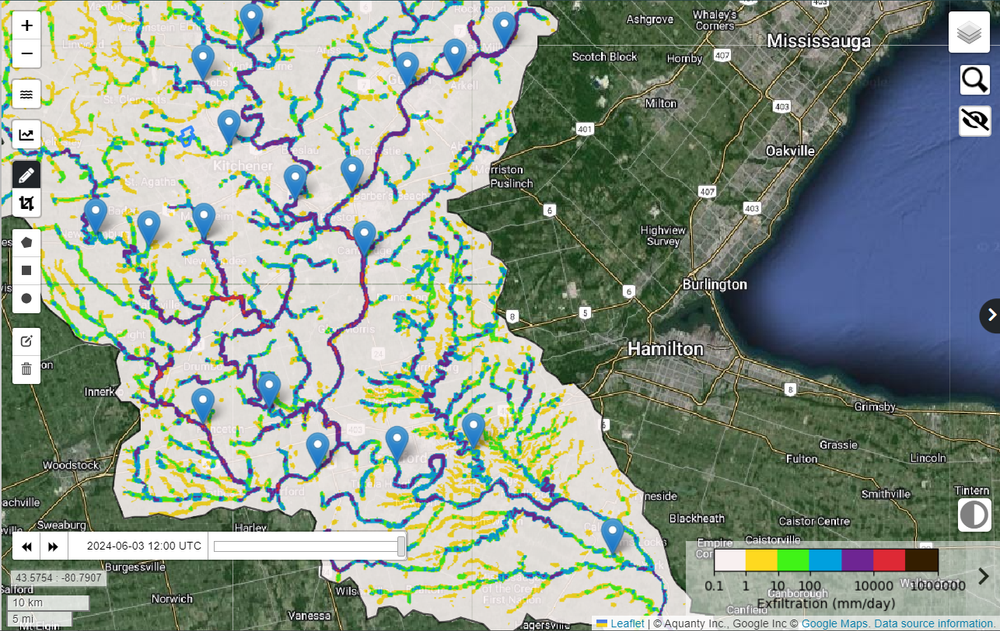
HydroGeoSphere generates hydrologic forecasting of watersheds in the Kitchener-Waterloo-Stratford area, specifically capturing exfiltration data for March 06, 2024. Photo credit: Aquanty
Complementing these physics-based tools is HydroSphereAI, a machine-learning driven streamflow forecasting system that generates real-time predictions through training on thousands of catchments — areas where surface water such as rainfall, snowmelt or springs collects or drains to a single low point, including rivers, lakes or wetlands — along with decades of hydrologic and weather data.
In recognition of its impact, HydroSphereAI received the 2025 Water Canada New Tech Award for its innovation in the Canadian water sector. Together, Aquanty’s tools can help communities anticipate floods, droughts and other water-related risks before they escalate into emergencies.
Building national and global resilience
Aquanty is also a key stakeholder in Canada1Water, a continental-scale modelling and data initiative developed by Natural Resources Canada to better understand how climate change will impact water resources across Canada over the long term. The project is creating an open continental-scale framework to support planning, risk assessment and policy development related to extreme weather, water security and land-use change.
Canada1Water is a collaboration between Natural Resources Canada, Agriculture and Agri-Food Canada and Aquanty, with initial funding provided through the Canadian Safety and Security Program, led by Defence Research and Development Canada (DRDC)’s Centre for Security Science.
As climate pressures grow and water challenges become more complex, Aquanty’s mission remains grounded in its academic roots, turning rigorous research into tools that help communities plan, adapt and thrive.