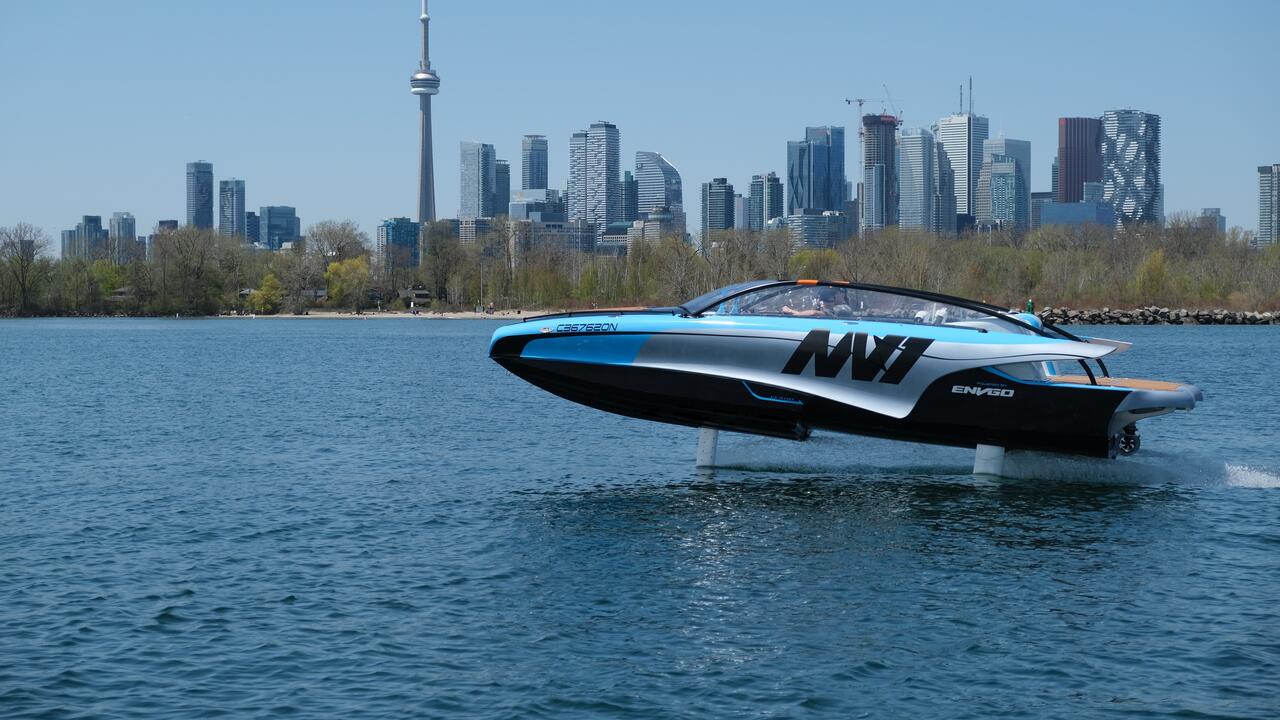
As Canada looks to strengthen coastal surveillance while reducing emissions, a University of Waterloo-founded company is expanding into defence with a new class of high-performance, zero-emission boats.
ENVGO, founded by Waterloo alum Dr. Mike Peasgood (BASc ’98, MASc ’04, PhD ’08), designs and builds electric vessels that use hydrofoiling technology to glide above the water's surface. The company recently announced a move into defence and public safety, positioning its vessels to support intelligence, surveillance and reconnaissance (ISR) and security operations along Canada's vast coastlines.
With more than 240,000 kilometres of shoreline — the longest in the world — Canada faces growing demand for persistent, efficient maritime monitoring. ENVGO’s approach combines electric propulsion with autonomy and advanced sensing systems, offering a cleaner and potentially more cost-effective solution for agencies such as the Coast Guard and Navy.
“Our designs for security and defence combine the speed and efficiency of hydrofoiling vessels with advanced autonomy and sensing capabilities to help organizations protect ports, harbours and coastlines,” Peasgood says. “What sets us apart is the ability to rapidly reach an area of interest … that’s where our experience building high-performance hydrofoils gives us a unique advantage.”
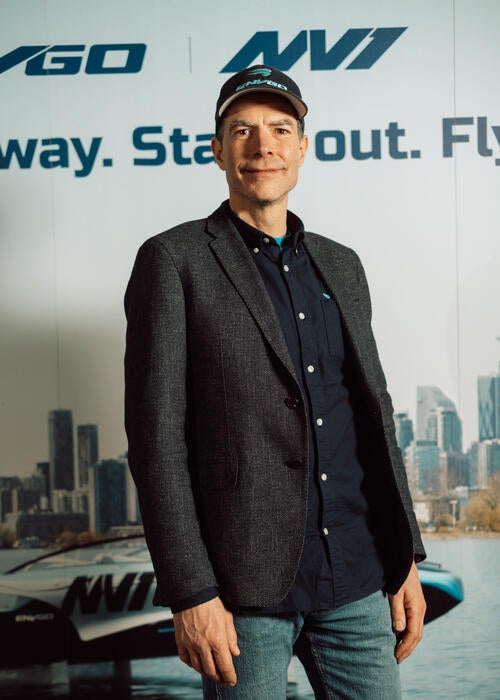
The company's expansion builds on a core idea that began with the recognition of a fundamental gap in the marine sector. “I love my electric car experience because I never have to go to a gas station ... and the performance is amazing, but I didn't find any equivalent in the boating world,” he says. “Almost all new boats are still gas powered.”
Boats require significantly more power than cars due to the drag created by pushing a hull through water, which has slowed electrification across the sector. Rather than adapting conventional designs, ENVGO rethinks the problem entirely.
“I wanted to create a better solution for high-performance electric boats,” Peasgood says. “It led to a whole different approach to boat design — a hydrofoiling boat — which uses a wing below the surface to lift the hull and fly over the waves.”
By raising the hull out of the water, hydrofoiling dramatically reduces drag and energy use, enabling electric boats to achieve the speed, range and performance needed for demanding applications. It also transforms the on board experience. “It creates an amazing feeling of flight over the water that feels more like flying a plane instead of crashing over waves,” he says.
Delivering that smooth “flight” requires sophisticated control systems, an area where Peasgood credits his time at Waterloo. Trained in systems design engineering, he approaches the challenge by integrating multiple disciplines — from mechanical design to software and controls — into a cohesive whole.
“Rather than considering components in isolation, the systems designer is required to make multi-disciplinary trade-offs,” he explains. “That perspective was critical in developing a reliable hyrdrofoiling platform.”
While ENVGO’s move into defence and security applications is relatively new, Peasgood and his team bring extensive experience in autonomous systems.
Before founding ENVGO, he was a co-founder of Aeryon Labs, a Waterloo-based pioneer in unmanned aerial systems, where he helped develop and deliver autonomous technologies used by defence, security and public safety organizations worldwide. He says many of the lessons learned from building mission-critical autonomous systems in the air are now being applied to the marine domain.
In addition to operational advantages, ENVGO’s technology also addresses environmental concerns — an increasingly important factor for both civilian and defence fleets. Conventional gas-powered boats contribute to pollution in lakes, rivers and coastal waters. Hydrofoiling vessels, regardless of power source, use a fraction of the energy of traditional boats, and the electrification eliminates direct emissions entirely.
Those advantages align with Canada’s goal of reducing emissions to 40 per cent below 2005 levels by 2030, while also supporting the growing need for sustainable infrastructure in both civilian and defence contexts.
Peasgood sees Canada as well-positioned to lead in this emerging sector. Building domestically allows ENVGO to tap into a strong engineering talent pool and benefit from early-stage government support, while also reinforcing Canada’s reputation as a stable supplier in global markets.
Looking ahead, he believes marine systems are on the cusp of the same transformation that has reshaped the automotive and aerospace industries — and positioned Canada to lead the next generation of marine technology.