April 15, 2016
Treatment to restore nearby vision a winner for Waterloo PhD student
Three-Minute Thesis competition challenges graduate students to make research relatable
Three-Minute Thesis competition challenges graduate students to make research relatable
Research that offers the promise of a pharmaceutical fix for age-related sight loss earned a Waterloo PhD candidate top honours in the provincial Three-Minute Thesis competition.
Gah-Jone Won, a PhD candidate in Vision Science and Biology, was selected as the winner of the Ontario Provincial Three Minute Thesis (3MT) competition. Won advanced to the provincial final, held April 14 at Wilfrid Laurier University, after being chosen from among 200 graduate students who took part in the 3MT competition at University of Waterloo.
Won’s research focuses on the development of a pharmaceutical treatment for presbyopia, an age-related condition that causes the eyes to lose the ability to focus on nearby objects. The treatment specifically targets and softens the crystalline lens in order to restore nearby vision.
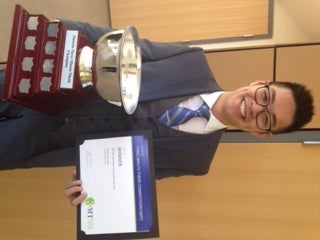
Gah-Jone Won gives his Three Minute Thesis presentation at the University of Waterloo final on March 31, 2016
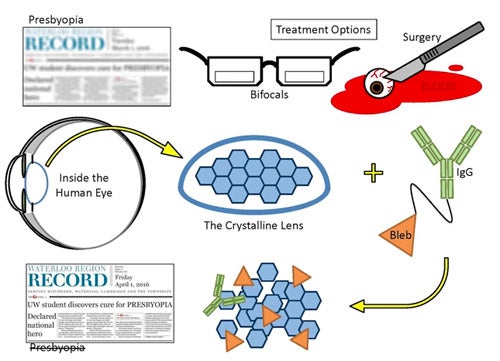
Won's 3MT presentation slide
The 3MT competition challenges graduate students to explain their research to a non-specialist audience in three minutes, using a single static slide and no props. The provincial competition included 20 universities from across Ontario. Won’s presentation is now in the running for the national 3MT prize, sponsored by the Canadian Association for Graduate Studies (CAGS). The national competition will take place online.
Won is supervised by Vivian Choh, an Associate Professor in the School of Optometry and Vision in the Faculty of Science.
Upon completion of his PhD, Won plans to continue his research as a postdoctoral fellow.