Protecting the nest
Two University of Waterloo Science students track vulnerable whooping crane habitat as nesting ponds in the Northwest Territories dry out
With fewer than 500 whooping cranes remaining in Canada, even a single dry summer can threaten the population. As water levels continue to decline, their nests and young are at further rusk, putting this critically vulnerable species in even greater danger.
Fourth-year Faculty of Science students Thenuja Vittanachchi and Emma Bacchiochi travelled to Wood Buffalo National Park in the Northwest Territories, a nesting area for whooping cranes, to conduct fieldwork aimed at understanding how water levels affect the cranes’ ability to reproduce.
The students collaborated with Parks Canada, sharing updates and coordinating the use of data loggers. They also partnered with ecologists at the Calgary Zoo’s Wilder Institute, who work directly with the whooping cranes and will use the findings to inform future conservation efforts.
The students split up the fieldwork to cover different periods of the nesting season. Bacchiochi set off on her first field campaign in May 2025, spending ten days collecting data as the cranes returned north to nest. Vittanachchi followed in September 2025, gathering data near the end of the season before the cranes migrated south for the winter. Together, their efforts captured a full season of habitat conditions.
Vittanachchi is completing her final year in Environmental Sciences with a specialization in Ecology, while Bacchiochi is completing a degree in Biology with a minor in Chemistry. Both students were introduced to this research in Dr. Roland Hall’s biology course on biostatistics and experimental design (BIOL 361).
Inspired by what they learned about his research on cranes in the Northwest Territories in that course, they proactively reached out to Hall a year in advance to ask him to supervise their senior honours theses (BIOL 499), which allowed them to apply for and receive funding through Polar Knowledge Canada’s Northern Scientific Training Program (NSTP). This funding made their fieldwork possible.
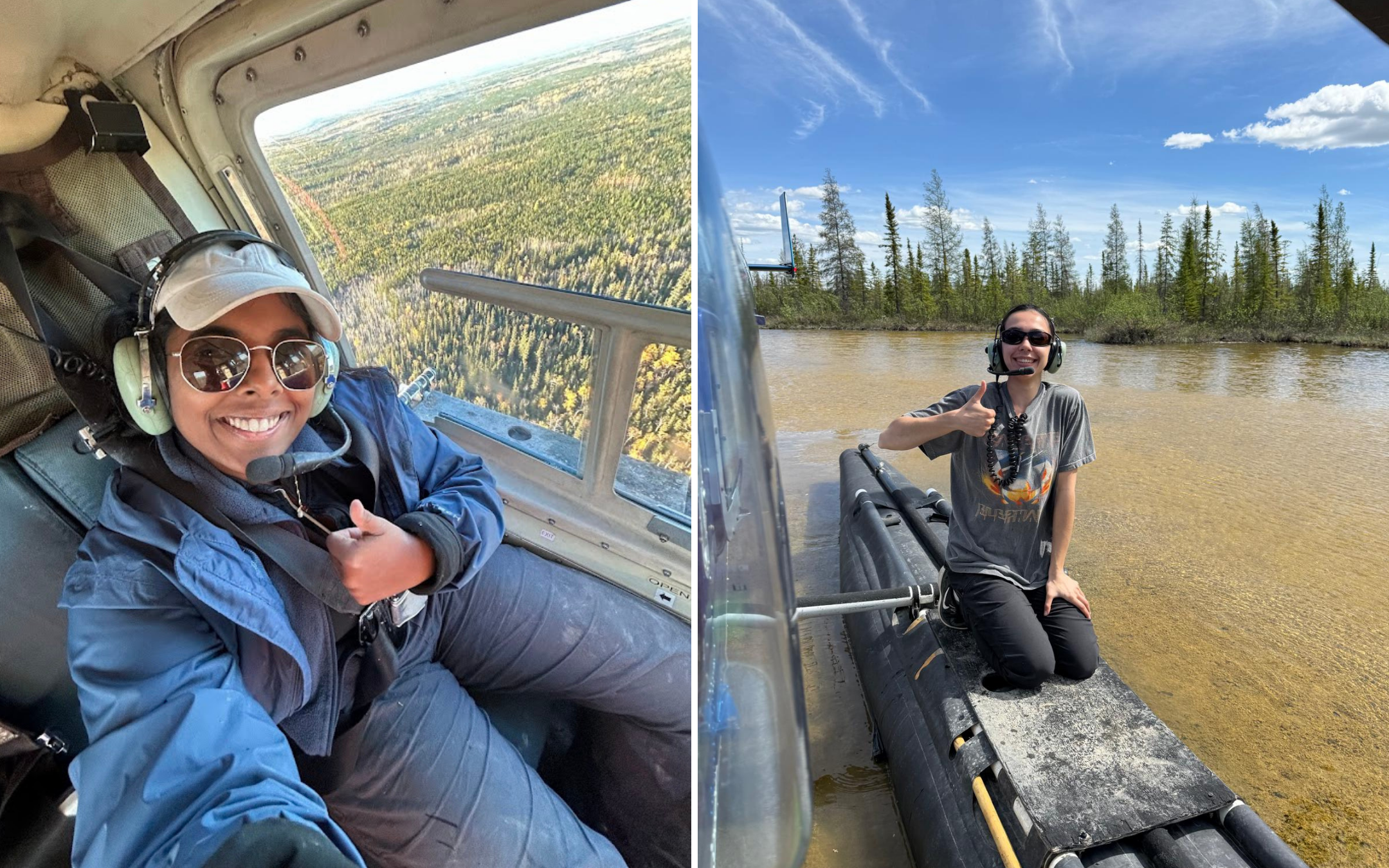
Thenuja Vittanachchi and Emma Bacchiochi conduct fieldwork by helicopter over Wood Buffalo National Park in the Northwest Territories.
Their fieldwork was challenging, but incredibly satisfying. During their field campaigns, Vittanachchi and Bacchiochi collected water-level measurements and sediment cores that captured environmental change over the past 300 to 1,200 years. Many of the ponds were remote and inaccessible, which meant most of their days were spent in a helicopter.
“We would land briefly at each pond, hop out to anchor data loggers and collect water samples, and then quickly move on to the next site,” Bacchiochi says.
Pond samples revealed that by the end of summer 2025, 60 per cent of the 63 ponds the team has sampled since 2022 in the study area were dry.
“Water levels are critical for whooping cranes to nest, as they require very precise water depth,” Bacchiochi says. “When water levels are too high, the babies drown, and when levels are low, predators can easily access the eggs.”
To understand a broader historical context, they also used radiometric dating and paleoenvironmental measurements in the lab to analyze sediment cores that preserve records spanning hundreds of years. By examining sediment layers that indicate past wet and dry conditions, they were able to compare current pond desiccation with long-term environmental trends.
“Our goal is to determine how often the ponds dry out, and if it’s a natural characteristic of the area, or if it’s linked to newer, more pronounced climate warming,” Vittanachchi explains. “Understanding these patterns is essential for predicting future habitat conditions and for informing conservation efforts.”
This hands-on experiential learning opportunity reflects the University of Waterloo’s commitment to solving complex challenges through excellence in applied research and meaningful partnerships with industry and the community. Through fieldwork, long-term environmental data, and collaboration with key conservation partners, Vittanachchi and Bacchiochi are conducting research that could inform conservation efforts to save one of Canada’s most endangered bird species.