Animal use protocol process

An application, or Animal Use Protocol (AUP), must be completed by researchers or instructors who plan to use live non-human vertebrate animals in research or teaching projects. The Animal Care Committee (ACC) reviews and approves all AUPs before the study begins.
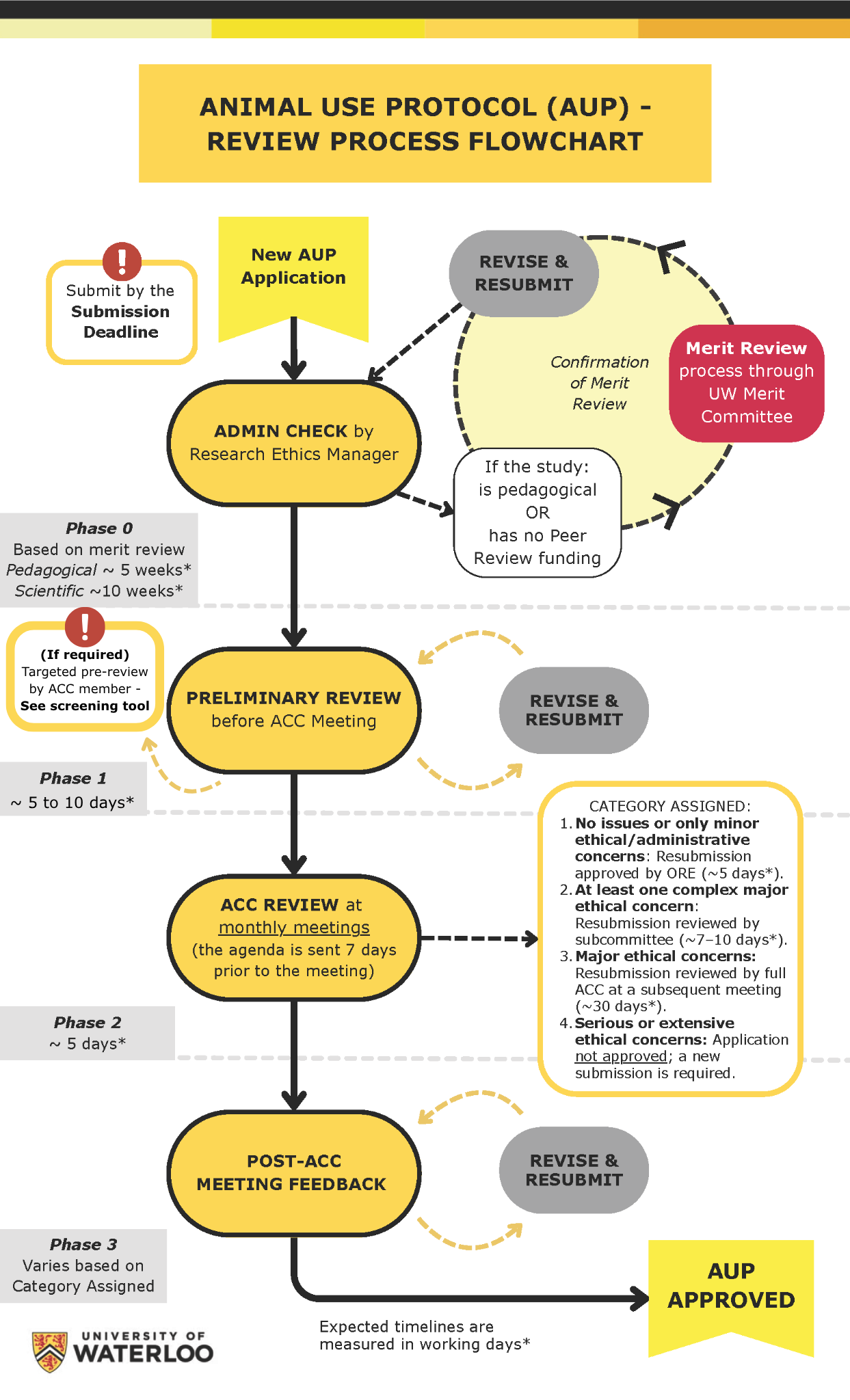
Info graphic of AUP review process including four stages from application development to decision and timing for each stage

Pre-review/preliminary review

This pre-review (i.e., preliminary) screening tool is used by the ACC Manager in the Office of Research Ethics (ORE) to identify which Animal Use Protocols (AUPs)/ethics applications would benefit from a targeted pre-review by specific ACC members (e.g., veterinarian, statistician, ACC chair, facility manager or AHT) before the full ACC membership review at a monthly meeting. 

This screening tool is used at the point of AUP submission (and after merit review has been confirmed) to determine whether a pre-review by one or more specific ACC members is recommended before the full ACC meeting. The feedback from the pre-review of the AUP will be shared with the research team to allow them to revise their AUP before the full ACC member review. The pre-review feedback will be sent through the research ethics system.

By ensuring that any major administrative, statistical, or animal health concerns are addressed in the AUP before the ACC review of the AUP, this allows the ACC to focus on evaluating the ethical use and welfare of the animals. This screening tool is not comprehensive, and additional AUP pre-review may be warranted on a case-by-case basis or when multiple concerns are present.

This screening tool is built on CCAC’s mandate, guideline structure and oversight principles as described in CCAC’s guidelines and policies.

Screening tool for AUPs after merit review confirmation

Invasiveness, procedures and endpoints

If one or more items in this category are identified, a pre-review of the AUP by the consulting veterinarian and a meeting with the consulting veterinarian will be recommended. 

  • The protocol involves an increased risk of pain/distress requiring enhanced monitoring (e.g., use of unalleviated pain or withholding analgesia (PDF)).
  • Nonstandard humane endpoints, or where early endpoints are difficult to define (e.g., procedures requiring special euthanasia criteria consistent with CCAC humane endpoints guidance (PDF) or high-risk morbidity/mortality models needing robust endpoint criteria).
  • Procedures fall into a level E category of invasiveness (PDF) (e.g., major surgery, significant distress, prolonged restraint).
  • Departure from standard CCAC accepted welfare practices (PDF) (e.g., non-standard housing, non-routine restraint).
  • Use of terminal endpoints or procedures (PDF) that are novel to Waterloo (e.g., a researcher is new to Waterloo, or the researcher is investigating a new direction from their regular research program).
  • Novel high-risk morbidity/mortality models need newly developed robust endpoint criteria.
  • Surgical procedures requiring general anesthesia with subsequent recovery.
  • Anesthesia/analgesia protocols that require further dosage clarification for species or are not usually practiced at Waterloo (e.g. inhalants other than Isoflurane) or protocols and/or dosages that seem inconsistent with current standards under the CCAC scientific procedures Part B) (PDF).
  • Procedures with survival endpoints requiring specialized or atypical monitoring due to the invasiveness of the surgery (e.g., lengthy 2-hour surgery, or novel surgery with potential complications).
  • Prolonged or repeated procedures that raise serious animal welfare concerns (e.g. lengthy anesthesia sessions or multiple sessions within a day).
  • Procedures requiring special euthanasia criteria that are not included in the CCAC euthanasia guidelines (PDF) or are considered not acceptable.
     

Species specific complexity and resourcing

Safety issues and/or exposures

If one or more items in this category are identified, a pre-review by the consulting veterinarian + safety office ACC member will be recommended.

  • Use of chemical, biological, or physical agents with the potential to cause animal distress or could be spread via wastewater or bedding.
  • Handling of any chemical, biological or physical agents for human handlers.
  • Special containment (BSL2/3) housing that requires additional provisions for safety.
     

Statistical and experimental design

If one or more items in this category are identified, a pre-review by the statistician ACC member will be recommended.

  • Complex experimental designs requiring evaluation of power, sample size, or randomization strategy.
  • Small sample sizes require strong justification under Reduction principles (Three Rs).
  • Repeated measures or longitudinal designs with potential animal welfare impacts.
     

Personnel, training and resourcing requirements

If one or more items in this category are identified, pre-approval by the facility manager/technician (CAF or WATER) will be recommended.

  • Personnel conducting the procedures require training verification (surgery, blood collection, anesthesia) beyond what is included in the standard Waterloo animal training program.
  • Novel techniques that may require specialized training or hands-on support from the Facility staff.
  • Resourcing support such as: 
    • Large mammals > 5 kg
    • Animals with specialized needs (e.g., cephalopods)
  • Any species requiring specialized housing that is not currently available at Waterloo or difficult to obtain, such as:
    • Special containment (BSL2/3), aquatic systems or large animal housing not routinely used.
    • Non-standard housing, environmental enrichment deviations or specialized environmental conditions.
    • Significant resource requirements that necessitate feasibility review (e.g., long-term studies needing staffing support, specialized equipment).
       

Administrative or other concerns

If one or more items in this category are identified, a pre-review by the ACC chair will be recommended.

  • Items that may require support and direction from the ACC chair.
  • AUP may be more appropriately structured as multiple AUPs (e.g., complexity of the proposed research, length of study).
     

Please keep in mind the ACC meeting dates and submission deadlines when planning your study.

If you have any questions regarding this process, please email oreaupp@uwaterloo.ca for assistance.