
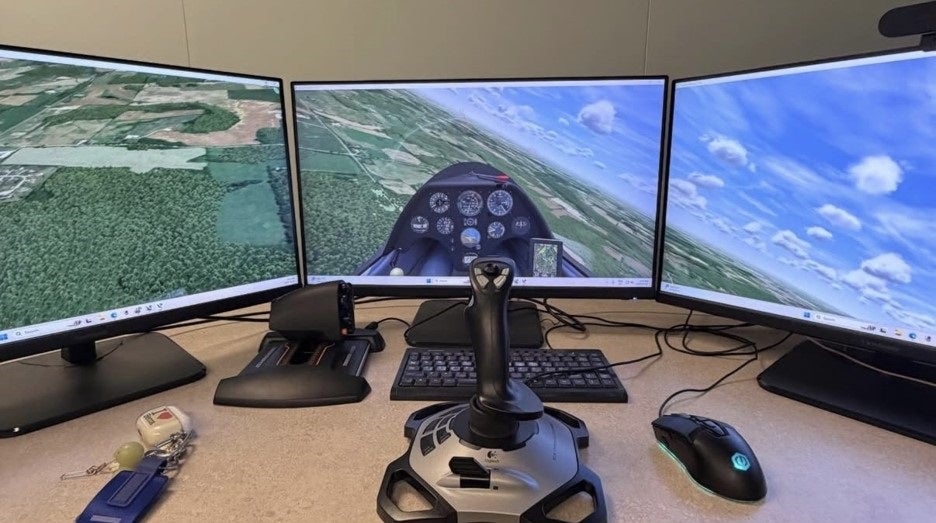
Simulators are used extensively to train pilots for big jets and advanced aircraft. They reduce costs, reduce emissions and increase safety. Can the same benefits be achieved for initial pilot training? If sim training can successfully enable skill development in novice pilots, it will reduce training costs, improve safety, and make training more accessible.
Researchers at the University of Waterloo, the Waterloo Institute for Sustainable Aviation (WISA), in collaboration with SOSA gliding club, Canada’s largest gliding pilot training organization, are exploring this question through an innovative study that uses simulators to prepare new glider pilots before they ever leave the ground.
Gliders are fixed-wing aircrafts that do not have an engine. This makes their maintenance and operating costs less than motorized aircraft. An important feature is that the controls to fly the glider in three dimensions, (ailerons, elevator and rudder) are the same as those in conventional aircraft. This makes the skills learned in gliders transferable to other aircrafts.
Three cohorts of five University of Waterloo students will be trained on simulators before taking to the sky in gliders. The first cohort of five students consists of Brianne, Danica, Eunsu, Gaurav and Li-Hsin. They come from the faculties of Environment, Science, Health and Engineering. Their performance will be compared to trainees at SOSA who will not have simulator training.
Professors Paul Parker, Shi Cao, and Gulnaz Bulbul received a Social Sciences and Humanities Research Council, Engage Partnership grant to support the research. A flight simulator has been set up in the Human Factors Lab in Systems Design Engineering with Soyeon Jang as the lab coordinator. Simulator instructors were recruited from SOSA (Joerg Stieber and Ray Wood) and UW students (Timothy Doak and Christopher Xie) with Air Cadet instructor experience.
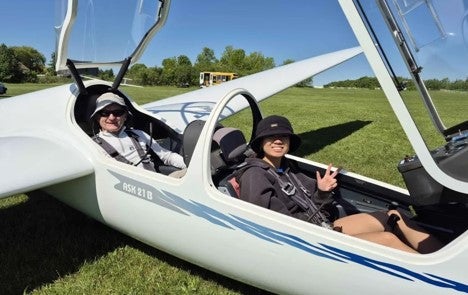
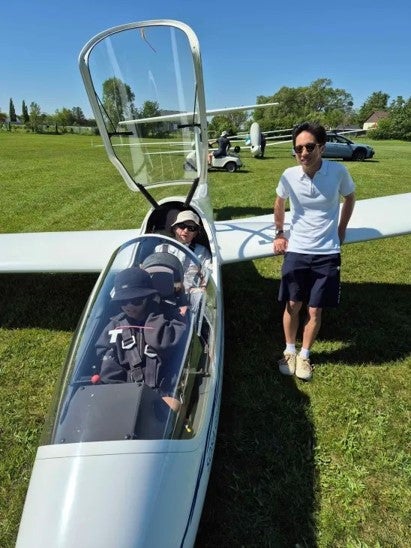
Each student received approximately ten hours of flight training with the simulator before heading to SOSA to fly a real glider. SOSA has three ASK 21 gliders, a popular trainer built in Germany and used for pilot training around the world, as well as two high performance two-seater gliders.
All five students have had their initial flights. Their comments indicate that simulator training is helpful to develop the skills needed to fly the aircraft.
Initial training exercises included learning to make coordinated turns. A student reported that "turns in the simulated environment felt easy. The coordination part of the turns with stick and rudder was useful and helped in the actual flight experience.”
Another exercise is to learn sideslips to increase the rate of descent of the aircraft. “Side slips in the simulator and in the aircraft were relatively similar and the simulator was very accurate which allowed me to be prepared to do it in the aircraft.”
One of the skills that takes many flights to develop in the aircraft is flying the aerotow, where the glider must fly in formation behind the tow plane while being towed to altitude. If simulator training can accelerate this skill development, it can shorten training time. Again, the students report a positive experience. “I found that the aerotow [exercise] was super effective in the skill transfer from the sim to the real glider.”
Another student said “It was great that the physics engine, especially wake turbulence, is implemented in the simulator which was very helpful in my aerotow exercise in-aircraft.”
The simulator can also be used to simulate different weather conditions that require specific responses from the pilot when planning and flying the circuit to land the plane. “In the sim, I was able to experience real weather occurrences, such as a tailwind in the downwind and a headwind on final. This helped me prepare for what I would experience when in the air and was very effective as a visual and hands-on learner.”
Although the simulator was good at providing accurate visual context for control inputs, the amount of physical effort used on the controls was not always the same as in the actual plane. As one student noted, “The real yaw control in the real aircraft ASK 21 requires much more input. My foot would have to press a lot more to get the same rudder output.”
Simulators may not be perfect, but their usefulness as a training tool will continue to be evaluated and developed.
Overall, the project is off to a great start as the students take the lessons that they learned in the simulator and refine them while flying in the air. The team will continue evaluating the effectiveness of simulation in accelerating learning, improving confidence, and enhancing the overall pilot training experience as more cohorts complete the program.