Researchers at the University of Waterloo are accelerating towards fully electrical spintronics.
The ability to manipulate magnetization is highly desirable in real world applications such as data storage and medical imaging. For instance, within the aerospace, defence and automotive industries, Magnetoresistive Random Access Memories (MRAM’s) are widely used for information storage. However, the manipulation of spin state in ferromagnetic materials is often not very energy efficient. In recent years, Spin-Orbit Torque (SOT), has received attention for its ability to manipulate the spin states in a more localized and energy efficient manner. Still, scalability remains a challenge.
In MRAM’s, the perpendicular configuration of spin elements makes them denser and often requires additional magnetic fields to manipulate the spins to the desired state (up or down). Conventional SOT can readily switch spin elements in the in-plane directions, but not up or down. To switch a perpendicular spin element, an external field is required to tilt it to the up or down position. This in turn adds additional overhead and accidental disturbances to neighboring bits.
TQT supported researchers Guo-Xing Miao (Professor, IQC and Electrical and Computer Engineering) and his group have demonstrated a way to bypass the need for additional magnetic fields. The researchers have shown that coupled with a low symmetry system, the fully electric SOT allows bias-field free, deterministic switching of the perpendicular spin elements to the desired state. This is done by breaking all-in plane symmetries, which conventional SOT cannot do without the use of external magnetic fields.
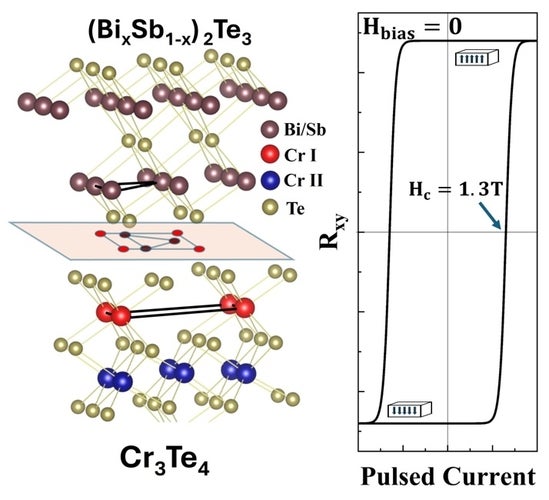
Stacking the three-fold symmetry of BiSbTe on top of the two-fold symmetry of intercalated-CrTe, the interface only permits a unidirectional symmetry which produces an extremely strong out-of-plane spin torque and can deterministically switch a very hard, perpendicular magnet with ease.
The researchers presented particular applications in hard magnets, which are ideal for robust, long term data storage. Due to the low symmetry of the system, assembled with Molecular Beam Epitaxy, and the extremely strong SOT, the researchers demonstrated that hard magnets can be manipulated with ease.
“By engineering the interfacial symmetries, we have achieved a giant, perpendicular spin-orbit torque that can switch even very hard magnets without actual applied field,” said Miao. “This is a breakthrough towards integrated, fully electric spintronic memory and logic devices.”
These findings enable the researchers to control the strength and direction of the SOT, and further pave the way for 2D quantum materials to be switched fully electrically, without the need for additional magnetic fields. While this research not only makes systems more compact and energy efficient, it also facilitates scalability in modern spintronic devices due to being simple in construction and robust against errors.
The researchers working in the Applied Quantum Materials and Devices Lab, run by Miao, have recently released papers on advancing the applications of topological and superconducting materials, quantum and spintronic devices. Going forward, the researchers hope to target SOT switching in altermagnets, a novel type of antiferromagnets, for next-generation ultrafast and dense memory applications.
“Field-Free, Deterministic Giant Spin-Orbit Torque Switching of 1.3 T Perpendicular Magnetization with Symmetry-Lifted Topological Surface States” was published on Advanced Materials by He Ren, Yawen Peng, Meixin Cheng, Yu Shi, Reza Asadi, Adam W. Tsen, Guo-Xing Miao.
DOI: https://doi.org/10.1002/adma.202519678
This project is supported in part by the Canada First Research Excellence Fund (CFREF) through Transformative Quantum Technologies (TQT).