The Department of Civil and Environmental Engineering is pleased to welcome Leigh McDermott, M.E.Sc., P. Eng., as the 2026 Douglas Wright Engineer-in-Residence.

Leigh McDermott has been the City of Waterloo’s Director of City Utilities in the Integrated Planning and Public Works Department since August 2020. Prior to joining the City, Leigh worked for the Region of Waterloo delivering complex capital projects for over 5 years, and for Stantec Consulting as the Water Sector Leader in the local area for over 10 years. Leigh started his career in the water industry with Pall Water (now part of Trojan Technologies) as Director Water Processing, responsible for membrane systems in the Canadian market for over 5 years.
Leigh holds a Bachelor of Engineering Science in Biochemical Engineering from Western University and a Master of Engineering Science in Chemical Engineering from Western University. He is licensed as a Professional Engineer in Ontario (Professional Engineers of Ontario) and Alberta (The Association of Professional Engineers and Geoscientists of Alberta).
Leigh has contributed over his career to water and wastewater industry associations and is a current member of the Water Environment Association of Ontario. He has participated on several associations, including as the previous chair of the Membrane Systems Subcommittee of the American Water Works Association’s Technical and Education Council.
Leigh is a strong advocate of charitable work and is the President and Chair of the Board for the Nice Day Shining Charity based in Waterloo, Ontario. The charity is focused on supporting education in the fine arts and supporting and awareness of mental health.
The Douglas Wright Engineer-in-Residence program
The Douglas Wright Engineer-in-Residence (EIR) program is a new initiative in the Department of Civil and Environmental Engineering, which falls within the mandate of the Turkstra Chair in Urban Engineering, who would lead the selection and oversight of the Douglas Wright Engineer-in-Residence. Accredited undergraduate programs often engage with senior professionals to serve in multiple capacities as a resource for faculty and students. Under the Turkstra Chair’s direction, the Department would invite a practicing engineer who serves in a leadership role in industry to fill this position. Engaging EIRs is one way that the Department of Civil and Environmental Engineering fosters a diversity of perspectives in the education of future and current graduate engineers.
The Douglas Wright Engineer-in-Residence program is very fittingly named after the first Dean of Engineering at the University of Waterloo, Douglas Wright. Students and faculty of the University of Waterloo know that the DWE building is the Douglas Wright Engineering (DWE) building, which was the first engineering building on campus.
The EIR program more broadly is an avenue for mutually beneficial engagement between the academic community and the engineering practice community. The Turkstra Chair’s activities are grounded in educational collaboration with the practice community, where the EIR is selected to foster and develop industry-academic engagements as they promote leadership among engineering students for the betterment of our cities now and into the future.
Marcia Friesen, Nadine Ibrahim, Grant McSorley, Steve Mattucci, 2019. “Engineers-in-Residence Programs as a Framework for Industry Engagement in Undergraduate Engineering Education: Challenges and Opportunities.” Proceedings 2019 Canadian Engineering Education Association (CEEA-ACEG19) Conference, Ottawa, June 8-12. Download (PDF)
"…the EIR programs are introduced as an academic-industry engagement, and take on various organizational frameworks from their inclusion as advisory or outreach to an immersion into the core-teaching mandate at universities. With EIR involvement on- or off-campus, lasting one term or one year or more, their effectiveness stems from their reason for being,…"
Roles and responsibilities
The Douglas Wright Engineer-in-Residence aligns with the vision for urban engineering by offering expertise in a variety of contexts including leadership, mentorship, technical guidance, in addition to teaching support, and other roles that leverage specific skills of the EIR.
The main objective of the EIR program is to empower civil engineers to take on authority and leadership in significant areas of urban engineering, and to motivate students to use emerging technologies and engineering methodologies to tackle the world’s toughest urban challenges. They can also support student hiring to mutual benefits for students and employers. The EIR will be selected and invited for a minimum of one academic term, and will have oversight by the Turkstra Chair in Urban Engineering. In this role, the EIR will engage with students and faculty in various capacities depending on the activities during the academic term of engagement.
Interested in nominating yourself or a senior professional you know? Please email Nadine Ibrahim
Past Engineers-in-Residence
The Turkstra Chair in Urban Engineering and the Department of Civil and Environmental Engineering introduced the Engineer-in-Residence initiative in January 2020. Mike Murray, M. Eng., P, Eng. held the inaugural Douglas Wright Engineer-in-Residence role in 2020.
2020: Mike Murray, M. Eng., P. Eng., CAO, Region of Waterloo

Before joining the Region, Mike worked as a consulting engineer, mainly in northern and western Canada where he was involved in the planning, design and construction of numerous water and wastewater treatment facilities. Mike has also been involved in several international projects including projects in Brazil (groundwater protection), China (environmental sustainability) and Ukraine (regional governance development).
Throughout his career Mike has fostered collaborative working relationships with diverse stakeholder groups. He was a founding member of the Waterloo Region Immigrant Employment Network, Waterloo Region Tourism Marketing Corporation, and the Creative Enterprise Initiative. Mike has also served on the Boards of numerous industry associations and not-for-profit organizations including the Canadian Water and Wastewater Association, Ontario Center for Environmental Technology Advancement, Canada’s Technology Triangle Inc., the Canadian Urban Institute, and The Kitchener and Waterloo Community Foundation.
In 2002, Mike was appointed by the Province of Ontario to serve on the Central Ontario Smart Growth Panel. He has also been honored by the Ontario Waterworks Association for dedication and leadership in the water industry, and by the Grand River Conservation Authority for significant contributions to the Grand River Watershed.
Mike has a Bachelor’s Degree in Chemical Engineering from McMaster University and a Master’s Degree in Civil/Environmental Engineering from the University of Toronto. He has also completed the Queen’s University Program for Public Executives, and leadership programs at the Banff Center for Management and the Niagara Institute.
Engineer-in-Residence contribution - Silos to Synergy
How can Planners and Engineers collaborate to support societal change? How cities develop and function is the endeavour of engineers and planners, among others, however, students and faculty in these two disciplines often have limited opportunity to work and study collaboratively. At the University of Waterloo, we are fortunate to have a Planner-in-Residence and an Engineer-in-Residence who bring industry perspectives to curricular activities in the School of Planning and in Civil and Environmental Engineering, respectively. Both experts believe in the advantages of collaboration and interdisciplinarity for the benefit of our cities and urban prosperity. This session is a first step toward bridging the two disciplines further, highlight examples of the shortfalls of working in disciplinary silos and the benefits of synergy among planners and engineers.
2021: Erin Mahoney, M. Eng., Commissioner of Environmental Services, York Region

Erin Mahoney is Commissioner of Environmental Services for York Region, overseeing water and wastewater services, waste management, forestry, corporate energy and Corporate Asset Management for 1.2 million residents and 28,000 businesses. Erin leads a team of over 400 staff in the Environmental Services department, which was inducted into the Leading Utilities of the World network in 2017.
Erin is a Board member of the Federal Sustainable Development Technology Canada and past Chair of the Regional Public Works Commissioners of Ontario. She also has served on the board of WaterTAP, a Canadian water technology accelerator.
She has over 30 years of public and private sector leadership experience on water and wastewater service delivery, policy, environmental legislation and public engagement.
Erin is currently leading a department-wide transformation to digital in Environmental Services.
As an active member of the public works community she holds memberships with Global Water Leaders (GWI), Canadian Chamber of Commerce, Toronto Region Board of Trade, American Public Works Association and American Water Works Association.
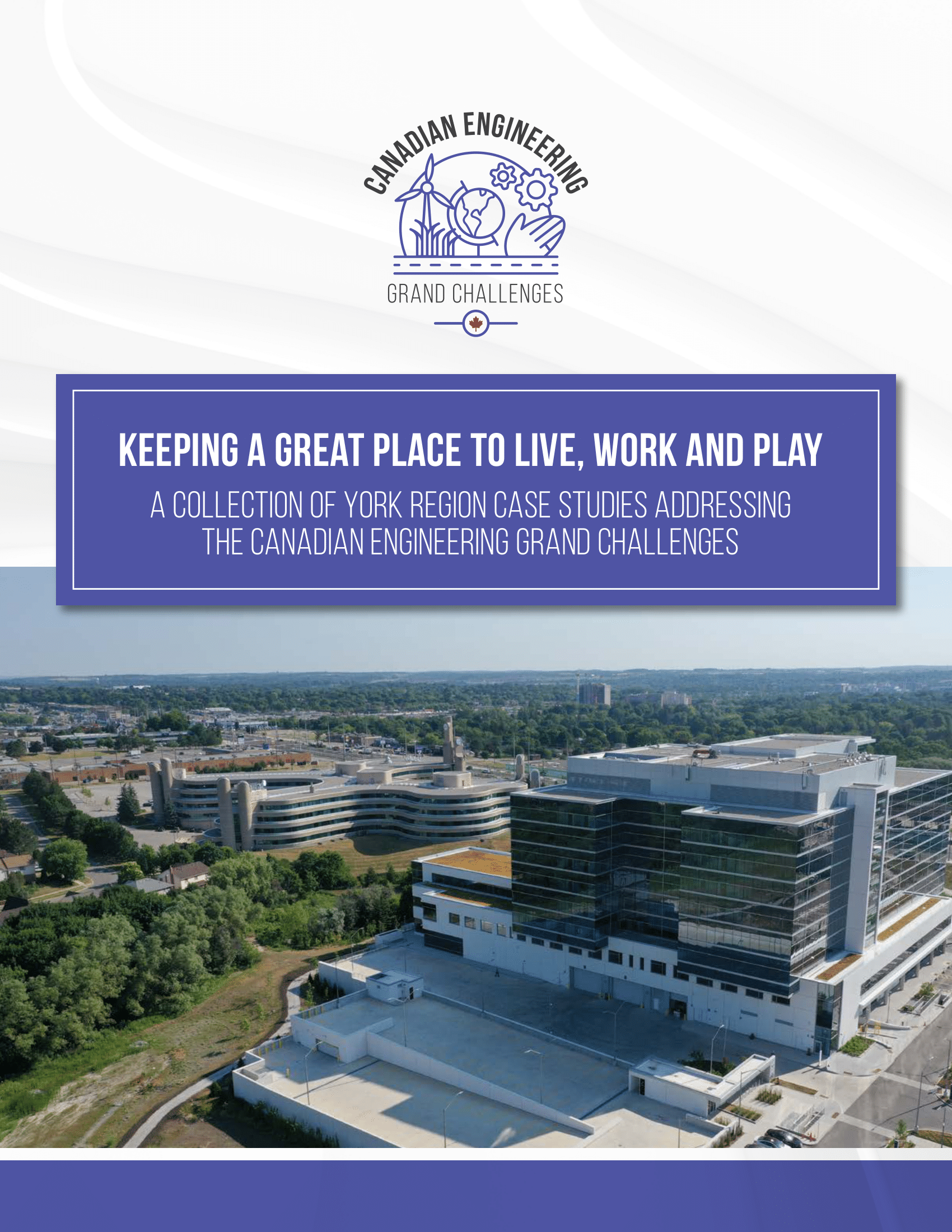
Engineer-in-Residence contribution – Addressing the Canadian Engineering Grand Challenges in York Region
Inspiring action on the Canadian Engineering Grand Challenges (CEGCs) empowers us to collaborate to improve life for Canadians and the world. The CEGCs were central to many of our conversations this year, and certainly, many professionals and academics have used a Grand Challenges approach to focus their respective professions. Recognizing the critical role that engineers play as technological leaders and stewards, the engineering profession has a pressing responsibility to address these challenges with urgency, and respond to the world’s call to action on the United Nations’ Sustainable Development Goals. This publication is an opportunity to bring the CEGCs to light and to showcase a number of projects and initiatives from York Region that are relevant to addressing each of the grand challenges. By raising awareness about these challenges, students will develop attributes and competencies by working in collaboration with people from other disciplines. These attributes include: the ability to design and create, the ability to integrate and solve, the understanding of business and innovation, the practice of being multicultural and diverse and the commitment to social consciousness and community.
2022: Kealy Dedman P. Eng., MPA, Commissioner of Public Works, Peel Region

Kealy Dedman is the Commissioner of Public Works for the Region of Peel. She leads a team of 1300 staff responsible for providing Transportation, Waste Management, Water and Wastewater, Planning and Development, and TransHelp services, to approximately 1.5 million people and over 175,000 businesses within the Region.
Prior to Peel, Kealy was the Deputy Chief Administrative Officer – Infrastructure, Development and Enterprise with the City of Guelph. She has also held engineering leadership positions with the cities of Cambridge and Mississauga, and began her career in the private sector.
With over 25 years of industry experience, she is committed to building sustainable communities through engineering excellence, innovation, and collaboration across sectors.
From a people perspective, Kealy thrives on developing and supporting diverse teams to become passionate municipal leaders of the future.
As a strong advocate for public works and sustainable infrastructure, Kealy is currently Chair of the Regional Public Works Commissioners of Ontario. Previously, she served as president of the Canadian Public Works Association and president of the Ontario Public Works Association. She has also been a member of several federal stakeholder groups to inform infrastructure-related government policy matters, including the Municipal Infrastructure Forum and the Canadian Report Card Advisory Committee.
Kealy earned Bachelor of Science degrees in both Civil Engineering and Biology from Queen’s University and has a Master of Public Administration degree from the University of Western Ontario.
Engineer-in-Residence contribution – Addressing the Canadian Engineering Grand Challenges in Peel Region
Inspiring action on the Canadian Engineering Grand Challenges (CEGCs) empowers us to collaborate to improve life for Canadians and the world. The CEGCs were central to many of our conversations this year, and certainly, many professionals and academics have used a Grand Challenges approach to focus their respective professions. Recognizing the critical role that engineers play as technological leaders and stewards, the engineering profession has a pressing responsibility to address these challenges with urgency, and respond to the world’s call to action on the United Nations’ Sustainable Development Goals. This publication is an opportunity to bring the CEGCs to light and to showcase a number of projects and initiatives from Peel Region that are relevant to addressing each of the grand challenges. By raising awareness about these challenges, students will develop attributes and competencies by working in collaboration with people from other disciplines. These attributes include: the ability to design and create, the ability to integrate and solve, the understanding of business and innovation, the practice of being multicultural and diverse and the commitment to social consciousness and community.
