Text:
Kenneth
McLaughlin
Kenneth
McLaughlin
is
Distinguished
Professor
Emeritus
at
the
University
of
Waterloo
I can still remember the excitement on campus when word came that David Johnston would be Waterloo's next president. Many knew his extraordinary reputation within the Canadian university community. The president-designate was a graduate of Harvard, Cambridge, and Queen's universities, and he taught law at Queen's and Toronto and served as dean of law at the University of Western Ontario before moving to Montreal, where he was principal of McGill for three terms. He was also a public figure in Canadian life, moderating the famous leaders' debate in the classic discussion between John Turner and Brian Mulroney; others knew him as the host of a highly regarded television program featuring leading Canadian and American intellectuals and politicians debating current issues. He had also been president of the Association of Universities and Colleges of Canada and was the first non-U.S. citizen to be elected as Chair of the Board of Overseers of Harvard University. Since stepping down as principal of McGill, he continued as an active scholar, publishing a series of legal texts as well as heading a council to investigate "the information highway."
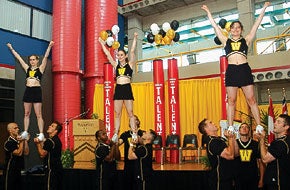
Waterloo cheerleaders strut their stuff at a Campaign Waterloo: Building a talent trust celebrationat the Davis Centre.
Photo: Chris Hughes
Many were surprised when David and Sharon Johnston left behind Montreal's Westmount to move to a 100-year-old farm near Waterloo. The contrast with McGill was striking. So, too, were the challenges facing the president at Waterloo. Three years later, however, at a conference in Toronto to celebrate the publication of Martin Friedland's history of the University of Toronto, someone in the audience asked Friedland when it was that the University of Toronto had begun to surpass McGill as Canada's leading university. Friedland hesitated, and then replied that in many areas, Toronto took University of Waterloo as its measure.
Waterloo's reputation as an innovative and creative university, unconventional and not bound by tradition, had piqued David's interest and his sense of service. At Waterloo, more than other universities, he felt that he could make a difference to the university, to its students, to the Canadian nation, and, in the rapidly changing world of the 21st century, to the international community. And as it turned out, make a difference he did.
On their exploratory visit to Waterloo, the Johnstons stayed in the Jakobstettel Inn in the village of St. Jacobs. Driving past the historic Old Order Martin meetinghouse, amidst the horse-and-buggies on nearby streets, the Johnstons must have wondered about the innovative and creative reputation of Waterloo.
The century-old Jakobstettel Inn, the Ontario Victorian home in which the Johnstons spent the night, had been built in 1898 by E.W.B. Snider, an Ontario miller who in 1902, on learning that an advance in technology made it possible to transmit electricity over long distances, initiated the movement to extend Niagara Falls hydro electric power across Ontario. The universal availability of hydro-electricity is in many ways a prologue for the next technical revolution that transmitted ideas through a wireless, electronic highway. David's then-new book, Getting Canada On-Line: Understanding the Information Highway, set out the challenges for Canada in the age of the Internet and instant communication.
"The spirit of adventure was an integral part of the Johnston years.
There has always been a fascination about the University of Waterloo, and Gerald Hagey, the university's first president, liked to talk about his university and the excitement and sense of adventure associated with Waterloo and its students. This became a benchmark for the Johnston presidency.
"During the early years of the university," Hagey once explained, "our students gained the type of experience that can only be gained at a new university. There were practically no precedents for them to follow; there were no organized student societies and there was little, if any, tradition to be found in any part of the university's operation. I believe that the students who participated in the organization of the student activities on campus felt that they were making a major contribution to the development of the university itself and it gave them a sense of feeling part of the university which they could hardly have achieved as easily on an older university campus."
Not by chance, this spirit of adventure was an integral part of the Johnston years. It carried over to the faculty members, who were conscious of the need to develop excellence at the same time that they were developing new programs. Waterloo's faculty members were encouraged to extend their research work as rapidly as possible. Those who know David recognized this sense of urgency that radiated from the new president as he walked the campus, learning to know each of us by name and encouraging new research and new ideas.
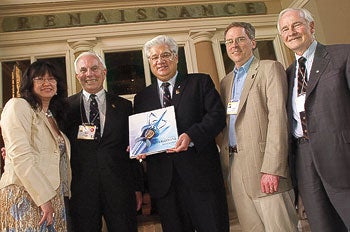
David Johnston embraced the unorthodox, unconventional, entrepreneurial spirit of Waterloo, with its rigorous academic standards and a commitment to both pure and applied research and what he liked to call "experiential learning." Fifty years on he sought to renew its flagship program in co-operative education by taking it to an international level, attracting students from abroad to Waterloo and Waterloo's students to work-study experiences around the world. Half a century earlier, the University of Waterloo's precedent-setting experiment in co-operative education had been described as "education in tune with Canadian times" and a major fundraising campaign raised $3 million. In 2010, David Johnston presided over Campaign Waterloo that raised more than $600 million, as business, government, and private donors rallied behind him and Waterloo's mission. Under David's leadership, Waterloo came to rank among the top three universities in Canada in fundraising. It was a reflection of the uniqueness of the Waterloo experiment and of the passion and generosity that he aroused among donors and governments.
In a precedent-setting move encouraged by David and led by the Region and the City of Waterloo, along with both the federal and provincial governments, funding was provided for the creation of the university's Research and Technology Park. The North Campus lands had lain fallow from the early days of the university and until David's initiative there seemed no way to move forward. The first tenants were two of the university's own spin-off companies, Sybase and Open Text. Shortly after they were joined by a host of internationally renowned companies seeking to be part of the university's outreach. In keeping with its traditional strength, the university also sponsored an "Accelerator Centre" to showcase new technologies and to provide an opportunity for technology transfer from the university to the community.
Although initially reluctant to sever any program from the Waterloo campus, David supported a move by a consortium of business leaders that included Valentine O'Donovan, then the university's chancellor, to move the university's School of Architecture from its inadequate and outdated space to a spectacular riverside setting among historic buildings in the city of Cambridge. The $30-million relocation, supported by municipal, regional, federal, and provincial leaders, was not without controversy, but the new building was stunning, and the students thrived.
The
relocation
of
the
School
of
Architecture
was
the
precedent
for
a
$35-million
donation
of
land
by
the
City
of
Kitchener
and
financial
support
from
the
Region
of
Waterloo,
along
with
federal
and
provincial
governments,
to
establish
a
University
of
Waterloo
School
of
Pharmacy
and
a
health
sciences
campus,
the
latter
in
association
with
McMaster
University's
Michael
G.
DeGroote
School
of
Medicine.
Located
on
the
site
where
Hagey
had
once
worked
as
an
advertising
executive
for
B.F.
Goodrich,
this,
too,
completed
a
historical
cycle
of
urban
renewal.
Toronto
Star
architecture
critic
Christopher
Hume
described
it
as
"an
urban
catalyst,
an
economic
generator,
and
a
civic
icon."
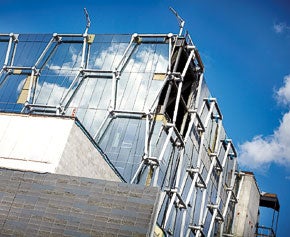
Photo: Bryn Gladding
Closer to the university campus in Waterloo, Research In Motion executive Jim Balsillie launched an entirely different initiative, with a personal donation of $50 million and matching funds from the federal and provincial governments, at the former Seagram Distillery complex. On this site, the Balsillie School of International Affairs is being created to house graduate programs of the University of Waterloo and Wilfrid Laurier University in co-operation with the Centre for International Governance Innovation. A spectacular building and an international studies initiative set the stage for a centre to compete with the very best in the world and to bring a distinctive Canadian view to international issues, one of David Johnston's strong passions.
The decision by Research In Motion's Mike Lazaridis, who served as chancellor of the university, and his wife Ophelia, both of them former Waterloo students, to donate more than $100 million, with matching donations of $50 million each from the federal and provincial governments, established the Mike and Ophelia Lazaridis Quantum-Nano Centre. Their goal was simple: to create a world-class centre of excellence in quantum-nano research and to place Waterloo among the one or two top institutions of its kind in the world. Located between the Student Life Centre and Biology 1, the Lazaridis Quantum-Nano Centre builds on Waterloo's already renowned strengths among its students and its professors in computer engineering, science, and mathematics and is a new focal point for the campus.
With these major initiatives, the University of Waterloo moved from being a university of national rank to one of international standing.
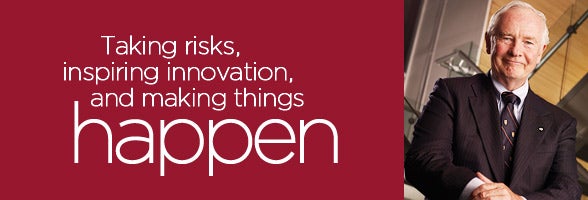
Alumni returning to Waterloo may not recognize their alma mater. Major expansions under the Johnston years to programs, and new buildings in engineering, science, arts, mathematics, applied health sciences, and environment - the latter to be a LEED platinum building - have profoundly changed the look and feel of the Waterloo campus. David is the first to admit these achievements are not his alone. The support and creativity of the university itself makes it possible to dream these dreams and to turn them into reality. At the same time, it is impossible to deny the role of the president in providing a unifying vision and a willingness to take the risk, inspire innovation, and make things happen.
In my role as the university historian, David and I often debated and argued, sometimes passionately, about Waterloo's past and its future. One morning, as we stood together in the robing room preparing for the university's convocation ceremonies, I mentioned that I had recently listened to Senator Edward Kennedy's eulogy at Robert Kennedy's memorial service. Kennedy had paraphrased the Irish dramatist George Bernard Shaw's quotation: "You see things; and you say 'Why?' But I dream things that never were and I say 'Why not?' " In his closing remarks at convocation that afternoon, David asked Waterloo's students to "Dream of things as they might be, and ask, Why Not?" And then, he told them, "follow your dreams!"
To dream of things as they might be and to ask "Why not?" expressed the spirit of the Johnston presidency and more broadly of the entire university. All universities, David liked to explain, ask the question why. It is part of being a university. But to dream beyond that and to ask why not was his challenge to all of us at Waterloo. The changes came quickly and they were many in number, but they were more than dreams. Often they were expressed in glass and steel, bricks and mortar, and they engaged the passion of philanthropists and donors, government leaders and prominent scholars, students and university staff, as each became engaged in and embraced the new ethos that permeated Waterloo.
To dream beyond that and to ask why not was David Johnston's challenge to all of us at Waterloo.
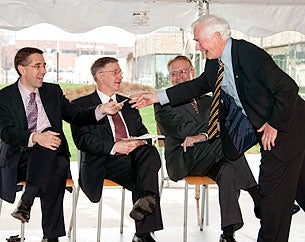
Photo: Chris Hughes
David's thoughts about his 11-year term as president of the University of Waterloo were that he hoped that he had made a difference for Canada and to the university in ways that were in the interest of the nation and the community, reminding us that we "are all citizens of the world who live in a country of the mind," as F.R. Scott had said. He regretted only that there was not time to achieve all that he had hoped to do, but noting the words of Robert Browning, "Ah, but a man's reach should exceed his grasp, or what's a heaven for"?