News

Filter by:

Limit to news where the title matches:
Limit to items where the date of the news item:
Date range
Limit to news items where the audience is one or more of:

Professor Pascal Poupart has been awarded $170,000 through the NSERC Alliance Grant program.

This funding is complemented by $85,000 from industry partner Manulife Financial, bringing the total project support to $255,000. Manulife is also providing significant in-kind contributions, including synthetic data, technical infrastructure for simulated business environments, and access to its technical experts.

In spring 2026, Professor Dan Brown appeared before the Senate of Canada’s Standing Committee on Transport and Communications to discuss intellectual property and safety concerns raised by the rise of generative AI. He highlighted concerns about the use of copyrighted works to train generative AI systems and the potential impact of these technologies on creative professionals, particularly writers and creators from minoritized communities.

In this Q&A, Professor Brown discusses the opportunities and limitations of generative AI and explores the ethical, legal and societal questions these technologies raise about creativity, copyright, and the future of creative work.

Professors Victor Zhong and Jimmy Lin have been awarded $1,641,776 through the NSERC Alliance Grant program. This funding is complemented by more than $1.8 million in combined cash and in-kind contributions from industry partner BASF Canada, bringing the total project value to roughly $3.5 million.

Titled “Deep Research Agents for Natural Science R&D,” the three-year project will co-develop and deploy an end-to-end intelligent research assistant capable of retrieving, reasoning over, and acting on diverse experimental data sources. Developed in partnership with BASF Canada, the project aims to transform chemical informatics from static information retrieval into dynamic, action-oriented knowledge systems that accelerate scientific discovery.

Professor Yaoliang Yu has received the 2026 Faculty of Mathematics Golden Jubilee Research Excellence Award. Established in 2017 to commemorate the 50thanniversary of the Faculty of Mathematics, the $2,500 award recognizes early- and mid-career faculty members for outstanding research contributions. Professor Yu won the award in the mid-career category.

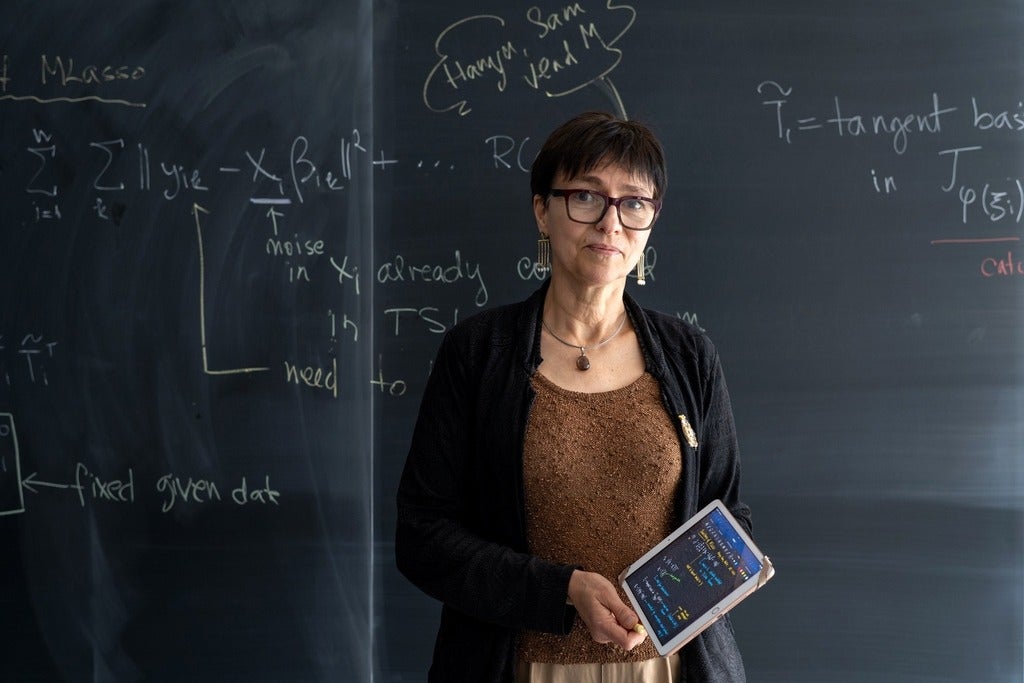
Professor Marina Meila has been appointed the Tier 1 Canada Research Chair in Reliable Structure Discovery. Tier 1 Chairs are awarded to outstanding researchers recognized by their peers as world leaders in their fields. Each chair is valued at $200,000 annually for seven years and may be renewed for an additional seven-year term.

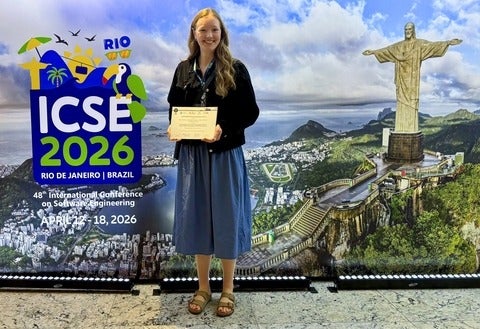
A team of researchers has won the ACM SIGSOFT Distinguished Paper Award at FORGE 2026, the 3rd ACM International Conference on AI Foundation Models and Software Engineering, held as part of ICSE 2026, the 48th IEEE/ACM International Conference on Software Engineering.

The award recognizes recent master’s graduate Evelien Riddell, whose thesis forms the foundation of the paper, along with MMath student James Riddell, PhD student Gengyi Sun, research engineer Michał Antkiewicz and Professor Krzysztof Czarnecki. Their paper is titled “Stalled, Biased, and Confused: Uncovering Reasoning Failures in LLMs for Cloud-based Root Cause Analysis.”

Professor Pascal Poupart has received a $50,000 grant from CIBC to support artificial intelligence research through PhD-level training. The award marks the first research collaboration between CIBC and the University of Waterloo focusing specifically on AI, and reflects the bank’s commitment to growing AI talent in Canada by funding doctoral research.

Titled Representation Learning for Tabular Data with Heterogeneous Feature Types, the CIBC-funded research will support PhD candidate William Loh, who is supervised by Professor Poupart.

Professor Shai Ben-David has been appointed a University Research Chair in recognition of his outstanding contributions to machine learning theory, logic, the theory of distributed computation and complexity theory. This prestigious title may be held for up to seven years and is conferred to recognize the exceptional achievements of Waterloo faculty members and to acknowledge their pre-eminence in a field of knowledge.

Researchers in artificial intelligence have developed an innovative way to identify a range of anti-social behaviour online. The new technique, led by Alex Parmentier, a master’s student at Waterloo’s David R. Cheriton School of Computer Science, detects anti-social behaviour by examining the reaction to a post among members of an online forum rather than examining features of the original post itself.