Students

󠀠

The University of Waterloo offers a wide range of AI-related academic programs for both undergraduate and graduate students.

For program details, please refer to the undergraduate or graduate sections.

about
Image of "Graduate Studies"

Arts Programs

Engineering Programs

Environment Programs

Health Programs

Faculty of Health

If you are looking for an AI-related graduate program in Health, click here for more information.

Mathematics Programs

Science Programs

Waterloo AI Institute Graduate Scholarship

Waterloo AI Institute Graduate Scholarship 2024

Award type: Scholarships

Award Description: Waterloo AI Institute Graduate Scholarships, valued at $5,000, will be awarded each year to graduate students registered full-time who are conducting research under supervisors affiliated with the Artificial Intelligence Institute at the University of Waterloo. Interested students must sign up for the Waterloo.AI Grad Mailing list to qualify as an applicant. The deadline to apply is 12:00 pm on Monday, March 18th, 2024.

Value: $5,000 - Three scholarships valued at $5,000 each will be awarded annually.

Eligibility & selection criteria: Graduate students registered full-time in a master's or doctoral program who are conducting research under supervisors affiliated with the Artificial Intelligence Institute at the University of Waterloo. Selection will be based on academic achievement (minimum 80% cumulative average in their current program) and demonstrated expertise in artificial intelligence and data science (in the broadest sense including but not limited to foundations of AI; applications of AI: and social, ethical issues, and implications of AI). A committee including the co-directors of the Artificial Intelligence Institute and other members of the Institute will select the recipients in the winter term.

Level: Masters, Doctoral

Program: Open to any UW graduate students from all faculties, studying in AI or Data Science.

Citizenship: Canadian/Permanent resident, International/study permit student.

Deadline: Monday, March 18th at 12:00 PM (EDT)

Application format: Applicants are to email (i) a completed application form, (ii) a supporting letter of a maximum of two pages describing their expertise in Artificial Intelligence and Data Science, and (iii) an unofficial transcript in PDF format with the title: Title_First Name_Last Name to Waterloo.AI's Managing Director, Harold Godwin (hgodwin@uwaterloo.ca) by 12:00 PM on March 18thPlease submit as one PDF document.

Additional instructions: Interested students must sign up for the Waterloo.AI Grad Mailing list to qualify (see link below).

Scholarship Application Workshop (Recording and Transcript Available): Harold Godwin, Waterloo.AI Managing Director, hosted a Scholarship Application Workshop on Wednesday, Feb. 21st, in the Waterloo.AI DC 2597 office space. Harold provided comprehensive guidelines for preparing your application, ensuring you have all the necessary information to apply successfully.

For those who missed the workshop, you can access the recording and transcript here: Scholarship Application Workshop Recording + Transcript

Submission Form: Waterloo AI Institute Graduate Scholarship 2024

For further information about this award, please contact Harold Godwin at hgodwin@uwaterloo.ca.

about
Image of "Undergraduate Studies"

Arts Programs

Faculty of Arts

If you are looking for an AI-related undergraduate program in Arts, click here for more information.

Engineering Programs

Environment Programs

Health Programs

Faculty of Health

If you are looking for an AI-related undergraduate program in Health, click here for more information.

Mathematics Programs

Science Programs

about

Netflix - "The Future of"

LinkedIn Learning Courses

The University of Waterloo faculty, staff and students can access web-based training from LinkedIn Learning using their username and password. Limited access is available to new graduates with the goal of expanding access to more alumni soon.  

What LinkedIn Learning offers:

  • Just-in-time training, as in-class courses may not be offered when you need them

  • Over 13,000 online courses to help you learn software, creative, IT, and business skills

  • Unlimited access to online courses available 24x7

  • Courses for all levels that cover technical skills, creative techniques, business strategies, and more

  • Top experts who are passionate about teaching

  • Watch from your computer, tablet, or mobile device. Switch back and forth as you choose

  • Create and save lists of courses you want to watch, and share them with friends or colleagues

about

News

The Tang Family Foundation donated $500,000 to Waterloo.AI to support graduate research in embodied AI, AI systems that perceive and act in the physical world through sensors and actuators (like robots), as opposed to purely text-based AI.

The inaugural cohort of eight graduate students from the faculties of Engineering and Math each received $15,000 scholarships to support their research. Their work spans robotics, exoskeletons, control systems, and the ethical questions around AI operating near people.

Waterloo.AI Director Dr. Stephen Smith explained the value of directing philanthropic funding toward students specifically: it gives them more time to focus on foundational research, which is where real long-term impact lies.

Roger Tang, founder of the Tang Family Foundation, sees embodied AI as the next major step in industrial development and views philanthropy as well-suited to backing high-risk foundational research that commercial markets later scale. He has had a growing relationship with Waterloo since establishing a Chair in New Energy Materials and Sustainability in 2023.

A second round of scholarships is expected to open in the fall.
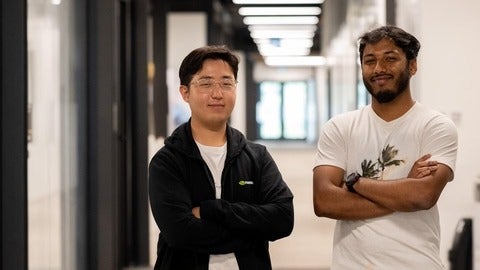
As artificial intelligence (AI) learns to write code, it still struggles to test firmware without access to physical hardware. For University of Waterloo founders Seungmin Hong (BASc ’26) and Ahnaf Shahriar (BASc in progress), that challenge represented an opportunity.
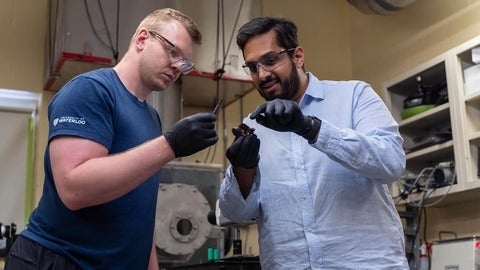
As artificial intelligence (AI) drives a global surge in data centres in Canada and around the world, a less visible but increasingly urgent challenge is growing alongside it. Researchers are beginning to investigate ways to manage the risks posed by the lithium-ion batteries that keep those facilities running.