Editor:
Brandon Sweet
University Communications
bulletin@uwaterloo.ca
Celebrating the 2025 Vanier scholars
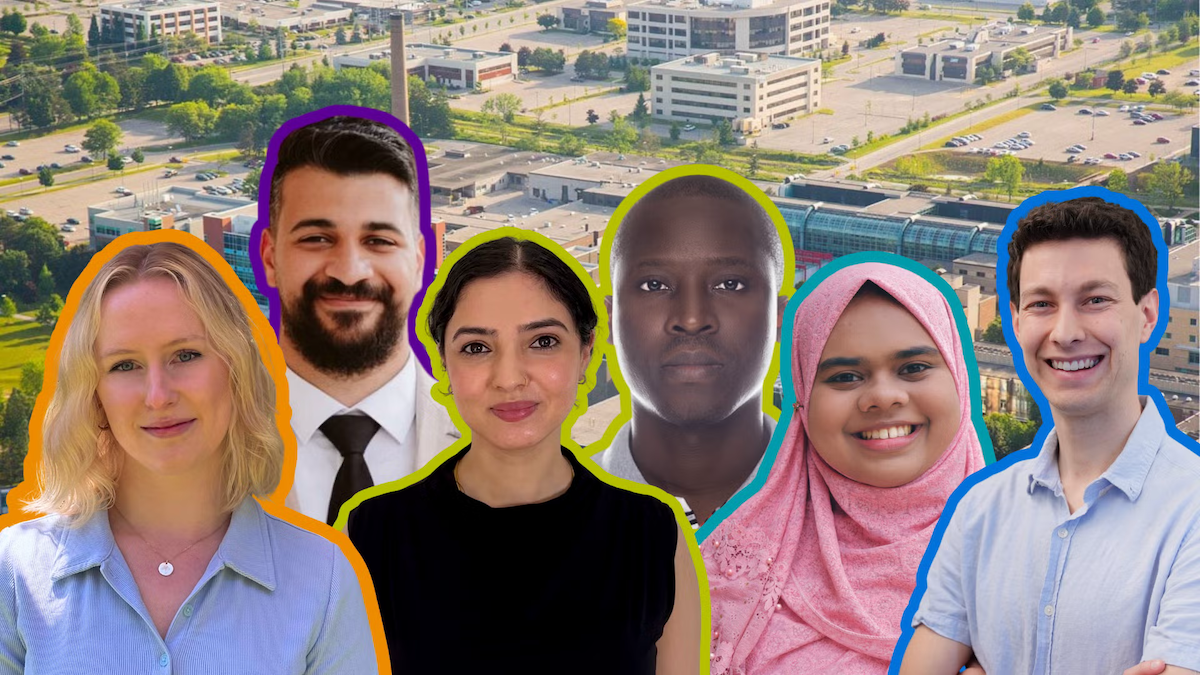
By Zoe Tipper. This article was originally published on Waterloo News.
As part of a recent Government of Canada announcement, six University of Waterloo doctoral students were named recipients of the Vanier Canada Graduate Scholarship (Vanier CGS).
The Vanier CGS is one Canada’s highest academic honours, awarded to doctoral students who demonstrate academic excellence, research potential and leadership. These scholars join a community of researchers at Waterloo who are tackling today’s most pressing challenges through both fundamental discovery and applied innovation.
Challenging systemic injustice with cross-border insight
Kaitlyn Hunter, a PhD candidate in Sociology, is exploring the far-reaching effects of American police violence on Canadian trust in law enforcement. Her research investigates how high-profile events influence crime reporting and perceptions of legitimacy in Canadian communities.
“I want to explore whether and how the consequences of touchstone events, such as the police murder of George Floyd, extend beyond geographic borders,” Hunter says. “Do high-profile cases of American police violence impact how people in Canada — especially in racialized communities — interact with and view the police?”
Read more about Hunter’s research
Engineering scalable tools for health and environmental safety
Ahmed Shahin, a PhD student in Mechanical and Mechatronics Engineering and a researcher at the Institute for Quantum Computing, is building the next generation of low-cost, highly selective gas sensors. These sensors can detect volatile compounds for applications in air quality monitoring, food safety and health diagnostics.
By leveraging a novel manufacturing technique known as AP-SALD, Shahin is making these sensors more affordable and scalable. “Unlike traditional methods that require expensive vacuum chambers, AP-SALD works in open air. This makes it faster and more affordable, and enables us to produce tiny, layered coatings that are sensitive to specific gases.”
Read more about Shahin’s research
Building more inclusive societies and resilient communities
Richard Adeleke and Satveer Dhillon, PhD candidates in the faculty of Environment, are using geography as a lens to examine social and health inequities at a local and global scale.
Adeleke’s research focuses on financial inclusion for people with disabilities in Waterloo region and is working to uncover the barriers that prevent access to basic financial services and advocating for equity in everyday life. “At the heart of my career aspirations lies the desire to contribute meaningfully to an inclusive society through my research, where no one is marginalized.”
Dhillon’s doctoral research focuses on the impacts of climate change on health and well-being in Uganda with a focus on regions that highly susceptible to resource scarcity. “The findings from this research will help us better understand how people residing in lower-income, vulnerable communities are adapting to climate change,” she explains. “The results can help inform what community-led interventions can be implemented to improve psychosocial health and well-being.”
Read more about Adeleke and Dhillon’s research
Forecasting climate threats with AI and compassion
Irfhana Zakir Hussain, an interdisciplinary PhD candidate in Public Health Sciences and Systems Design Engineering, uses AI, data science and community collaboration to predict and prevent heat-related health crises. Her work aims to identify vulnerable Waterloo neighbourhoods and help cities prepare for extreme climate events before they happen.
“Heat is one of the most immediate and severe consequences of climate change,” Zakir Hussain says. “Some homes, especially in lower-income neighbourhoods, don’t have access to cooling resources and people may live in structures with poor insulation or infrastructure issues. We’re currently trying to incorporate indoor smart thermostats in these neighbourhoods to collect information we can then use as an indicator.”
Read more about Zakir Hussain’s research
Powering a sustainable future through materials science
Cameron Dean, a PhD candidate in Chemistry, is unlocking the potential of solid-state batteries by using computational methods to explore the smallest building blocks of energy storage. His work could reshape the future of electronics, electric vehicles and sustainable energy systems.
“I want to better understand the function of battery materials, so that we can improve battery performance, safety and cost,” Dean says.
Read more about Dean’s research
Centre for Teaching Excellence to host integrated accessibility retreat
The Centre for Teaching Excellence (CTE) is hosting an Integrated Accessibility Retreat (CTE7032) on Thursday, July 17, from 9:30 a.m. to 3:30 p.m. in MC2036.
This one-day retreat is intended for instructors and provides attendees with the opportunity to learn how to incorporate accessible education practices into their courses.
Facilitators from the Centre for Teaching Excellence (CTE) and the Centre for Extended Learning (CEL), including Victoria Feth, Christine Zaza, Rebecca MacAlpine and Rachael Verbruggen will be present to help instructors with their questions.
“With an overarching goal to reduce overwhelm, this retreat is for instructors at any level of accessibility confidence,” says a note from the CTE.
WatSPEED brings industry leaders together to advance Canada’s AI readiness
This is an excerpt of an article originally published in Waterloo News.
As artificial intelligence (AI) continues to reshape the global economy, WatSPEED is helping Canadian business and technology leaders strategically position themselves for the future.
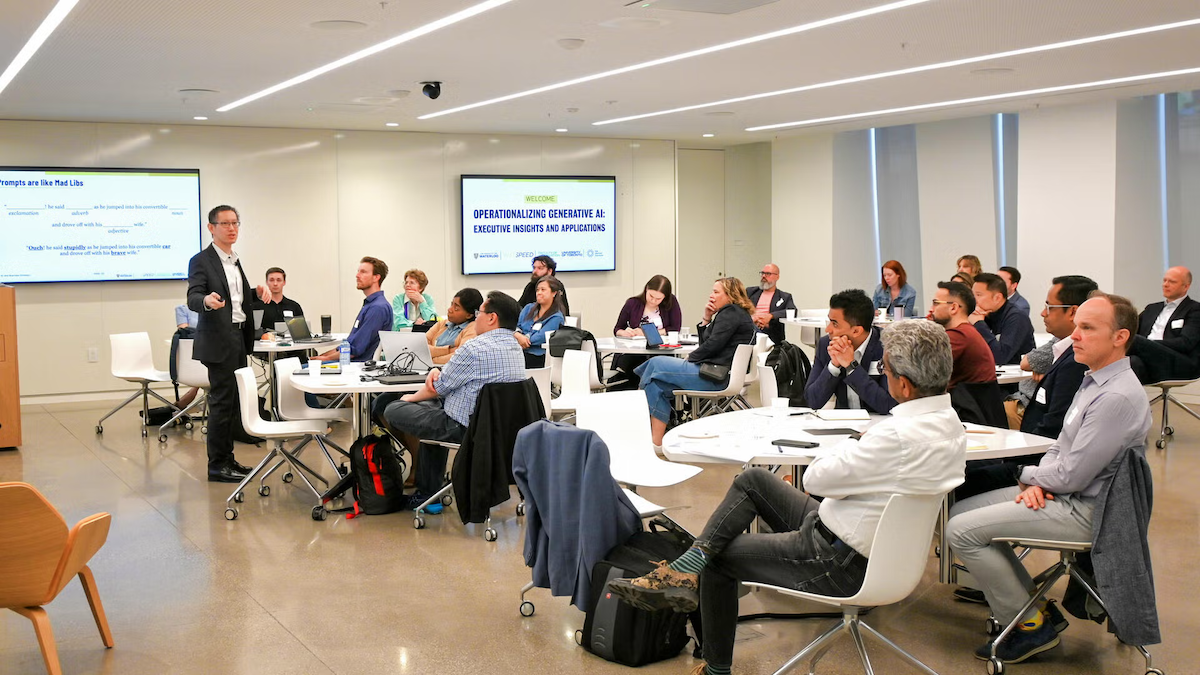
The University of Waterloo’s professional, executive and corporate education arm recently convened senior leaders from across sectors for a one-day, in-person course: Operationalizing Generative AI: Executive Insights and Applications. Delivered in partnership with the iSchool Institute at the University of Toronto, the program offered attendees a practical exploration of how generative AI tools can be implemented to drive real value in their organizations.
From theory to application
Led by Dr. Jimmy Lin, co-director of the Waterloo Data and AI Institute and one of the world’s most cited AI scholars, the course examined how large language models (LLMs) can enhance productivity, support data-driven decision-making and improve client and employee experiences.
Lin’s sessions framed prompt engineering as an emerging essential skill, comparable to the early days of digital literacy.
“At some point, you had to learn how to search Google,” says Lin, who is also the Cheriton Chair in Software Systems at Waterloo’s Cheriton School of Computer Science. “Today, it’s exactly the same thing for prompt engineering.”
Throughout the day, Lin emphasized the need for a culture of adaptability and lifelong learning as generative AI transforms how organizations structure work, evaluate talent and plan for the future.
“The transformational impact of LLMs will be no less than that of the steam engine, than electricity, than the internet,” he notes. “In fact, it will probably be more.”
Building executive AI literacy
With participants from health care, finance, technology and government, the course fostered rich dialogue around the practical realities of AI integration, including enterprise-scale deployment, regulatory compliance and responsible implementation.
Eily Hickson, head of global data and AI strategy at Sanofi, shared use cases spanning pharmaceutical research and development, accessibility technologies and clinical diagnostics. She highlighted how AI could help detect cancer earlier, alleviate long-term pain and enhance independence for people with disabilities.
“If you live in the ‘scary,’ you’ll never get to the ‘good,’” Hickson says. “I’m cautiously optimistic about the benefits — from curative medicine to quality-of-life improvements.”
She also emphasized the importance of executive alignment and storytelling in ensuring long-term AI success.
“If you don’t have executive buy-in, you can have the best strategies, but if the mindset isn’t ready to receive them, it will fall flat,” Hickson says. “AI has to be wrapped into every layer of your business, from how you run a portfolio to how you tell your story to investors.”
Link of the day
Stand up and be counted: It's World Population Day
When and where
The Campus Wellness Student Medical Clinic offers healthcare visits with Physicians and Nurse Practitioners to current undergraduate and graduate students. Services include: vaccinations, immunity testing, naturopathic services and more. Counselling Services offers appointments with counsellors in person as well as via phone and video. Students can book appointments for these services by calling Campus Wellness at 519-888-4096.
The privately-run Student Health Pharmacy (located in the lower level of the Student Life Centre) is now offering new COVID booster shots and flu shots. Covid booster shorts are available by appointment only – please call ext. 33784 or 519-746-4500. The Student Health Pharmacy’s summer hours are Monday to Friday, 9:30 a.m. to 4:30 p.m. Naloxone kits are still available – pick them up in the pharmacy at no charge.
BioBlitz 2025 Guided Walks, Monday, July 7 to Friday, July 11.
BioBlitz 2025 Independent identification, Monday, July 7 to Friday, July 11.
Bike Fair 2025, Friday, July 11, 11:00 a.m. to 2:00 p.m., Dana Porter Arts Quad.
Lunch and learn: Menstruation and Mental Health, Monday, July 14, 12 noon to 1:00 p.m., online.
Buckthorn Pull, Tuesday, July 15, 10:00 a.m. to 12 noon, meet between Village 1 - South 3 Building and the forest.
IBPOC Student Writing Cafés, Tuesday, July 15, 3:00 p.m. to 5:00 p.m., South Campus Hall (SCH 228F).
Community Wellbeing Fruit and Veg Market, Wednesday, July 16, 12:30 p.m. to 4:30 p.m. Engineering 7, 1st floor.
In-person Grad Writing Cafés, Wednesday, July 16, 2:00 p.m. to 4:30 p.m., Student Life Centre (SLC 3216).
Integrated Accessibility Retreat (CTE7032), Thursday, July 17, 9:30 a.m. to 3:30 p.m., MC2036.
University of Waterloo Choir end of term concert, Saturday, July 19, 7:30 p.m., Trillium Lutheran Church, 22 Willow Street, Waterloo. $5 students/$10 general, tickets available at the door.
Quo Vadis: Orchestra@UWaterloo,Sunday, July 20, 7:30 p.m., Knox Presbyterian Church, 50 Erb St. West Waterloo. Free admission.
Brave Space Conversations, A Care-Centered Approach to Navigating Difficult Dialogues Through an EDI-R Lens, Wednesday,July 23, 12 noon to 1:30 p.m., online. Register.
The Co-op Workplace Simulation, Wednesday, July 23, 5:30 p.m. to 7:30 p.m., Dana Porter Library Learning Lab room 323.
Shad Waterloo 2025 Open Day Exhibits, Thursday, July 24, 1:30 p.m. to 4:00 p.m., Conrad Grebel University Great Hall.
WIN Distinguished Lecture with Prof. Orlando Rojas | Waterloo Institute for Nanotechnology | University of Waterloo, "The Role of Bio-Based Colloids in Gelation Technologies and Green Interfaces," Thursday, July 24, 2:00 p.m., QNC 1501.
Spring Forward, Fall Back: Jazz Ensemble Concert. Sunday, July 27, 2:00 p.m., Conrad Grebel University College Great Hall (room 1111). Free admission.
Instrumental Chamber Ensembles, Sunday, July 27, 7:30 p.m. Conrad Grebel University College Chapel. Free admission.
Cycles, Cramps, and Cravings… Oh My! Nutrition for Menstrual Wellness, Tuesday, July 29, 12 noon to 1:00 p.m., online.
Buckthorn Pull, Wednesday, July 30, 10:00 a.m. to 12 noon, meet between Village 1 - South 3 Building and the forest.
Community Wellbeing Fruit and Veg Market, Wednesday, July 30, 12:30 p.m. to 4:30 p.m. Engineering 7, 1st floor.
Upcoming service interruptions
Stay up to date on service interruptions, campus construction, and other operational changes on the Plant Operations website. Upcoming service interruptions include:
-
Psychology, Anthropology, and Sociology (PAS) building southeast corner exterior stair closure, Friday, June 20 to Friday, July 18, exterior stair to the 2nd floor podium/seating area will be closed for the duration of the shutdown, pedestrian access will be directed around the construction activity.
-
Modern Languages washroom closure, Saturday, June 21 to Friday, August 1, washrooms ML-112 and ML-118 will be temporarily closed for upgrades, please use the nearest available washrooms located at ML-251 and ML-252.
-
MC second floor closure (NE Corner: Loading Dock 2039, Corridor 2078, 2097), Monday, June 23 to July 28 (approximately)
-
Engineering 2 and 3, Davis Centre, Math & Computer fire alarm testing, Monday, July 14, 6:30 a.m. to 8:15 a.m.
-
Aberfoyle - Biorem fire alarm testing, Monday, July 14, 10:00 a.m. to 11:00 a.m.
-
Fire Research Facility fire alarm testing, Monday, July 14, 1:00 p.m. to 2:30 p.m.
-
Needles Hall steam shutdown (addition portion of building only), Wednesday, July 16, 5:00 a.m. to 4:00 p.m., there will be a steam shutdown to accommodate meter installation, steam and hot water will not be available for the duration of the shutdown.
-
Carl Pollock Hall, Douglas Wright Engineering, South Campus Hall, Rod Coutts Hall, Grad House fire alarm testing, Wednesday, July 16, 6:30 a.m. to 8:15 a.m.
-
General Services Complex, Commissary, Central Plant fire alarm testing, Wednesday, July 16, 10:00 a.m. to 11:00 a.m.
-
Needles Hall steam shutdown (original portion of building only), Thursday, July 17, 5:00 a.m. to 4:00 p.m., there will be a steam shutdown to accommodate meter installation, steam and hot water will not be available for the duration of the shutdown.
-
Engineering 2 (E2) and Engineering 3 (E3) electrical shutdown, Monday, July 21, 1:00 a.m. to 7:00 a.m., all power will be off in E3 except for the GAIA Lab, 600v power will be off in E2, all air handling units in E2 will be affected during the shutdown.
-
Engineering 2 (E2) and Engineering 3 (E3) electrical shutdown, Wednesday, July 30, from 1:00 a.m. to 7:00 a.m., all power will be off in E3 except for the GAIA Lab, 600v power will be off in E2, all air handling units in E2 will be affected during the shutdown.