Editor:
Brandon Sweet
University Communications
bulletin@uwaterloo.ca
Tech Horizons forum receives global recognition with CASE award

Jagdeep Singh Bachher, chancellor of the University of Waterloo (left) and Bruce Flatt, CEO of Brookfield Asset Management (right), engage in a thought-provoking fireside chat during the 2024 Tech Horizons Executive Forum.
By Emma Pavlovich. This article was originally published on the WatSPEED website.
The University of Waterloo’s Tech Horizons Executive Forum has received a 2025 Circle of Excellence Award from the Council for Advancement and Support of Education (CASE).
Recognized with a bronze award in the Special Events In-Person (Single Day) category, the recognition highlights the forum’s innovative approach to community engagement and its growing impact as a catalyst for dialogue at the intersection of technology, leadership, and societal change.
“Tech Horizons reinforces Waterloo’s longstanding commitment to bring together leaders from industry, government, and academia to explore the future of business and innovation,” says Sanjeev Gill, associate vice-president, innovation at the University of Waterloo. “This recognition reflects the importance of creating space for meaningful dialogue about emerging technologies and the value of cross-sector collaboration in leading real-world impact.”
The CASE Circle of Excellence Awards are the premier recognition program for educational advancement, celebrating creativity, ingenuity, and strategic excellence at institutions around the world. This year, judges determined award recipients from more than 4,460 nominations, including representation from more than 640 instructions in 33 countries.
Winners were chosen for overall quality, innovation, use of resources, and the impact on their institutions and communities—such as students, alumni, faculty, staff, and partners.
“The Circle of Excellence Awards shine a spotlight on the extraordinary creativity, passion, and innovation demonstrated by advancement professionals at institutions around the world,” says Sue Cunningham, president and CEO of CASE. “These awards not only celebrate outstanding achievements but also underscore how essential this work is to strengthen educational communities and positively shape lives and society. I extend my heartfelt congratulations to this year's recipients for their dedication and remarkable accomplishments.”
Launched in 2023 by WatSPEED, the University’s professional, executive, and corporate education arm, Tech Horizons brings together senior leaders from across sectors to explore bold ideas, engage with emerging technologies, and examine how innovation can drive resilience and sustainable growth.
As technological disruption accelerates across industries, the forum has established itself as a flagship event for convening forward-thinking executives and thought leaders seeking to navigate the future with confidence and purpose.This year’s event takes place on November 10 in Toronto. To stay informed about updates and ticket availability, visit the Tech Horizons website.
Biochemistry and computer science students combine expertise to help automate blood stem cell analysis
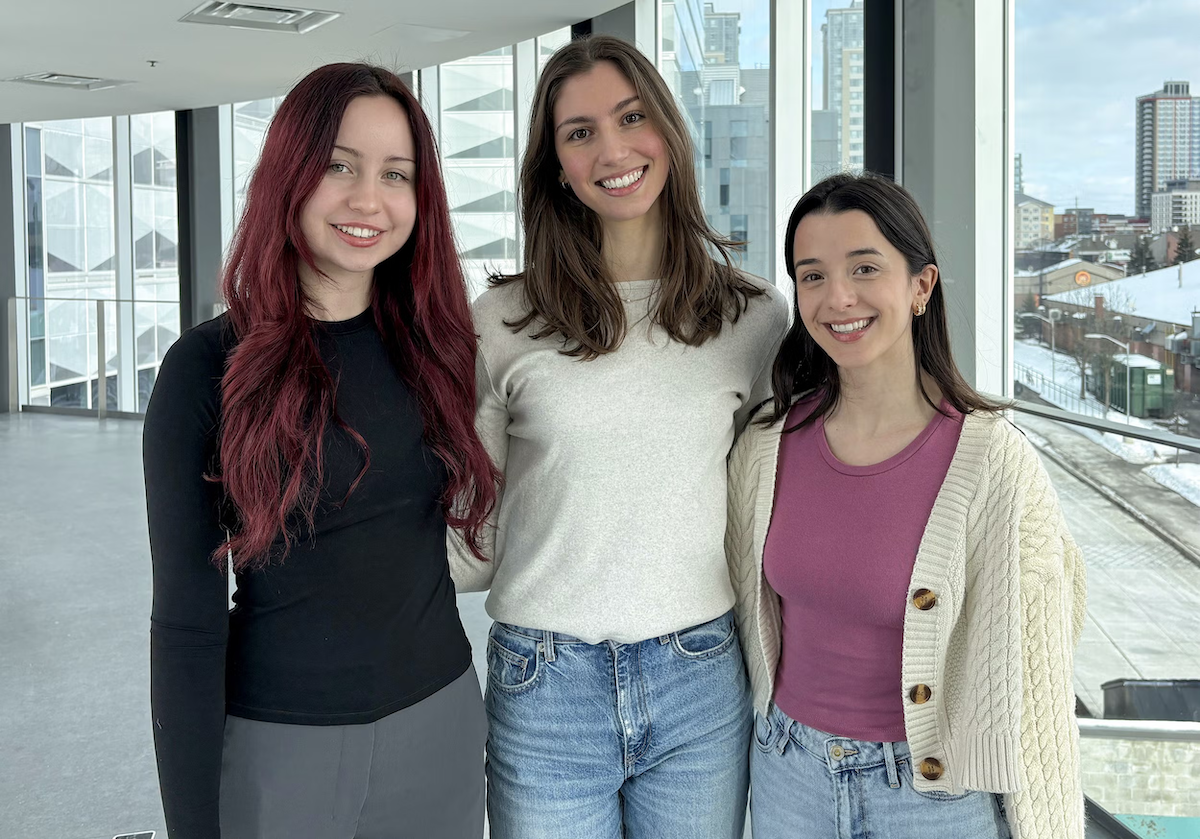
Veronika Sustrova, Katarina Makivic, and Isabella Di Biasio.
This article was originally published on the David R. Cheriton School of Computer Science.
A trio of recent Waterloo graduates has tackled a long-standing problem in clinical research with an automated solution that could help scientists analyze blood stem cells faster and more accurately.
“During my co-op placement at Princess Margaret Cancer Centre I was working on a project that used immunofluorescence image analysis to answer a specific scientific question about hematopoietic stem cells,” said Isabella Di Biasio, a recent graduate of Waterloo’s biochemistry program. “I was having difficulties related to the ImageJ software researchers use. In talking to my supervisor, Dr. Stephanie Xie, I learned that many people at the cancer centre shared similar frustrations.”
Hematopoietic stem cells, or HSCs, are found in bone marrow and are responsible for generating all blood cells throughout a person’s life. They give rise to all three types of blood cells — red blood cells, which transport oxygen to tissues and remove carbon dioxide; white blood cells, which are essential for immune defence; and platelets, which help blood clot and prevent excessive bleeding.
“One of the remarkable properties of hematopoietic stem cells is their ability to self-renew, meaning they can replicate themselves to maintain the pool of stem cells,” Isabella explained. “They can also remain in a quiescent state for extended periods. These cells are central to maintaining blood and immune system health. But if they don’t function as they should, they can contribute to immunodeficiency diseases and cancers of the blood such as acute myeloid leukemia.”
To study HSCs, researchers typically use bioimage analysis, a method that involves analyzing microscope images of cells to extract quantitative information. Researchers measure fluorescence intensity density, a metric that captures the brightness and concentration of fluorescent markers bound to specific proteins in the cells. By examining the fluorescence intensity of these biomarkers, scientists can assess a blood cell’s “stemness” — its ability to remain a stem cell versus one that has begun to differentiate into a type of blood cell.
“The process is incredibly manual,” Isabella explains. “Scientists use a software tool called ImageJ to classify cells, but they have to write their own scripts and analyze hundreds, even thousands of images by hand. It’s time consuming and prone to error.”
Recognizing the need for a solution, Isabella began to think how automation and machine learning might help, but as a biochemistry student she didn’t have the specific background in computer science.
That’s when she teamed up with Katarina Makivic and Veronika Sustrova, two recent graduates from Waterloo’s Computer Science program. The three students formed a team through the Interdisciplinary Capstone Design Course, an initiative that brings together students from across the university’s six faculties to tackle real-world challenges.
“Katarina and I knew each other from a previous co-op placement and she told me about Isabella’s work,” Veronika recalled. “I had taken a few biology electives that same term, so this seemed like a great opportunity to apply my computer science knowledge to a practical problem involving human cells. I was also excited by the potential of creating a project that could greatly improve scientists’ scripting experience and quality of life at work.”
“Once we were introduced to each other and to the project we began to have meetings, usually weekly,” Katarina added. “We’d hash out the biology and computer science terminology and figure out what was relevant to the project. We were all interested in participating in this intersection of skills and knowledge. That’s what drew us in — the possibilities that exist if we combine our fields.”
Bringing together their expertise in biology and computer science, the trio developed a two-part solution. The first component they created was a domain-specific language designed for HSC analysis to allow researchers to write and customize image-processing scripts more easily. The second was developing a machine learning–based classifier to automatically identify HSCs in microscope images by analyzing the expression of key biomarkers.
The project was developed with researchers at Princess Margaret Cancer Centre and focused on user experience and practical design. It is the first to combine both co-op and capstone components under a recent Memorandum of Understanding between Waterloo and Princess Margaret Cancer Centre, a part of the University Health Network. This partnership aims to advance cancer research and address urgent health care challenges. Enabling students to explore real-world problems during co-op placements, then develop solutions through their capstone projects, sparks new innovations and enriches education.
“Our goal was to make something the scientists could use in the lab, not just a research prototype,” Isabella said.
By streamlining image analysis and automating key steps, the trio’s tool aims to accelerate scientific discovery in stem cell biology and possibly contribute to the development of new clinical treatments.
“We’re hoping our tool will free up their time and mental space so the researchers can focus on the science,” Katarina said. “And we’re hoping that as we further refine our machine learning model, that it will be able to detect patterns in the image data and make predictions — finding something that’s invisible to the human eye, perhaps leading to new insights and discoveries.”
The team presented their work at the 2025 Interdisciplinary Capstone Design Symposium, an event that brought together undergraduate students from all six faculties at Waterloo. Organized in collaboration with the Future Cities Institute, the symposium featured 34 student-led projects developed in partnership with organizations. A summary of the team’s research — abstract number 25 — is presented in the symposium’s booklet.
Shad Waterloo 2025 Open Day Exhibits coming up
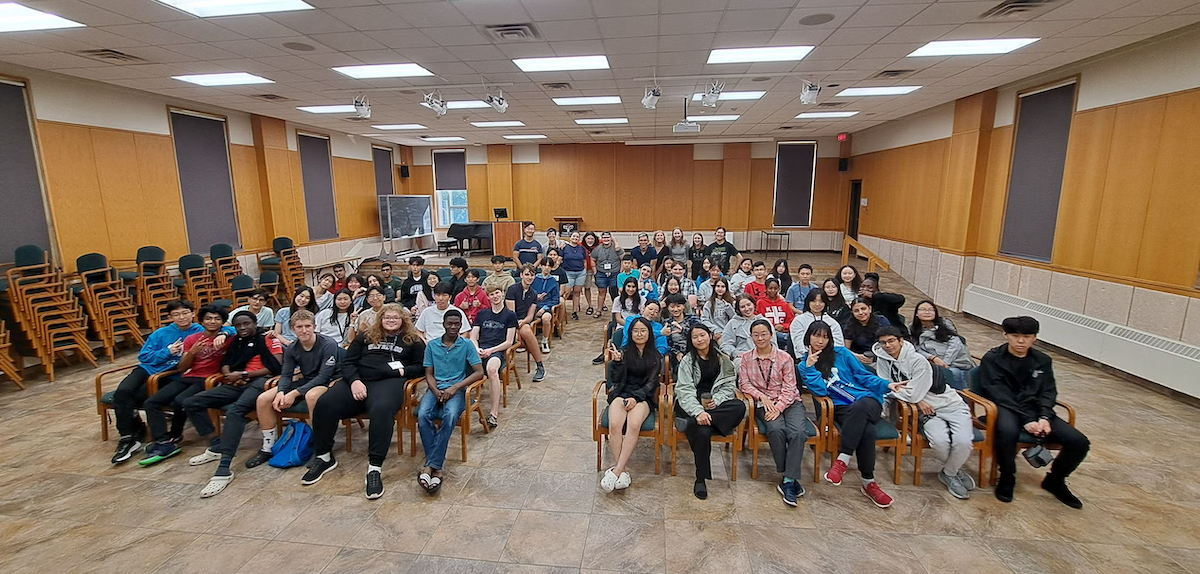
The participants of the Shad Waterloo high school enrichment program are holding a public open house on Thursday, July 24 to share highlights of their experiences, including creative ideas they have come up with to tackle this year’s design project theme.
Shad is a STEAM summer enrichment experience for high school students from across Canada and around the world. During Shad, students develop skills such as understanding and solving problems, communicating effectively, thinking critically, and collaborating within teams through hands-on projects.
The open house takes place on Thursday, July 24, from 1:30 p.m. to 4:00 p.m. in Conrad Grebel University College’s Great Hall.
To learn more about the Shad program, please visit the Shad Canada website.
20% off everything for staff + faculty at the W Store

A message from the W Store.
W Store invites you to enjoy 20% off everything for a Staff and Faculty Appreciation Event! From July 21 – 25, shop in-store and online as a thank you for all you do.
Visit W Store (SCH), W Store Essentials (MC) or wstore.ca to shop and save! Apply code STAFF20 when you shop online or let our staff in-store know you are a staff or faculty member. Don’t miss this chance to treat yourself—you deserve it!
Exclusions include course kits, textbooks, custom orders, Indigenous Collection items, YETI drinkware, Jellycat products, LEGO products, Herschel products, diploma frames, clearance products, gift cards, calculators, and all technology items.
To learn about future staff discounts, sales and events, subscribe to the Staff + Faculty eNewsletter!
Link of the day
100 years ago: The Scopes Trial
When and where
The Campus Wellness Student Medical Clinic offers healthcare visits with Physicians and Nurse Practitioners to current undergraduate and graduate students. Services include: vaccinations, immunity testing, naturopathic services and more. Counselling Services offers appointments with counsellors in person as well as via phone and video. Students can book appointments for these services by calling Campus Wellness at 519-888-4096.
The privately-run Student Health Pharmacy (located in the lower level of the Student Life Centre) is now offering new COVID booster shots and flu shots. Covid booster shorts are available by appointment only – please call ext. 33784 or 519-746-4500. The Student Health Pharmacy’s summer hours are Monday to Friday, 9:30 a.m. to 4:30 p.m. Naloxone kits are still available – pick them up in the pharmacy at no charge.
Brave Space Conversations, A Care-Centered Approach to Navigating Difficult Dialogues Through an EDI-R Lens, Wednesday, July 23, 12 noon to 1:30 p.m., online. Register.
The Co-op Workplace Simulation, Wednesday, July 23, 5:30 p.m. to 7:30 p.m., Dana Porter Library Learning Lab room 323.
Structure and dynamics of the dopamine and ochratoxin A aptamer complexes, Wednesday, July 23, 10:30 a.m., C2-361 (Reading Room)
Indigenous Constellation Stargazing Night, Wednesday, July 23, 9:00 p.m. to 11:00 p.m., PHY 150. Open to all students, faculty, and staff but space is limited to 40 participants. Registration is required.
Lunch and learn: Menstruation and Mental Health,Monday, July 14, New date - Thursday, July 24, 12 noon to 1:00 p.m., online.
Shad Waterloo 2025 Open Day Exhibits, Thursday, July 24, 1:30 p.m. to 4:00 p.m., Conrad Grebel University Great Hall.
WIN Distinguished Lecture with Prof. Orlando Rojas | Waterloo Institute for Nanotechnology, "The Role of Bio-Based Colloids in Gelation Technologies and Green Interfaces," Thursday, July 24, 2:00 p.m., QNC 1501.
Applied Math Distinguished Lecture - virtual finite element and hyperbolic problems: the PAMPA algorithm by Professor Rémi Abgrall. Thursday, July 24, 2:30 p.m. to 3:30 p.m., MC 5501
Spring Forward, Fall Back: Jazz Ensemble Concert. Sunday, July 27, 2:00 p.m., Conrad Grebel University College Great Hall (room 1111). Free admission.
Instrumental Chamber Ensembles, Sunday, July 27, 7:30 p.m. Conrad Grebel University College Chapel. Free admission.
Cycles, Cramps, and Cravings… Oh My! Nutrition for Menstrual Wellness, Tuesday, July 29, 12 noon to 1:00 p.m., online.
Lectures and classes end, Wednesday, July 30.
Buckthorn Pull, Wednesday, July 30, 10:00 a.m. to 12 noon, meet between Village 1 - South 3 Building and the forest.
Community Wellbeing Fruit and Veg Market, Wednesday, July 30, 12:30 p.m. to 4:30 p.m. Engineering 7, 1st floor.
In-person Grad Writing Cafés, Wednesday, July 30, 2:00 p.m. to 4:30 p.m., SLC 3216.
Pre-examination study days, Thursday, July 31 and Friday, August 1.
August civic holiday, Monday, August 4, most University operations closed.
Final examination period, Tuesday, August 5 to Saturday, August 16.
University of Waterloo Knowledge Mobilization Community of Practice 2025 Summer Social, Thursday, August 7, 12 noon to 1:30 p.m., Grad House. Please let Nadine Quehl know if you’re planning to join.
PhD oral defences
Pure Mathematics. Robert Harris, "Exotic constructions on covers branched over hyperplane arrangements." Supervisor, Dr. B. Doug Park. Thesis available from MGO - mgo@uwaterloo.ca. Oral defence Wednesday, July 30, 9:00 a.m.
Computer Science. Shubhankar Mohapatra, "Towards practicable and efficient private learning." Supervisor, Dr. Xi He. Thesis available from MGO - mgo@uwaterloo.ca. Oral defence Wednesday, July 30, 10:00 a.m., DC 2310.
Physics and Astronomy. Nigel Andersen, “Statistical Mechanics of Finite Length Semiflexible Wormlike Polymers.” Supervisor, Dr. Jeff Chen. Please visit the Faculty of Science Thesis Submission Notices website for details on requesting a copy. Oral defence Wednesday, July 30, 3:00 p.m., PHY 352 and remote via MS Teams.
Recreation and Leisure Studies. Kelly McManus, "Crisis Response, Recovery and Resilience of Community Events: The Case of Kitchener and COVID-19." Supervisor, Dr. Troy Glover. Email health.graduate.administration@uwaterloo.ca for a copy. Oral defence Wednesday, July 30, 5:00 p.m., hybrid.
Upcoming service interruptions
Stay up to date on service interruptions, campus construction, and other operational changes on the Plant Operations website. Upcoming service interruptions include:
-
Modern Languages washroom closure, Saturday, June 21 to Friday, August 1, washrooms ML-112 and ML-118 will be temporarily closed for upgrades, please use the nearest available washrooms located at ML-251 and ML-252.
-
MC second floor closure (NE Corner: Loading Dock 2039, Corridor 2078, 2097), Monday, June 23 to July 28 (approximately)
-
Engineering 2 (E2) and Engineering 3 (E3) electrical shutdown, Monday, July 21, 1:00 a.m. to 7:00 a.m., all power will be off in E3 except for the GAIA Lab, 600v power will be off in E2, all air handling units in E2 will be affected during the shutdown.
-
Environment & Info Tech, Earth Science & Chemistry, Physics, Chemistry 2 fire alarm testing, Monday, July 21, 2025 between 6:30 a.m. to 8:15 a.m.
-
Engineering 3 room 2174 substation electrical shutdown, Monday, July 21, 2025 from 7:00 a.m. to 5:00 p.m.
-
Village 1 fire alarm testing, Monday, July 21, 2025 between 1:00 p.m. to 2:30 p.m.
-
UW Daycare (Brightstarts), Toby Jenkins Building, Optometry, Columbia Ice Field fire alarm testing, Wednesday, July 23, 2025 between 6:30 a.m. to 8:15 a.m.
-
Waterloo South, Woolwich South, Beck Hall -> UWP fire alarm testing, Wednesday, July 23, 2025 between 1:00 p.m. to 2:30 p.m.
-
Science Teaching Complex (STC) fire testing, Wednesday, July 23, 2025 from 6:30 a.m. to 7:00 a.m.
-
East Campus Hall, Engineering 5, 6, 7 fire alarm testing, Friday, July 25, 2025 between 6:30 a.m. to 8:15 a.m.
-
Wilmot South, Wellesley South, Eby Hall, Claudette Miller Hall fire alarm testing, Friday, July 25, 2025 between 1:00 p.m. to 2:30 p.m.
-
Environment 1 electrical shutdown, Sunday, July 27, 2025 from 7:00 a.m. to 11:00 a.m.
-
MC exterior concrete stair demolition, Monday, July 28 to August 1, access to exit at the 1.5 level will be closed, access to the existing door at Level 2 loading dock will be closed, entry and exit will be from new temporary stairs at the loading dock. Excessive noise will be heard throughout the building for the duration of the demolition, with the northeast corner most affected.
-
Engineering 2 (E2) and Engineering 3 (E3) electrical shutdown, Wednesday, July 30, from 1:00 a.m. to 7:00 a.m., all power will be off in E3 except for the GAIA Lab, 600v power will be off in E2, all air handling units in E2 will be affected during the shutdown.