Editor:
Brandon Sweet
University Communications
bulletin@uwaterloo.ca
More than $32 million awarded to advance University of Waterloo research
This is an excerpt of an article originally published on Waterloo News.
For 17 consecutive years, the University of Waterloo has been recognized as Canada's top comprehensive research university — driven by a bold, multi-disciplinary approach and strong industry partnerships that turn ideas into impact.
Waterloo researchers are receiving more than $32 million to support research as part of a $1.3 billion Government of Canada announcement for research across Canada.
The funding announced for Waterloo researchers includes support from the Natural Sciences and Engineering Research Council of Canada (NSERC), Social Sciences and Humanities Research Council of Canada (SSHRC) and the Government of Canada’s New Frontiers in Research Fund (NFRF).
This year, more than 100 Waterloo researchers from all six faculties were awarded funding through the NSERC Discovery research program, including:
- Anita Layton | Faculty of Mathematics — Understanding the effects of sex and age in electrolyte homeostasis: Modelling and analysis ($685,000 over five years)
- Brian Dixon | Faculty of Science — Antigen Presentation in Teleost Fishes ($480,000 over five years)
- Karim Sallaudin Karim | Faculty of Engineering – Radiation detectors and systems for spectral and phase contrast X-ray imaging ($450,000 over five years)
- Evan Risko | Faculty of Arts — Basic Processes in the Monitoring and Control of Cognition ($325,000 over five years)
- Brian Laird | Faculty of Health – Speciation, bioaccessibility, and new approach methods for metals in wild-harvested fish in northern environments ($325,000 over five years)
- Richard Petrone | Faculty of Environment — Vegetation change and water use in alpine ecosystems ($300,000 over five years)
The recent Government of Canada announcement was made by the Honourable Mélanie Joly, Minister of Industry and Minister responsible for Canada Economic Development for Quebec Regions, and the Honourable Marjorie Michel, Minister of Health supporting more than 9,700 researchers and research projects across Canada.
Numerous researchers have also received funding under the following grants and programs:
Several Waterloo researchers received awards through the NFRF 2024 Exploration Competition, a Government of Canada program that supports high-risk, interdisciplinary projects with the potential to drive transformational innovation in areas with strong engineering and societal applications.
The recipients have demonstrated exceptional research leadership across engineering, natural sciences, health sciences and social sciences. With this federal government funding, Waterloo researchers are advancing bold ideas that will transform future societies, health, economies, technologies and the environment. Learn more about their research projects below.
Read the full story on Waterloo News
Professor Lisa Dang brings the heat with lava planet research

By Vanessa Parks. This article was originally published on the Faculty of Science news site.
The Department of Physics and Astronomy is fired up to welcome its newest faculty member, Professor Lisa Dang, whose research focuses on uncovering the mysteries of lava planets.
“Lava planets are similar to Earth, except that they’re being blasted with heat from their star,” says Dang. “They’re so hot that their surfaces are molten. If you imagine where a villain in a movie might come from, that’s a lava planet!”
Dang joined the Faculty of Science in May in the role of assistant professor. She researches exoplanets, or planets orbiting stars other than the sun. Her current work is primarily focused on mapping lava planets, an approach that connects her background in astronomy and cartography.
“I make thermal maps, similar to the maps you see on the Weather Channel,” says Dang. “I figure out what places are hot, what places are cool, and then what directions and how strong the winds are blowing. This allows us to better understand the atmosphere of these planets and, one day, maybe, to start answering the question of whether or not any of them are habitable.”
Using the James Webb Space Telescope, Dang has mapped one particular lava planet, not so creatively named K2-141b, and she has been awarded additional time to conduct a more extensive study. This study will look at five planets of different ages and with different parent stars. She is hoping to gain insight into how these planets evolve and the factors influencing their state.
Dang comes from the University of Montreal, where she honed her interest in exoplanets as part of a team focused on this area of study. What excites her now is the opportunity to engage in interdisciplinary work. “The things that govern a planet are not just physics,” she notes. “It’s a little bit of biology, and little bit of chemistry. It’s very interdisciplinary.”
The similarities between lava planets and our own planet make them particularly interesting to Earth scientists. “These lava planets represent a unique opportunity to learn about what Earth was like in the early days” says Dang. “All rocky planets first form as a ball of lava, and eventually they cool down and create the crust that we stand on today. I’m collaborating with Earth scientists and geophysicists who are excited about the early Earth and having an opportunity to learn from real observations, not just theory.”
But there’s a broader audience for Dang’s work, too. “I was invited to Hal-Con, a Comic-Con-like convention in Halifax, to talk about exoplanets and lava worlds,” says Dang. “It turns out that a lot of people who go to sci-fi conventions are not only sci-fi fans, but they also write sci-fi. For them, my work on lava planets offered ideas for new worlds they can invent in their stories.”
Her new role at Waterloo has moved Dang away from family and friends in Montreal, where she grew up and went to school. She’s finding that she has a little more time to herself, time she’s using to indulge in hobbies like biking, cooking, and perfecting a flat white. She also loves learning languages. Dang is a native French speaker and currently working to master Portuguese.
A warm welcome, Professor Dang! We’re excited to have you here.
Sepehr Assadi receives 2025 Presburger Award
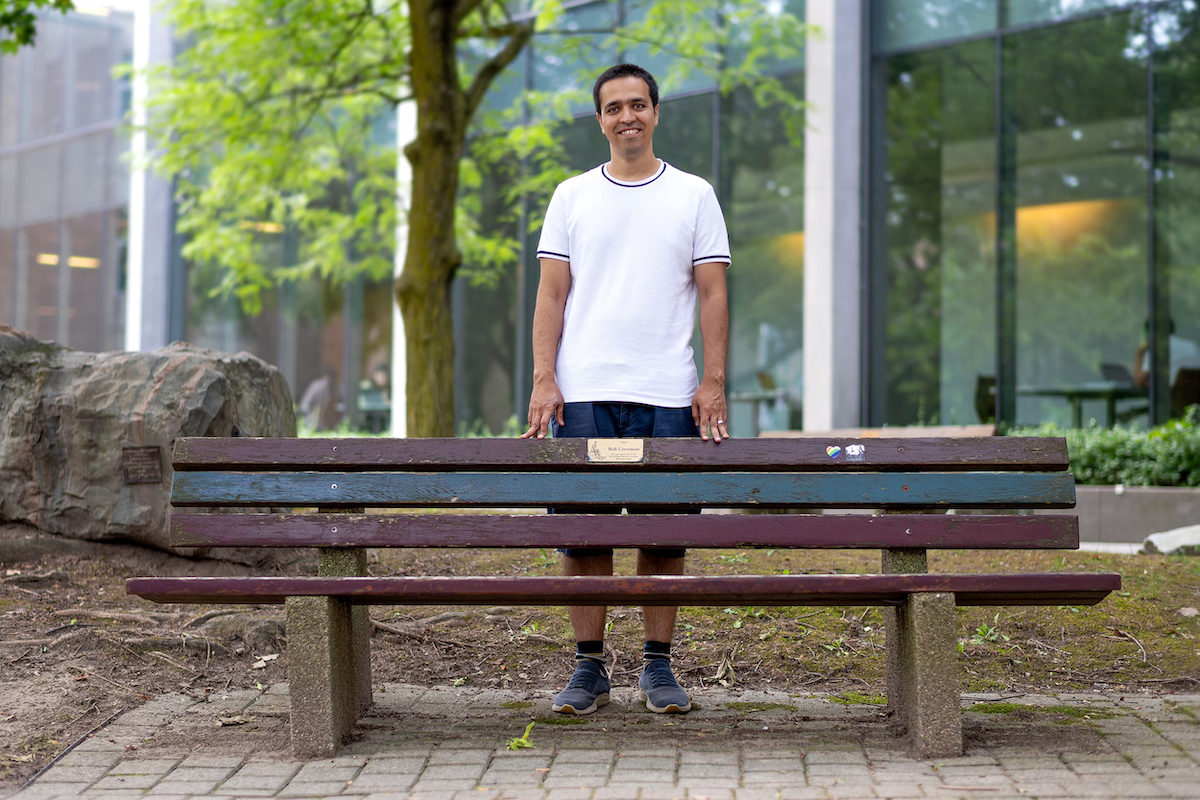
This article was originally published on the Cheriton School of Computer Science website.
Professor Sepehr Assadi has won the 2025 Presburger Award, a prestigious honour recognizing his exceptional contributions to theoretical computer science. The honour specifically acknowledges his pioneering work on establishing lower bounds for multi-pass streaming algorithms, a long-standing and challenging problem in the field.
Since 2010, the European Association for Theoretical Computer Science has conferred the Presburger Award annually to a young scientist who has made outstanding contributions in theoretical computer science, documented by a published paper or series of papers. The award is named in honour of Mojżesz Presburger, who conducted pioneering research on the decidability of the theory of addition, work that is now known as Presburger arithmetic.
“Congratulations to Sepehr on receiving this year’s Presburger Award,” said Raouf Boutaba, University Professor and Director of the Cheriton School of Computer Science. “Since joining us in July 2023, he has received a steady stream of prestigious recognitions for his research excellence — a 2023 Sloan Research Fellowship, a Faculty of Mathematics Research Chair, the Faculty’s 2025 Golden Jubilee Research Excellence Award, along with recent best paper awards at SOSA 2025 and STOC 2025.”
Sepehr Assadi is an Associate Professor at the Cheriton School of Computer Science. His research interest is in theoretical computer science and primarily algorithm design and complexity theory for modern models of computation. This includes sublinear algorithms and lower bounds in various models for processing massive datasets such as streaming, distributed, massively parallel, and sublinear time algorithms. He is also interested in graph theory, communication complexity, online algorithms, and algorithmic game theory. As of July 2025, his papers have been cited collectively more than 2,500 times, with an h-index of 30 according to Google Scholar.
Lower bounds in multi-pass graph streaming
Multi-pass graph streaming algorithms process large graphs by making multiple passes over a stream of their edges. These algorithms aim to solve graph problems efficiently while using minimal memory and as few passes over the data as possible. The central goal in the study of these algorithms is to determine the optimal trade-offs between the number of passes and the space complexity needed for solving various graph problems.
Understanding multi-pass streaming algorithms not only has direct applications to processing massive datasets in practice, but also reveals rich connections between this model and other areas of computer science. The challenges in understanding this model have made it one of the most important frontiers of research to better understand fundamental time- and space-complexity trade-offs in complexity theory.
Multi-pass graph streaming lower bounds, in particular, have proven to be remarkably hard to obtain. For most fundamental problems of interest studied in this model — such as maximal independent set, minimum spanning tree, and maximum matching — no non-trivial lower bounds were known on the space complexity of any p-pass streaming algorithms whenever p is greater than 1. Indeed, until very recently, proving any multi-pass lower bounds for almost any problem of interest appeared as a significant barrier, which requires new ideas and techniques.
Starting from 2019, Professor Assadi has been leading the research toward shattering this barrier. This research direction involved developing techniques for proving first non-trivial lower bounds for multi-pass graph streaming algorithms in his earlier work and has since matured to even establish optimal lower bounds for several problems of interest in this model:
- Maximal independent set: With Christian Konrad, Kheeran Naidu, Professor Assadi and his PhD student Janani Sundaresan established the first non-trivial multi-pass lower bound for the maximal independent set problem, a lower bound that is also optimal, thus fully settling the complexity of this fundamental problem.
- Approximate maximum matching: In work with Soheil Behnezhad, Christian Konrad, Kheeran Naidu and Janani Sundaresan, Professor Assadi and his collaborators obtained not only the first non-trivial lower bound for approximating the maximum matching problem, but also improved decades-old algorithms to obtain optimal bounds for this problem.
- Minimum spanning tree: In collaboration with Gillat Kol and Zhijun Zhang, Professor Assadi gave the first multi-pass lower bound for the minimum spanning tree problem over dynamic streams. Once again, this lower bound is optimal.
These new lower bounds all required significant new conceptual and technical innovations. In particular, the proofs of the first two results have been obtained by developing a new technique, called hierarchical embedding, which provides a novel way to combine combinatorial and information-theoretic constructions for obtaining strong round-elimination arguments in the multi-party communication complexity model.
Link of the day
Nelson Mandela International Day
When and where
The Campus Wellness Student Medical Clinic offers healthcare visits with Physicians and Nurse Practitioners to current undergraduate and graduate students. Services include: vaccinations, immunity testing, naturopathic services and more. Counselling Services offers appointments with counsellors in person as well as via phone and video. Students can book appointments for these services by calling Campus Wellness at 519-888-4096.
The privately-run Student Health Pharmacy (located in the lower level of the Student Life Centre) is now offering new COVID booster shots and flu shots. Covid booster shorts are available by appointment only – please call ext. 33784 or 519-746-4500. The Student Health Pharmacy’s summer hours are Monday to Friday, 9:30 a.m. to 4:30 p.m. Naloxone kits are still available – pick them up in the pharmacy at no charge.
University of Waterloo Choir end of term concert, Saturday, July 19, 7:30 p.m., Trillium Lutheran Church, 22 Willow Street, Waterloo. $5 students/$10 general, tickets available at the door.
Quo Vadis: Orchestra@UWaterloo, Sunday, July 20, 7:30 p.m., Knox Presbyterian Church, 50 Erb St. West Waterloo. Free admission.
NEW - Indigenous Constellation Stargazing Night, Wednesday, July 23, 9:00 p.m. to 11:00 p.m., PHY 150. Open to all students, faculty, and staff but space is limited to 40 participants. Registration is required.
Brave Space Conversations, A Care-Centered Approach to Navigating Difficult Dialogues Through an EDI-R Lens, Wednesday, July 23, 12 noon to 1:30 p.m., online. Register.
The Co-op Workplace Simulation, Wednesday, July 23, 5:30 p.m. to 7:30 p.m., Dana Porter Library Learning Lab room 323.
Structure and dynamics of the dopamine and ochratoxin A aptamer complexes, Wednesday, July 23, 10:30 a.m., C2-361 (Reading Room)
Lunch and learn: Menstruation and Mental Health,Monday, July 14, New date - Thursday, July 24, 12 noon to 1:00 p.m., online.
Shad Waterloo 2025 Open Day Exhibits, Thursday, July 24, 1:30 p.m. to 4:00 p.m., Conrad Grebel University Great Hall.
WIN Distinguished Lecture with Prof. Orlando Rojas | Waterloo Institute for Nanotechnology, "The Role of Bio-Based Colloids in Gelation Technologies and Green Interfaces," Thursday, July 24, 2:00 p.m., QNC 1501.
Applied Math Distinguished Lecture - virtual finite element and hyperbolic problems: the PAMPA algorithm by Professor Rémi Abgrall. Thursday, July 24, 2:30 p.m. to 3:30 p.m., MC 5501
Spring Forward, Fall Back: Jazz Ensemble Concert. Sunday, July 27, 2:00 p.m., Conrad Grebel University College Great Hall (room 1111). Free admission.
Instrumental Chamber Ensembles, Sunday, July 27, 7:30 p.m. Conrad Grebel University College Chapel. Free admission.
Cycles, Cramps, and Cravings… Oh My! Nutrition for Menstrual Wellness, Tuesday, July 29, 12 noon to 1:00 p.m., online.
Lectures and classes end, Wednesday, July 30.
Buckthorn Pull, Wednesday, July 30, 10:00 a.m. to 12 noon, meet between Village 1 - South 3 Building and the forest.
Community Wellbeing Fruit and Veg Market, Wednesday, July 30, 12:30 p.m. to 4:30 p.m. Engineering 7, 1st floor.
In-person Grad Writing Cafés, Wednesday, July 30, 2:00 p.m. to 4:30 p.m., SLC 3216.
Pre-examination study days, Thursday, July 31 and Friday, August 1.
August civic holiday, Monday, August 4, most University operations closed.
Final examination period, Tuesday, August 5 to Saturday, August 16.
University of Waterloo Knowledge Mobilization Community of Practice 2025 Summer Social, Thursday, August 7, 12 noon to 1:30 p.m., Grad House. Please let Nadine Quehl know if you’re planning to join.
PhD oral defences
Physics and Astronomy. Yi Hong Teoh, “Autoregressive Generative Models for Many-body Physics.” Supervisors, Dr. Roger Melko, Dr. Kazi Rajibul Islam. Please visit the Faculty of Science Thesis Submission Notices website for details on requesting a copy. Oral defence Friday, July 25, 9:00 a.m., remote via MS Teams.
Mechanical and Mechatronics Engineering. Mazin Jassim Oheil Khalati, "Cold Spray Assisted Mg/Al Dissimilar Resistance Spot Welds." Supervisors, Dr. Adrian Gerlich, Dr. Hamid Jahed Motlagh. Thesis available via SharePoint - email eng.phd@uwaterloo.ca to request a viewing link. Oral defence Monday, July 28, 9:00 a.m., E5-3052.
Mechanical and Mechatronics Engineering. Ahmet Gulsaran, "Miniaturized Sensors: Effects, Packaging, and Interface." Supervisors, Dr. Mustafa Yavuz, Dr. Eihab Abdel-Rahman. Thesis available via SharePoint - email eng.phd@uwaterloo.ca to request a viewing link. Oral defence Monday, July 28, 11:15 a.m., E5-2004.
Department of Sociology and Legal Studies. Sandra Majthenyi, "An Assessment of the Utility of Academic Research to Intelligence Professionals in Canada: A case study in Knowledge Mobilization." Supervisor, Dr. Lorne Dawson. Available upon request from the Faculty of Arts, Graduate Studies and Research Officer. Oral defence Monday, July 28, 1:00 p.m., PAS 2464.
Psychology. Allison Drody, "Towards a Holistic Understanding of the Drivers of Media Multitasking." Supervisors, Dr. Dan Smilek, Dr. James Danckert. Available upon request from the Faculty of Arts, Graduate Studies and Research Officer. Oral defence Monday, July 28, 1:00 p.m., PAS 3026.
Sociology and Legal Studies. Sandra Majthenyi, "An Assessment of the Utility of Academic Research to Intelligence Professionals in Canada: A Case study in Knowledge Mobilization, Supervisor, Prof. Lorne Dawson, Department of Sociology and Legal Studies. Available upon request from the Faculty of Arts, Graduate Studies and Research Officer. Oral defence Monday, July 28, 1:00 p.m., PAS 2464.
Psychology. Baaba Vanessa Dadzie, "Boredom and the Sense of Agency." Supervisor, Dr. James Danckert. Available upon request from the Faculty of Arts, Graduate Studies and Research Officer. Oral defence Tuesday, July 29, 10:00 a.m., PAS 2464 and hybrid.
Pure Mathematics. Larissa Kroell, "Partial C*-dynamical systems and the ideal structure of partial reduced crossed products." Supervisor, Dr. Matthew Kennedy. Thesis available from MGO - mgo@uwaterloo.ca. Oral defence Tuesday, July 29, 10:00 a.m., MC 5403.
Management Science and Engineering. Ali Rizvi, "Towards Design of Interactive Systems for Constrained Spaces." Supervisor, Dr. Mark Hancock. Thesis available via SharePoint - email eng.phd@uwaterloo.ca to request a viewing link. Oral defence Tuesday, July 29, 1:00 p.m., remote.
Upcoming service interruptions
Stay up to date on service interruptions, campus construction, and other operational changes on the Plant Operations website. Upcoming service interruptions include:
-
Psychology, Anthropology, and Sociology (PAS) building southeast corner exterior stair closure, Friday, June 20 to Friday, July 18, exterior stair to the 2nd floor podium/seating area will be closed for the duration of the shutdown, pedestrian access will be directed around the construction activity.
-
Modern Languages washroom closure, Saturday, June 21 to Friday, August 1, washrooms ML-112 and ML-118 will be temporarily closed for upgrades, please use the nearest available washrooms located at ML-251 and ML-252.
-
MC second floor closure (NE Corner: Loading Dock 2039, Corridor 2078, 2097), Monday, June 23 to July 28 (approximately)
-
School of Architecture fire alarm testing, Friday, July 18, 6:30 a.m. to 8:15 a.m.
-
Digital Media Stratford fire alarm testing, Friday, July 18, 12 noon to 3:00 p.m.
-
Engineering 3 room 2174 substation electrical shutdown, Sunday, July 20, 7:00 a.m. to 1:00 p.m., power will be off to hydraulic pump in 2101C, Heavy Lab Panel in 2121N, The Gia Lab, Press located in room 2136, PP2121 located in room 2121.
-
Engineering 2 (E2) and Engineering 3 (E3) electrical shutdown, Monday, July 21, 1:00 a.m. to 7:00 a.m., all power will be off in E3 except for the GAIA Lab, 600v power will be off in E2, all air handling units in E2 will be affected during the shutdown.
-
Engineering 3 room 2174 substation electrical shutdown, Monday, July 21, 2025 from 7:00 a.m. to 5:00 p.m.
-
Environment & Info Tech, Earth Science & Chemistry, Physics, Chemistry 2 fire alarm testing, Monday, July 21, 2025 between 6:30 a.m. to 8:15 a.m.
-
Village 1 fire alarm testing, Monday, July 21, 2025 between 1:00 p.m. to 2:30 p.m.
-
UW Daycare (Brightstarts), Toby Jenkins Building, Optometry, Columbia Ice Field fire alarm testing, Wednesday, July 23, 2025 between 6:30 a.m. to 8:15 a.m.
-
Waterloo South, Woolwich South, Beck Hall -> UWP fire alarm testing, Wednesday, July 23, 2025 between 1:00 p.m. to 2:30 p.m.
-
Science Teaching Complex (STC) fire testing, Wednesday, July 23, 2025 from 6:30 a.m. to 7:00 a.m.
-
East Campus Hall, Engineering 5, 6, 7 fire alarm testing, Friday, July 25, 2025 between 6:30 a.m. to 8:15 a.m.
-
Wilmot South, Wellesley South, Eby Hall, Claudette Miller Hall fire alarm testing, Friday, July 25, 2025 between 1:00 p.,. to 2:30 p.m.
-
Environment 1 electrical shutdown, Sunday, July 27, 2025 from 7:00 a.m. to 11:00 a.m.
-
MC exterior concrete stair demolition, Monday, July 28 to August 1, access to exit at the 1.5 level will be closed, access to the existing door at Level 2 loading dock will be closed, entry and exit will be from new temporary stairs at the loading dock. Excessive noise will be heard throughout the building for the duration of the demolition, with the northeast corner most affected.
-
Engineering 2 (E2) and Engineering 3 (E3) electrical shutdown, Wednesday, July 30, from 1:00 a.m. to 7:00 a.m., all power will be off in E3 except for the GAIA Lab, 600v power will be off in E2, all air handling units in E2 will be affected during the shutdown.