Editor:
Brandon Sweet
University Communications
bulletin@uwaterloo.ca
Does DNA carry an imprint of the environment?
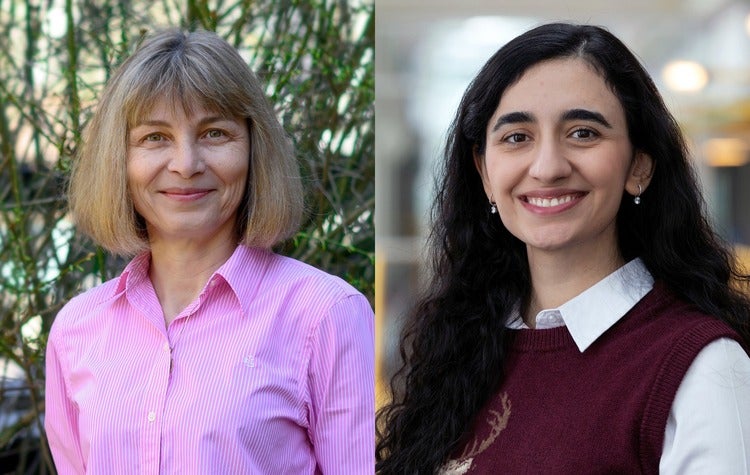
Lila Kari and Monireh Safari, the authors of the study from the University of Waterloo.
This article was originally published on the Cheriton School of Computer Science website.
Evolutionary biologists have long known that DNA, the molecule that carries the genetic instructions for the development, functioning, growth and reproduction of all organisms, contains a record of ancestry. Indeed, the theory of common descent, a central pillar of modern evolutionary biology, holds that all life on Earth is related through an unbroken chain of genetic inheritance stretching back to a single ancestral organism in the distant past.
Making sense of that web of evolutionary relationships relies increasingly on computation. Lila Kari, a Professor at the Cheriton School of Computer Science, uses mathematical and computational techniques to analyze DNA sequences, classify organisms and understand how they are related.
But is ancestry the only story DNA tells? Could genomes also bear an imprint of the environments in which organisms evolved? According to a recent study, the answer, at least for some life forms and for some extreme environments, is an unexpected yes.
The focus of the study is an unusual group of organisms known as microbial extremophiles, microscopic species that thrive at the edges of biological tolerance, in environments that by human standards are inhospitable if not outright lethal.
“Extremophiles are found in the harshest environments on Earth,” Professor Kari says. “They’ve been isolated from heated sediments near volcanoes, in deep-sea hydrothermal vents, in polar sea ice, almost every extreme environment biologists have examined for life.”
Some extremophiles, called hyperthermophiles, grow optimally at temperatures approaching 100°C. Others, known as psychrophiles, thrive at temperatures as low as -12°C. Still others inhabit highly acidic lakes with pH values near 0.5, highly alkaline lakes with pH around 11, or even solid rock several kilometres beneath the Earth’s surface.
Most extremophiles are bacteria and archaea, single-celled microbes so evolutionarily distant that they belong to different domains of life, the deepest division in the tree of life. Despite having diverged from one another about four billion years ago, researchers at the Cheriton School of Computer Science, working with colleagues at Western University and the University of Guelph, discovered that bacterial and archaeal extremophiles adapted to the same extreme environments can nonetheless exhibit strikingly similar genomic signatures.
To understand how the research team detected this unexpected environmental signal in microbial genomic signatures requires a short digression into the structure of DNA, mathematical ways to represent DNA sequences, and different kinds of machine learning techniques used for identification and classification.
Just as letters of the alphabet combine to form words, DNA molecules are composed of four “genetic” letters — the nucleotides adenine (A), cytosine (C), guanine (G), and thymine (T) — linked together along the DNA phosphate backbone to comprise an organism’s genome.
One way to visualize patterns in the frequency and arrangement of these nucleotide letters is using a mathematical technique called Chaos Game Representation. In CGR, a DNA sequence is plotted as a two-dimensional image that captures how often specific nucleotide patterns occur.
The illustration below shows how the short nucleotide sequence ACTCG is plotted (left), producing a simple image (right) that can be processed computationally.
Staff to Board of Governors nominations closed
A message from the Secretariat.
Thank you to those that put their names forward as candidates for the Staff Board of Governors election. Nominations have now closed.
To view Candidate statements, please visit the Staff Election website.
Voting will begin as follows:
- Online Voting (Regular full-time staff members) Wednesday, March 4 at 9:00 a.m. to March 10 at 4:30 p.m.
- Paper Ballots (Union staff members) Wednesday, March 4, at 9:00 a.m. to March 17 at 4:30 p.m. Ballots must be returned by the deadline. Please ensure ample time for internal mail delivery.
Any questions relating to the above, or the role and expectations of a Governor may be directed to the Secretariat via elections@uwaterloo.ca. Eligible Staff will receive an online ballot from SimplyVoting on March 4 at the commencement of voting. Union staff members will receive a paper ballot by March 4. If you do not receive a ballot, or for questions, please contact elections@uwaterloo.ca.
The secret math behind catchy melodies
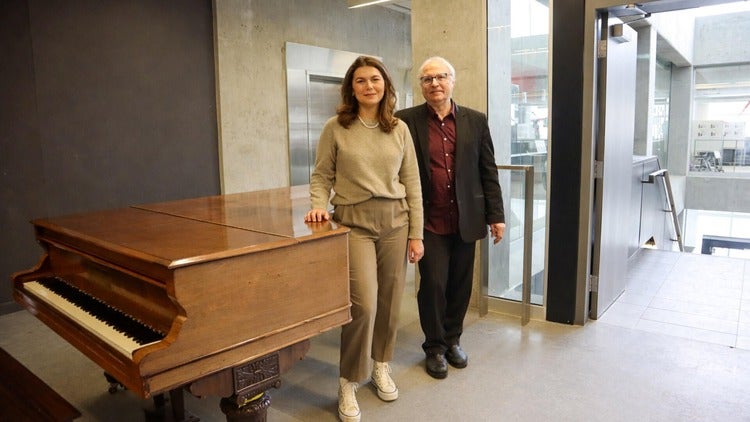
This article was originally published on Waterloo News.
Why do some melodies feel instantly right, balanced, memorable and satisfying, even if you have never heard them before?
New research from the University of Waterloo suggests that more than creativity is at play. Behind many great melodies, researchers found something surprisingly powerful: symmetry. Their work shows that advanced algebra can reveal deep musical patterns that are not always obvious by ear or even on a written score.
The findings could help composers better understand what makes melodies work, as the study offers a recipe for generating new melodies that follow specific symmetry rules, opening new creative possibilities for composers and researchers.
“Our goal was to build a clear mathematical bridge between abstract algebra and the experience of listening to music,” said Dr. Olga Ibragimova, a PhD graduate in computational mechanics in Waterloo’s Faculty of Engineering. “When we think of melodies as shapes we can transform, it becomes clear that composers have been using these kinds of symmetries intuitively for centuries.”
To explore the blueprint of melody, the team used group theory, a branch of mathematics that studies symmetry and transformations. They simplified melodies into their essential note groups and examined how common musical changes affect structure. These changes include transposition, which shifts a melody up or down; inversion, which flips it; retrograde, which reverses it; and translation, which moves it through time.
Their analysis revealed symmetrical relationships in many melodies that help explain why certain musical phrases feel cohesive and complete.
The researchers created a framework that assigns each of the 12 notes in the chromatic scale a number from one to 12. This turns melodies into a form that can be studied using algebra. With this structure in place, they examined two major types of symmetry: tonal symmetry, which relates to the notes themselves, and positional symmetry, which relates to how those notes are arranged.
By separating those two layers, the team developed formulas showing how a melody can be transformed while keeping its underlying structure intact or intentionally reshaping it in predictable ways.
“What surprised us is how cleanly the mathematics separates tonal structure from positional structure,” said Dr. Chrystopher Nehaniv, a professor of systems design engineering at Waterloo. “This duality helps us identify patterns that are not obvious by ear or by looking at a musical score. It also means we can systematically construct and count all possible symmetric melodies for a given length.”
A paper on the study, Algebraic Applications in Investigation of Musical Symmetry, was published in the proceedings of the 6th AMMCS-International Conference on Applied Mathematics, Modeling, and Computational Science.
Guess when the mercury will rise and other notes

Students are making their way back to campus after Reading Week. So what's good, Waterloo?
The 2026 edition of the annual Eric D. Soulis Weather Station contest has begun. "After a second very harsh winter, which might go down as the coldest in about a decade, perhaps people are thinking even more about when it will first hit 20C," says a note from the weather station. "Let us know when you think it will first hit 20C by entering the 2026 Weather Station contest."
The challenge is to guess the exact date and time the E.D. Soulis Memorial Weather Station at the University of Waterloo will first register a temperature of 20.0 degrees or greater. In case nobody guesses the exact time, the winner will be the person closest to the correct time.
Don't delay — the deadline for entry is Friday, February 27 at 10:00 a.m.
The Understanding PCOS and Endometriosis: Taking Charge of Your Reproductive Health lunch and learn event takes place from 12 noon to 1:00 p.m. today online. Session attendees will learn "What’s fact, what’s fiction, and what really matters when it comes to PCOS and Endometriosis."

Black Studies is hosting the Black Book Fair today and tomorrow from 9:00 a.m. to 5:00 p.m. in the Hagey Hall Project Cube (HH 2034).
"Celebrate Black authors, their stories, and their voices!" says a note from the Faculty of Arts. "Join Black Studies in this opportunity to connect with writers, explore new books, and support Black scholarship and creativity."
Link of the day
When and where
The Campus Wellness Student Medical Clinic offers healthcare visits with Physicians and Nurse Practitioners to current undergraduate and graduate students. Services include: vaccinations, immunity testing, naturopathic services and more. Counselling Services offers appointments with counsellors in person as well as via phone and video. Students can book appointments for these services by calling Campus Wellness at 519-888-4096.
The privately-run Student Health Pharmacy (located in the lower level of the Student Life Centre) is now offering new COVID booster shots and flu shots. Covid booster shots are available by appointment only – please call ext. 33784 or 519-746-4500. The Student Health Pharmacy’s summer hours are Monday to Friday, 9:30 a.m. to 4:30 p.m. Naloxone kits are still available – pick them up in the pharmacy at no charge.
The Waterloo Eye Institute optometry clinics in Waterloo and downtown Kitchener offer comprehensive eye exams and eyewear, including glasses and contact lenses, with the Waterloo location offering various specialized services including urgent eye care. Discounts apply for University of Waterloo students and employees. The Waterloo Clinic is at a nearby interim location, 419C Phillip St, during construction at the School of Optometry and Vision Science. The Kitchener Clinic remains at the Health Sciences Campus, 10B Victoria St. S. Book online or by phone at 519-888-4062.
Warriors Winter Youth Camps, registration is now open for multi-sport and games, baseball, basketball, eSports, football and hockey camps for boys and girls ages 5 to 18. Register today!
Winter 2026 Student Experience Survey. The Winter SES is now open. Please check your @uwaterloo email or visit LEARN to see if you have been invited. Those that submit their responses will receive $5 on their WatCard. The survey is open until February 27.
Understanding PCOS and Endometriosis: Taking Charge of Your Reproductive Health, Monday, February 23, 12:00 p.m. to 1:00 p.m., online.
The Black Book Fair, Monday, February 23 and Tuesday, February 24, 9:00 a.m. to 5:00 p.m., Hagey Hall Project Cube.
Dating and Neurodiversity, Tuesday, February 24, 6:30 to 7:00 p.m.
Systematic and Scoping Reviews: Systematic and Scoping Review Methods, Tuesday, February 24, 10:00 a.m. to 12 noon, online.
Accessibility and GenAI - Online (CTE7554), Tuesday, February 24, 12 noon to 1:00 p.m., online.
GIS Speed Run: Essential Analysis Tools, Tuesday, February 24, 2:30 p.m. to 3:30 p.m.
CIGI Signature Lecture: Emerging Dual-Use Technologies in an Era of Strategic Competition, Tuesday, February 24, 5:30 p.m. to 7:30 p.m., CIGI Campus.
Cooperathon 2026 Information Session, Wednesday, February 25, 12 noon to 1:00 p.m., virtual (hosted by Velocity at the University of Waterloo in partnership with Desjardins) — learn how to win up to 100K in cash prizes.
Fruit and Veg Market, Wednesday, February 25, 12 noon to 4:00 p.m., SLC lower atrium, PSE 1st floor, EV3 1st floor. $10 for a bag of assorted produce while supplies last.
AI & Tech Facilitated Deepfake Abuse Workshop, Wednesday, February 25, 12 noon to 1:00 p.m. and Thursday, February 26, 1:00 p.m. to 2:00 p.m.
Noon Hour Concert: Wondrous Winds, Wednesday, February 25, 12 noon, Conrad Grebel Chapel. Free admission.
Teaching Critical Engagement with AI - In Person (CTE7560), Thursday, February 26, 10:30 a.m. to 12:00 p.m., MC 2036.
February Book Club Meeting, Friday, February 27, 1:00 p.m. to 2:00 p.m., International Experience Lounge, Needles Hall
Systematic and Scoping Reviews: Systematic Search Methods, Tuesday, March 3, 1:00 p.m. to 3:00 p.m., online.
Fruit and Veg Market, Wednesday, March 4, 12 noon to 4:00 p.m., SLC lower atrium, PSE 1st floor. $10 for a bag of assorted produce while supplies last.
NEW - Into the Open: An exploration of education without paywalls, Wednesday, March 4, 10:30 a.m. to 1 p.m., SLC Black & Gold Room 2144
NEW - International Women’s Day 6th Annual High Tea Social, presented by the Faculty of Science. Friday, March 6, 3:00 p.m. to 4:00 p.m., virtual discussion on Zoom. Register today.
Home Routes folk concert: Onna Lou and Keri Latimer, Friday, March 6, 7:00 p.m., Brubacher House - North Campus.
Upcoming service interruptions
Stay up to date on service interruptions, campus construction, and other operational changes on the Plant Operations website. Upcoming service interruptions include:
-
Quantum-Nano Centre, Biology 1 and 2, Health Services, Science Teaching Complex fire alarm testing, Monday, February 23, 6:30 a.m. to 8:15 a.m.
-
Bright Starts daycare, Toby Jenkins Building, Optometry, Columbia Ice Field fire alarm testing, Wednesday, February 25, 6:30 a.m. to 8:15 a.m.
-
UWP - Waterloo South, Woolwich South, Beck Hall fire alarm testing, Wednesday, February 25, 1:00 p.m. to 2:00 p.m.
-
East Campus Hall, Engineering 5, 6, Pearl Sullivan Engineering (E7) fire alarm testing, Friday, February 27, 6:30 a.m. to 8:15 a.m.
-
Wilmot South, Wellesley South, Eby Hall, Claudette Millar Hall fire alarm testing, Friday, February 27, 1:00 p.m. to 2:00 p.m.
-
Earth Sciences and Chemistry electrical shutdown, Saturday, February 28 from 7:00 a.m. to 12:00 p.m.