Editor:
Brandon Sweet
University Communications
bulletin@uwaterloo.ca
Event will honour Missing and Murdered Indigenous Women and Girls

Join the Office of Indigenous Relations (OIR) and the Sexual Violence Prevention and Response Office (SVPRO) on Tuesday, May 5, for Red Dress Day, the National Day of Awareness for Missing and Murdered Indigenous Women, Girls, and Two-Spirit People (MMIWG2S).
"The day will begin with a sacred fire led by Elder Myeengun Henry at 10:30 a.m. on the BMH Green, followed by the hanging of red dresses inspired by Jaime Black’s REDress Project," says a note from event organizers. "Participants will then move to HLTH LHS-1621 for Stories Carry Us, featuring keynote speaker Tamara Bernard, who will share how storytelling, advocacy, and education honour MMIWG and inspire accountable action. The event will also feature the Aki Ogichidaa Kewwak N’gamowak Women’s Hand Drum Group.
The event takes place on Tuesday, May 5, from 10:30 a.m. to 1:30 p.m. on the BMH Green and in HLTH LHS-1621 (Applied Health Sciences expansion building).
Tamara Bernard, a mixed-race Anishinaabe Kwe from Gull Bay First Nation, is an internationally-recognized leader in MMIWG education and advocacy, a contributor to national and provincial eports, a TEDx speaker, and founder of Tamara Kwe Consulting.
All campus and community members are welcome to attend, reflect, and honour this important day.
Annual Hallman Lecture will feature Clara Hughes

The Faculty of Health is inviting the University community to a special public lecture featuring one of Canada’s most inspiring and accomplished athletes, Clara Hughes.
In her talk, Open Heart, Open Mind, Clara shares a powerful and personal story beyond her athletic success. After early Olympic experiences, she faced severe depression — hidden beneath the pressures of elite sport. Her journey toward healing became central to her return to competition and her life’s purpose.
The event takes place on Wednesday, May 13. Doors open at 5:00 p.m., with the lecture beginning at 5:30 p.m. Light refreshments and a photo opportunity will begin at 6:30 p.m. This free event takes place in the Humanities Theatre.
The only athlete in Olympic history to win multiple medals in both the Summer and Winter Games, Clara has represented Canada in both cycling and speed skating. She proudly served as Team Canada’s flag-bearer at the 2010 Vancouver Olympic Winter Games. Now a dedicated humanitarian and mental health advocate, Clara inspires audiences through her message of resilience, connection, and hope.
The event is free, but registration is required.
Second wave of Canada Impact+ Research Training Awards funding now available

A message from Graduate Studies and Postdoctoral Affairs (GSPA).
Following the January 2026 announcement of a new way to fund PhD students and postdocs: Canada Impact+ Research Training Awards (CIRTA), Graduate Studies and Postdoctoral Affairs (GSPA) is pleased to share that the second wave of the CIRTA program is now open, with a deadline of May 8 at 12 noon.
CIRTA is a tri-agency initiative that provides generous funding for up to 600 doctoral awards and 400 postdoctoral awards across Canada. For wave two, the University of Waterloo quota is 5 PhD students and 3 postdoctoral scholars. CIRTA-funded research must align with any of the eight priority research areas critical to Canada’s innovation future:
- Advanced digital technologies (AI, quantum, cybersecurity)
- Health, including biotechnology
- Clean technology and resource value chains
- Environment, climate resilience, and the Arctic
- Food and water security
- Democratic and community resilience
- Manufacturing and advanced materials
- Defence and dual-use technologies
Award details
- PhD students: $40,000/year for up to 3 years*
*Supervisors (nominators) must commit to providing support for PhD student for the full duration of their PhD degree program (beyond the 3 years CIRTA funding) as per institutional minimum funding levels.
- Postdocs: $70,000/year for up to 2 years
Key deadlines
- May 8, 12 noon: Deadline to submit nominations to GSPA
- Summer 2026: Results announced
- PhD student start: fall 2026 term; latest intake: winter 2027 term.
- Postdoctoral scholar start: January 1, 2027, at the latest (SSHRC/NSERC) and March 1, 2027 (CIHR).
For full eligibility criteria and supervisory guidance:
- Supervisors supporting PhD applicants with an active application/offer of admission: Canada Impact+ Research Training Awards (CIRTA) webpage;
- Supervisors seeking future postdoctoral scholars: Canada Impact+ Research Training Awards (CIRTA) Program webpage.
AI for diabetes: Waterloo team wins social impact award
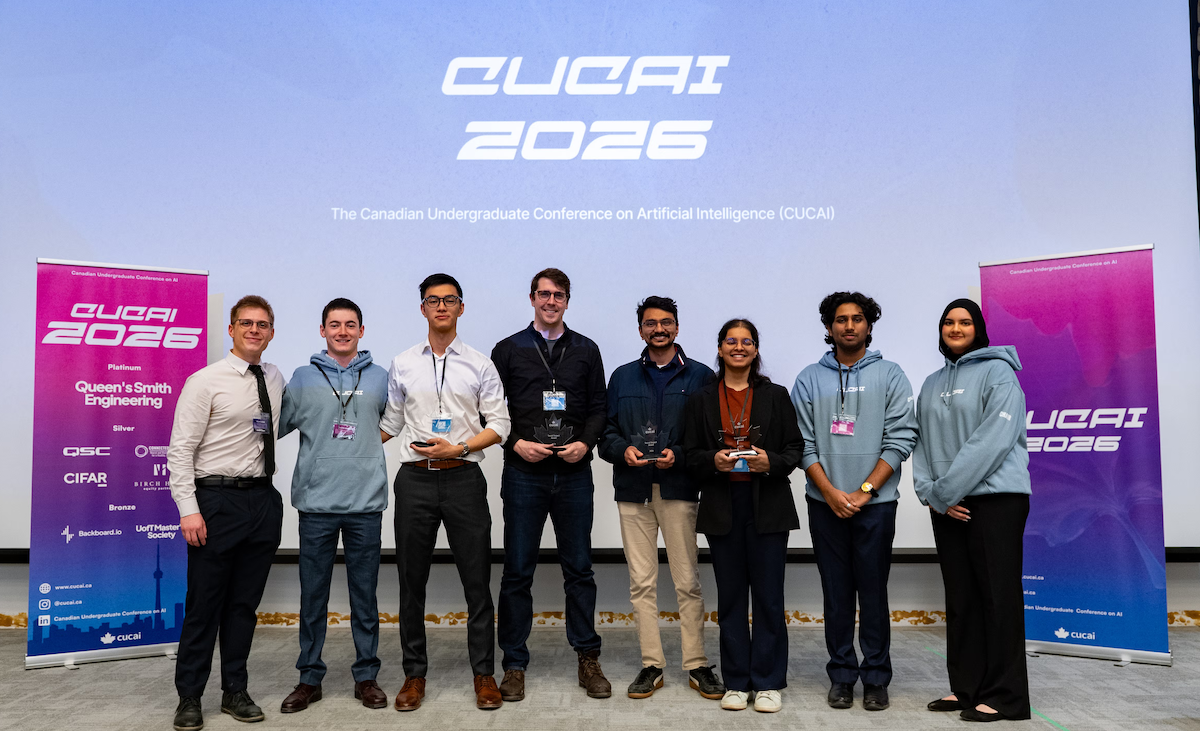
(Third from the left to right): Tony Chan, Christopher Risi, Shivam Singal and Alyssa D'Souza on stage with the Social Impact award. Kirpa Chandok also attended the conference but wasn't photographed.
By Mayuri Punithan. This article was originally published on the Cheriton School of Computer Science website.
A Cheriton School of Computer Science-led research team won the Social Impact Award at the 2026 Canadian Undergraduate Conference on AI (CUCAI), held in early March.
CUCAI is Canada’s largest undergraduate AI conference. Every year, it connects around 300 students nationwide with industry leaders and innovators to “inspire the future leaders of AI.”
CUCAI selects five teams out of dozens of applicants to conduct a spotlight presentation on their research. Among those selected were PhD student Christopher Risi, and undergraduate students, Divyansh Bhandari, Tony Chan, Kirpa Chandok, Alyssa D'Souza, Cristiano Da Silva, Jonathan Gong, Arohi Gopal, Shivam Singal, Gavin Katz, Vilo Rao, Yimeng Xie, and Julia Zhu. They showcased their diabetes-management technology, which earned them the award.
The conference took place at the University of Toronto, where insulin and its treatment for diabetes were discovered in 1921. Sharing the same stage as its discoverers carried a special weight for Christopher, who was diagnosed with Type 1 diabetes in 2023.
“The event was held in the Medical Sciences Building. All over the walls were murals dedicated to Frederick Banting and Charles Best, the people who saved my life. Their legacy was everywhere,” Christopher says. “My students and I found photos of Banting’s graduation class. All of that made the award even more meaningful.”
A century after Drs. Banting and Best’s breakthrough, Christopher is hoping AI can further push diabetes care.
When we eat, the carbohydrates in our food are converted into glucose, our body’s main source of energy. Insulin is key to moving glucose from our blood into our cells, thus fueling our bodies. However, people with Type 1 diabetes don’t produce insulin, so they must administer it by injection or pump to maintain their body’s blood glucose levels, also known as blood sugar levels.
“Your blood is supposed to have about four to eight grams of sugar at all times,” explains Christopher. “That’s equal to a teaspoon or two. Your pancreas is incredible at keeping that number within that range. When your blood sugar level is too high, your body is just secreting tons of insulin. If it’s too low, your body stops production. But when you have Type 1 diabetes, those pancreatic islet cells are sort of dead or non-functioning.”
If a person’s blood sugar levels are too high, a condition called hyperglycemia, it can cause long-term complications, including blindness and increased risk of cardiovascular disease. Hypoglycemia occurs when the blood sugar levels are too low. It can be an immediate medical emergency, with symptoms including confusion, loss of consciousness or seizures.
One of the biggest nightmares for people with Type 1 diabetes is dead-in-bed (DIB) syndrome, where an otherwise healthy diabetic passes away in their sleep. It is believed that nighttime hypoglycemia can trigger cardiovascular-related problems, including heart arrhythmia and cardiac autonomic neuropathy, causing DIB syndrome.
“It’s thought to be the leading cause of death for Type 1 diabetics under 40,” explains Christopher.
He wants to help people with diabetes reduce the risk of DIB by leveraging time series foundation models, a type of AI model pre-trained on massive datasets to recognize patterns and forecast future values from historical data. Similar technology is used to predict stock prices, energy demand, and weather.
The team’s model can forecast blood sugar levels up to 8 hours ahead, specifically, nocturnal blood sugar levels. While most continuous glucose monitoring–based prediction systems typically forecast only 30 minutes. If a user knows their levels are likely to drop or rise overnight, they could intervene by modifying their food or insulin intake. This feature is essential since hitting the sweet spot between insulin and food portions is difficult, given the dozens of factors that can impact blood sugar levels. For example, alcohol consumption or exercise can greatly decrease these levels, while a sunburn can raise them.
Their models could also make diabetes management less stressful. Although devices like continuous glucose monitors can notify people with diabetes about concerning blood sugar levels, they can be inconvenient.
“There is so much anxiety around sleep for people using insulin,” says Christopher. “Sometimes, phones can die, or you’re too deep in sleep and don’t wake up. Besides, who wants to be woken up multiple times a night to eat candy?”
With such an ambitious project, Christopher realized he could scale his vision to incorporate more datasets and models, while creating real-world research opportunities for undergraduate students. He collaborated with WAT.ai, the undergraduate student body of the Waterloo Data and Artificial Intelligence Institute, to recruit student researchers. Together, they developed a variety of state-of-the-art models using datasets of hundreds of patients and over 50 million datapoints from continuous glucose monitors.
Leading a team of 12 students while being newly diagnosed with diabetes, starting a job with industry research partner, Gluroo, and teaching an undergraduate course for the first time was no small feat. But the effort paid off: the team produced a benchmarking study evaluating the ability of time series foundation models to forecast nocturnal hypoglycemia, as well as an open-source code repository for the broader research community. They also plan to publish a paper on their findings.
He also felt proud that he played a role in Waterloo’s innovative spirit.
“What I love about Waterloo is that students here don't just want to learn; they want to build something that matters. So many students were drawn to this project, not just for the research, but because they genuinely wanted to help people. My team showed up every week ready to push this forward. That dedication made this possible.”
Register for a Budget Q&A session
Two in‑person Q&A sessions will be held to discuss the 2026/2027 operating budget and related initiatives in May. Both sessions will be livestreamed. Please register for one of the following sessions:
-
Q&A Session 1, Thursday, May 14, 10:00 a.m. to 11:00 a.m, Humanities Theatre
-
Q&A Session 2, Friday, May 15, 9:30 a.m. to 10:30 a.m.
For more details, visit the Waterloo Budget Plan website.
Link of the day
When and where
The Campus Wellness Student Medical Clinic offers healthcare visits with Physicians and Nurse Practitioners to current undergraduate and graduate students. Services include: vaccinations, immunity testing, naturopathic services and more. Counselling Services offers appointments with counsellors in person as well as via phone and video. Students can book appointments for these services by calling Campus Wellness at 519-888-4096.
The privately-run Student Health Pharmacy (located in the lower level of the Student Life Centre) is now offering new COVID booster shots and flu shots. Covid booster shots are available by appointment only – please call ext. 33784 or 519-746-4500. The Student Health Pharmacy’s summer hours are Monday to Friday, 9:30 a.m. to 4:30 p.m. Naloxone kits are still available – pick them up in the pharmacy at no charge.
The Waterloo Eye Institute optometry clinics in Waterloo and downtown Kitchener offer comprehensive eye exams and eyewear, including glasses and contact lenses, with the Waterloo location offering various specialized services including urgent eye care. Discounts apply for University of Waterloo students and employees. The Waterloo Clinic is at a nearby interim location, 419C Phillip St, during construction at the School of Optometry and Vision Science. The Kitchener Clinic remains at the Health Sciences Campus, 10B Victoria St. S. Book online or by phone at 519-888-4062.
Warriors Summer Youth Camps, registration is now open for multi-sport and games, baseball, basketball, eSports, football and hockey camps for boys and girls ages 5 to 18. Register today!
Final examination period, Thursday, April 9 to Thursday, April 23.
Vision Science Graduate Student Conference registration deadline, Thursday, April 23.
Assessment Redesign and Generative Artificial Intelligence (GenAI) - (CTE7556) – Part Two, Thursday, April 23, 9:30 a.m. to 12:30 p.m., MC 2036.
Chemistry Seminar: “Interfaces and Chemo-Mechanics in Solid-State Batteries” featuring Matthew T. McDowell, Georgia Institute of Technology, Thursday, April 23, 11:00 a.m., C20361 Reading Room and MS Teams.
Spring 2026 Joint University of Waterloo–St. Jerome’s University Legal Studies Seminar featuring Dr. Elaine Craig, “Law, Technology and the Platformization of Sex: Sexual Violence in a Data Driven Era,” Thursday, April 23, 1:00 p.m., online Via Zoom. Register now.
WISE Public Lecture, “The Global Energy System in the Cross Hairs of a Geopolitical Storm: The Way Ahead” by Professor Jatin Nathwani, Thursday, April 23, 1:30 p.m. to 2:30 p.m., E2 2350 and online via Zoom. Register today!
CPI Talk: Intimate Images, Deep Fakes and the Law, Thursday, April 23, 2:30 p.m. to 4:00 p.m., EC5-1101/1111.
Lectures in Catholic Experience presents Fr. Matthew Durham, DMin, “The Last Shall Be First: Equity and Mercy in End-of-Life Care for the Forgotten,” Thursday, April 23, 7:30 p.m. to 9:00 p.m., St. Jerome’s University Notre Dame Chapel.
Vision Science Graduate Student Conference 2026, Monday, April 27, 9:30 a.m. to 4:15 p.m., OPT 347.
CareNext Collective presents “AI-empowered patients,” Monday, April 27, 12 noon to 1:00 p.m., online. Register now.
Campus living labs for climate learning and action in all disciplines, Monday, April 27, 2:00 p.m. to 4:00 p.m., Environment 3 (EV3).
Documenting your Teaching for Tenure and Promotion - Online (CTE9908), Tuesday, April 28, 12 noon p.m. to 1:15 p.m., online.
GenAI in Teaching Material Development - In Person (CTE7553), Wednesday, April 29, 11:00 a.m. to 12:30 p.m., MC 2036.
PhD oral defences
Systems Design Engineering. Paul Wolfe, “Neuromodulatory Enhancement of BCI-Critical EEG Features: Site-Specific iTBS Effects on Movement-Related Cortical Activity.” Supervisor, Dr. Arash Arami. Thesis available via SharePoint – email eng.phd@uwaterloo.ca to request a viewing link. Oral defence Tuesday, April 28, 11:00 a.m., E5 6111.
Electrical and Computer Engineering. Pablo Verdugo Rivadeneira, “Modeling and Control of Thermo-Electrical Microgrids Considering Uncertainties.” Supervisors, Dr. Claudio Canizares, Dr. Mehrdad Pirnia. Thesis available via SharePoint – email eng.phd@uwaterloo.ca to request a viewing link. Oral defence Tuesday, April 28, 2:30 p.m., EIT 3142.
Electrical and Computer Engineering. Seyyed Mojtaba Pourjaafari, “Tunable Band-Pass Filters with a Wide Tuning Range and Minimum Number of Tuning Elements.” Supervisor, Dr. Raafat Mansour. Thesis available via SharePoint – email eng.phd@uwaterloo.ca to request a viewing link. Oral defence Wednesday, April 29, 1:00 p.m., EIT 3142.
Chemical Engineering. Yonglin Wang, “Structural and Interfacial Engineering of 2,5-Dihydroxy-1,4-Benzoquinone Coordination-Polymer Cathodes for Sustainable Lithium-Ion Batteries.” Supervisor, Dr. Yuning Li. Thesis available via SharePoint – email eng.phd@uwaterloo.ca to request a viewing link. Oral defence Thursday, April 30, 9:00 a.m., remote.
Upcoming service interruptions
Stay up to date on service interruptions, campus construction, and other operational changes on the Plant Operations website. Upcoming service interruptions include:
-
East Campus Hall, Engineering 5, 6, Pearl Sullivan Engineering (E7) fire alarm testing, Friday, April 24, 6:30 a.m. to 8:15 a.m.
-
Wilmot South, Wellesley South, Eby Hall, Claudette Millar Hall fire alarm testing, Friday, April 24, 1:00 p.m. to 2:00 p.m.
-
GSC 1st and 2nd floor perimeter heating/cooling shutdown, Friday, April 24, 9:00 a.m. to Saturday, April 25, 4:00 p.m., perimeter heating/cooling will be off from Key Control/Parking to Ring Road, including Custodial, Print Shop, equipment hub spaces, supplemental heating from air handling units will be available.
-
Biology 1 water shutdown, Saturday, April 25, 7:00 a.m. to 4:00 p.m., main water service will be off for the duration, Plant Ops will back feed the majority of the building but the greenhouse and fish lab will be without water during the shutdown.
-
Chemistry 2 water shutdown, Saturday, April 25, 7:00 a.m. to 4:00 p.m., domestic water line serving the building will be off for a 4 to 5 hour window, affecting washrooms and building supply.
-
Biology 2 electrical shutdown, Sunday, April 26, 7:00 a.m. to 12 noon, emergency power and the elevator at Biology and Science Teaching Complex will be available.
-
Columbia Icefield, Warrior Field, Field House and Brubaker House electrical shutdown, Monday, April 27, 6:30 a.m. to 3:30 p.m., emergency lighting will be available.
-
QNC fan maintenance, Saturday, May 2, 6:00 a.m. to 4:00 p.m. (rain date Sunday, May 3), all exhaust fans and air make-ups will be affected while the semi-annual preventative maintenance on rooftop fans is carried out.