Students explore how cities should grow at World Cities Week
Five days of lunch-hour sessions brought University of Waterloo students together with practitioners to discuss, build and present ideas for Canadian cities
University of Waterloo students spent November 2 to 6 exploring how Canadian cities should grow, from sprawl and rezoning to water capacity, at World Cities Week 2026.
The week of lunch-hour sessions, open to all students, was hosted by the Future Cities Institute founded by CAIVAN (FCI) and Dr. Nadine Ibrahim, Turkstra Chair in Urban Engineering. It is one of the ways FCI connects students with the practitioners and problems shaping Canadian cities, from where new housing should go to who pays for the services that reach it.
Weighing in on growth
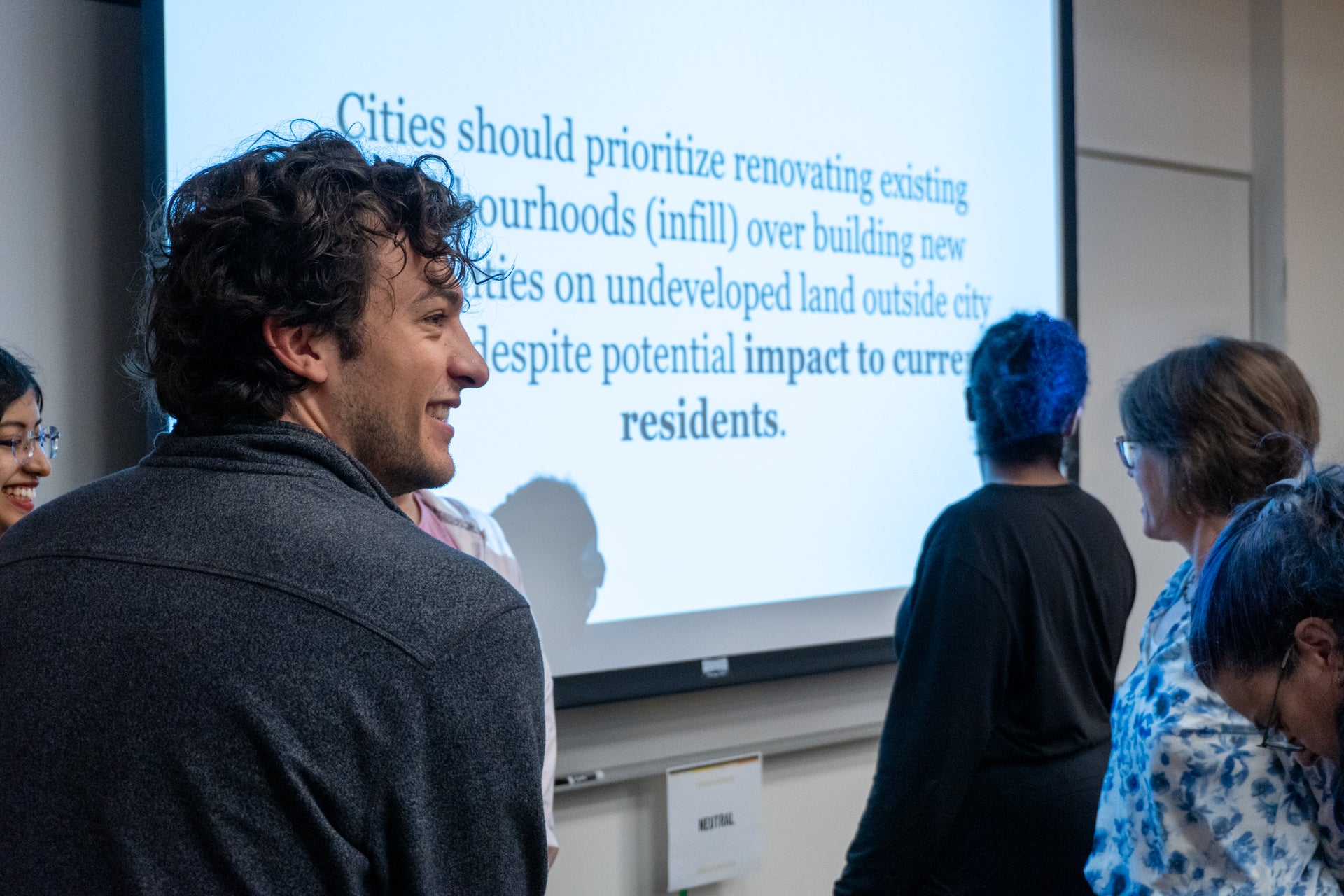
Ibrahim opened Tuesday’s session with an overview of Waterloo’s Master of Engineering programs, including the Future Cities Specialization in Civil Engineering. Students then took positions on a spectrum taped to the front wall, from “strongly agree” to “strongly disagree,” based on statements projected on the main screen. The statements covered some of the hardest questions in Canadian housing: whether cities should renovate existing neighbourhoods before building on undeveloped land, whether every residential neighbourhood should allow apartment buildings, and whether the Region of Waterloo is right to pause new housing development over water capacity.

Several students changed positions as FCI’s Melanie Hains, academic program development lead, added context to each statement.
Seeing the problem differently
On Monday, a panel of University of Waterloo’s experts in residence, engineer-in-residence Jessica Kellerman, planner-in-residence Claire Basinski and practitioner-in-residence Helen
The liveliest discussion came over whether residents of new low-density developments should pay more for municipal services. Some students argued it was a matter of economics, not values, saying those developments cost more to service than they return and that development charges are sometimes forgiven to attract them. Others pointed out that for many people, a home outside the city is the only one they can afford.

Kerr, discussed why people choose to live in cities in the first place, how remote work is changing the way people experience them, and how the University can prepare students to embrace uncertainty. Kellerman stayed on to talk about public-sector careers, drawing on her role at the City of Waterloo.
“Engineers can design great things, but they need to remember who is using them,” Kellerman said.
Engineers can design great things, but they need to remember who is using them.
Alon Eisenstein of the University of British Columbia closed the week with Friday’s Turkstra Talk, on how people think inside the box, outside it and about the box itself. Drawing on examples from The Beatles, Dr. Seuss, Tom Hanks and Schrödinger, he made the case that how a problem is defined shapes the solutions people can see.
New life for old buildings
Wednesday’s session turned to adaptive reuse, starting with how historic houses in Fuzhou, China, were restored using traditional techniques. Student teams then proposed new uses for Kitchener’s former Charles Street Terminal, a site that has been a coal gasification plant, a department store, a transit terminal and a COVID-19 testing centre. Working through the lens of housing, mobility or infrastructure, they suggested everything from a community café and market space to indoor walking paths for winter. Several ideas, including an amphitheatre and new green space, echo options the Region of Waterloo has considered for the site.
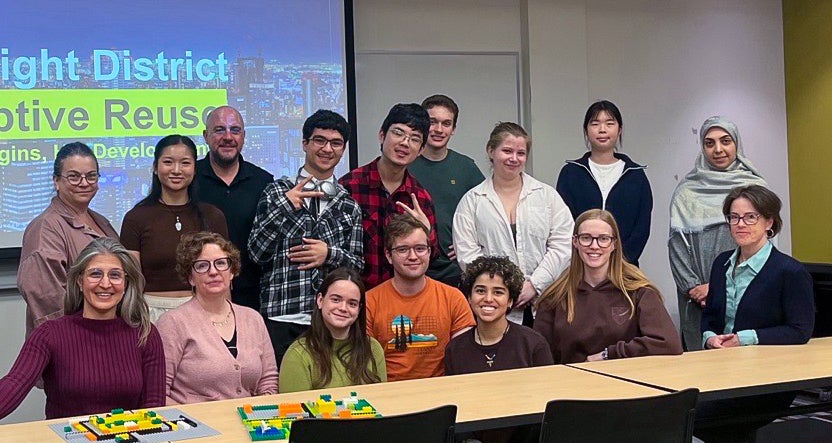
On Thursday, Scott Higgins, president of HIP Developments, showed what adaptive reuse can look like at scale. HIP transformed the former Tiger Brand factory and Southworks in Cambridge into the Gaslight District, a mixed-use development whose regular events, free and open to everyone, have brought new activity to the area.
Thinking with your hands
Thursday also brought a LEGO Serious Play session led by Ibrahim, where students built a community around the United Nations goal for cities and communities using bins of colour-coded bricks: blue for water, grey for transit, yellow for homes and dark green for parks.
As time ran out on the builds, Ibrahim told students not to worry about finishing.
“It’s okay if you’re not done,” she said. “No city is ever finished.”