UW Students Build Mapping Tool for Kitchener Public Library
When a growing city plans for expanding public infrastructure, municipal decisions usually follow population numbers. But when Kitchener Public Library (KPL) wanted to evaluate where library resources are needed most, they looked for a different starting point. KPL approached the Future Cities Institute (FCI) to build an evidence-backed method that pairs community need with population growth.
Over the summer term, University of Waterloo Faculty of Environment planning students Miki Zheng and Alexa R. took on the project. Guided by FCI Director Dr. Leia Minaker and FCI Member Dr. Rob Feick, the student team used ArcGIS overlay analysis to map three factors against each other: projected population growth, and deprivation measured two ways, once through the Canadian Index of Multiple Deprivation, and once through EQAO test scores.
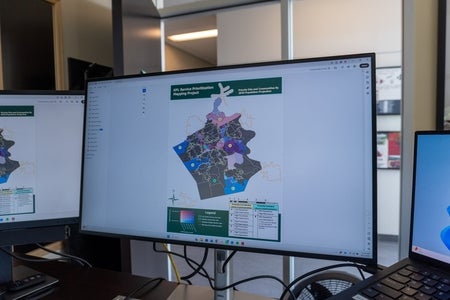

What came out of it is a practical tool KPL can use to test locations, including options like the automated library lockers already running at local community centres. By combining these data layers into visual matrices and layouts, the project gives decision-makers a clear view of where resource gaps overlap with neighbourhood growth.
This was a great opportunity to apply our GIS skills towards a real-life problem with a client... It was exciting to work with KPL towards something meaningful and important to the Kitchener community.
As development charges change and Kitchener keeps growing, the question of how public services keep pace with new housing is not going away. Tools like this one make the answer easier to see, and harder to argue with. At FCI, we connect partners with interdisciplinary student talent to build practical tools for real municipal decisions.
