Why Water, Primary Care, and Child Care Unlock Everything Else
Rain fell lightly on Erb Street West on the morning of October 1st. Inside the Delta Waterloo's Silver Lake Ballroom, the breakfast buffet was open, the tables were filling, and the clatter of cutlery was starting to compete with conversation. The Greater Kitchener Waterloo Chamber of Commerce was hosting Vision 1 Million: Healthcare, and the question on the table was a big one: is this region ready for one million people?
The Vision 1 Million Scorecard exists to answer that question with evidence. Produced by BestWR and the Future Cities Institute founded by CAIVAN (FCI), the scorecard grades 28 metrics across housing, transportation, healthcare, employment, and placemaking, and is updated twice a year. Its second update was released in July.
28 metrics is a lot to hold in your head over breakfast. FCI Director Dr. Leia Minaker's job was to make them useful. She walked the room through what has improved since January, what is lagging, and what is holding steady.
Lagging does not mean out of reach. "We've done hard things in the past as a region," Minaker reminded the room. What matters now is where the region puts its effort. "Where should we focus our attention?" For Minaker, the answer was clear: "Water, primary care, and child care."
Child care is labour force infrastructure. When people have adequate and reliable child care, employment outcomes are better.
Fix those three, she argued, and progress follows across several domains at once. Water serves every kind of development, not only new homes. When capacity ran short this year, new development approvals were paused for months, and they are only now resuming in stages. Primary care takes pressure off emergency departments and mental health services. Child care might sound like it belongs on a different list, but Minaker made the case that it is just as foundational as the other two. "Child care is labour force infrastructure," she said. "When people have adequate and reliable child care, employment outcomes are better."
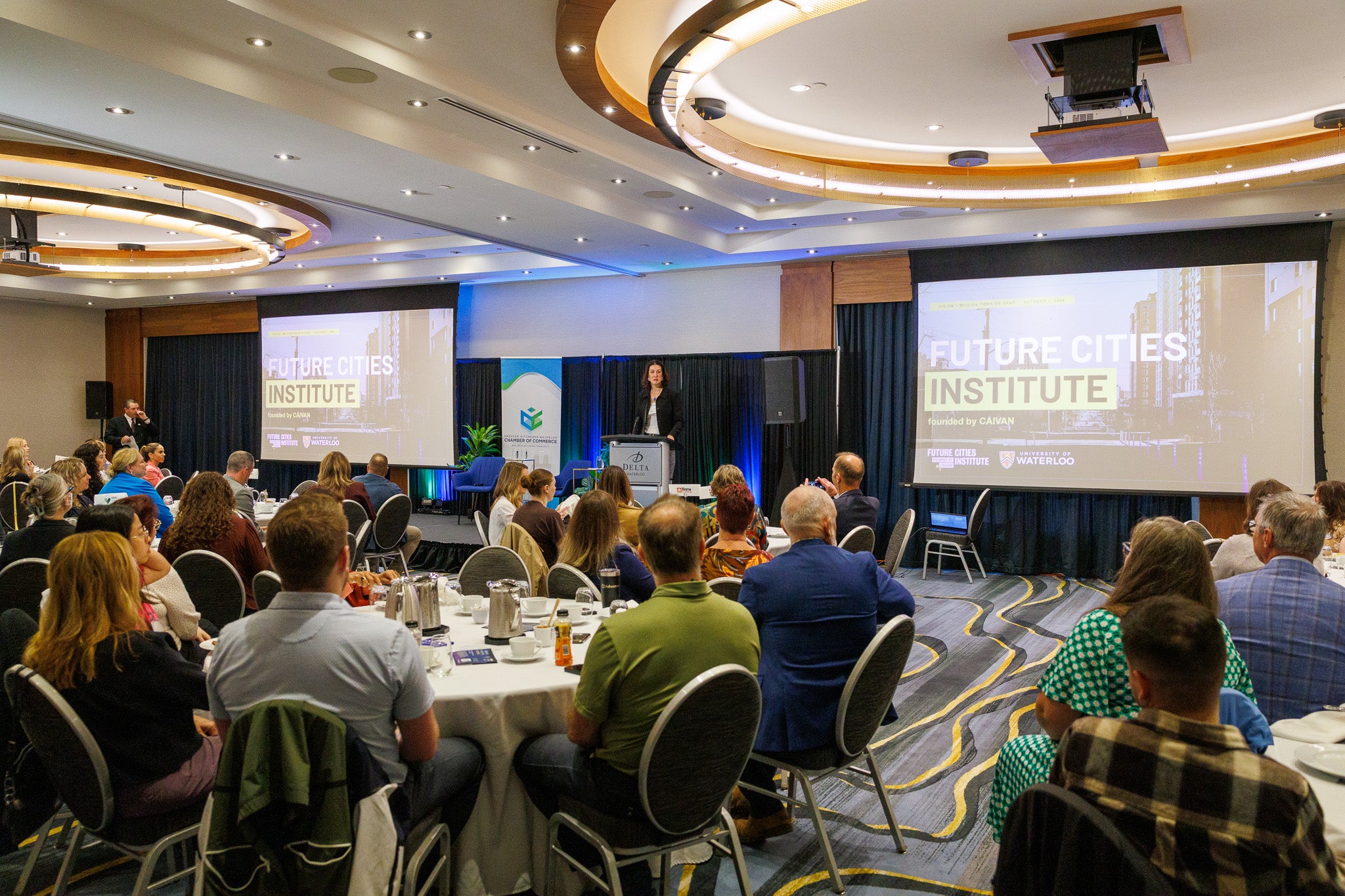
Photo by Alex Kinsella
The rest of the morning showed how tightly those systems connect. Ian McLean, President and CEO of the Greater KW Chamber of Commerce and Chair of BestWR, hosted the event and kept the focus on who the work is for. "Our community needs and deserves a new hospital," he said, but a building alone is not the goal. "Having a hospital that doesn't serve the people is a fool's errand." Norma McDonald Ewing, Interim President of Conestoga College, put it plainly: "A population of one million requires us to work together."
The region will not stop growing toward one million, and FCI does not plan to stop the research that helps it get there. When her microphone failed mid-presentation, Minaker did not pause. "I'll just yell," she said, projecting to the back of the ballroom with the same clarity she started with. The next update arrives in January.
Explore the Vision 1 Million Scorecard at fciprojects.ca/vision-1-million-scorecard.
Banner photo by Alex Kinsella