News

Filter by:

Limit to news where the title matches:
Limit to items where the date of the news item:
Date range
Limit to news items where the audience is one or more of:
Limit to news items where the faculty or school is one or more of:

When a 13-year-old girl stops riding her bike to school, the reasons usually extend far beyond the bike path. During their initial on-campus residency week for the Master of Future Cities (MFC) program, student teams analyzed municipal transportation data and developed practical strategies to address why women and young girls opt out of cycling networks. Using Waterloo as a primary case study, one team introduced "Bridging the Cycling Gap," mapping the transition into early adolescence through a fictional persona named Maya and proposing a gamified social app to reward riders for using municipal cycling routes.

At the AMO conference in Ottawa, municipal leaders and city staff connected with FCI to explore practical, data-backed solutions for their communities. From high-demand resources like the Development Charges Monitor and CivicInquire (an AI-powered homelessness policy platform led by FCI Director Dr. Leia Minaker that recently secured SSHRC funding) to collaborative student partnerships, FCI demonstrated how research moves out of academia and directly into local council chambers. Through the i-Capstone program, municipalities of any size can partner with University of Waterloo student teams to tackle local infrastructure and policy challenges across one or two terms at zero cost.

What does excess heat from a data centre have to do with warming a local hospital? For University of Waterloo students in the WE Accelerate program, it is a practical answer to Waterloo Region's growing resource limits. On July 29, student teams presented data-backed concepts for a municipal design challenge framed by the Future Cities Institute and the Region of Waterloo. Focused on the water-energy-food nexus, student concepts delivered actionable interventions, from capturing data centre heat for hospital infrastructure to expanding urban tree canopies using Silva Cell stormwater systems.

University of Waterloo student Neil Simmons and his classmates took first place at Toronto's TransitData Challenge 2026 by developing TTC ScheduleWatch, an interactive tool that tracks streetcar delays stop by stop across 100,000 trips. Connected with FCI Mobility Cluster Lead Dr. Jeff Casello through FCI Director Dr. Leia Minaker, the student team used live GPS data and neighbourhood demographics to highlight transit gaps and propose evidence-backed schedule improvements.

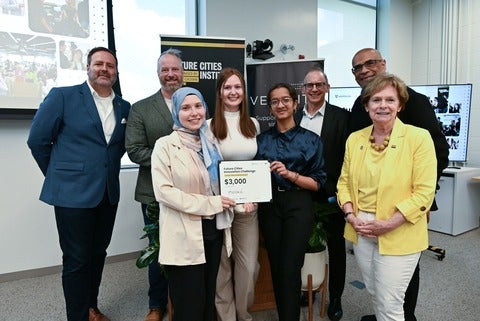
The Future Cities Institute founded by CAIVAN partnered with Velocity to host the Future Cities Innovation Challenge. The high-intensity, two-week sprint brought interdisciplinary student teams together to build data-backed business concepts targeting the Canadian housing crisis, modern infrastructure demands, and municipal service systems.

What started as an interdisciplinary i-Capstone collaboration has grown into a transformative partnership between the City of Iqaluit and the Future Cities Institute. Faced with complex infrastructure challenges in a harsh Artic environment, the city turned to Waterloo co-op students to bring fresh thinking and technical expertise to the table, and the results have been impactful.  

Engineering student Ahraz Yousuf spent a co-op term in Iqaluit, modernizing the city’s fleet management system. From implementing Fleetio software to building custom tools and leading multi-department training, Yousuf’s work has helped streamline operations and improve service delivery in the North. “I got to build something from the ground up,” he shared. “It allowed me to step outside of the traditional software development and into stakeholder collaboration.” 

This partnership continues to create opportunities for students to apply their skills in meaningful, community-driven projects, advancing real innovation in Canada’s northern cities. 

From AI-powered civic tools to sustainable housing solutions, University of Waterloo students came together to present interdisciplinary projects tackling real-world issues at this year's i-Capstone symposium. 

Held on March 26, the event showcased student creativity, teamwork and dedication to solving real-world urban challenges. Designed to unite students from every faculty, i-Capstone — the University of Waterloo’s first interdisciplinary undergraduate capstone program — enables students to tackle complex problems facing Canadian communities while working with real world partners, all for academic credit. This includes areas like sustainable housing, infrastructure and integrated urban planning.

New article alert from FCI member Michael Drescher!

How can cities balance urban growth with climate adaptation? Dr. Michael Drescher, from the School of Planning at the University of Waterloo, explores this challenge in his latest journal article: "Nature’s role in residential development: Identifying leverage points for climate change planning in Ontario, Canada."