News

Filter by:

Limit to news where the title matches:
Limit to items where the date of the news item:
Date range
Limit to news items where the audience is one or more of:

That’s a wrap on World Cities Week 2025!

This year’s program brought together students, researchers, and practitioners for a dynamic mix of panels, workshops, and hands-on sessions exploring how cities can adapt, connect, and thrive in an ever-changing world.

Each conversation reflected the energy and creativity that define the University of Waterloo and the Future Cities Institute, where ideas move from research to real-world impact through collaboration across disciplines.

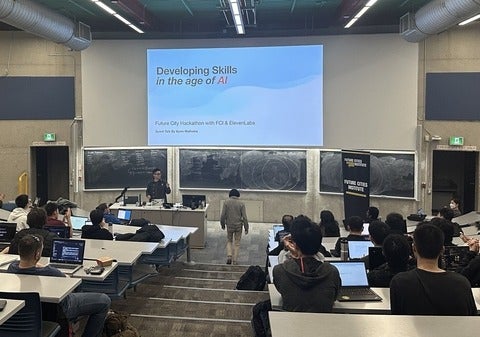
The Future Cities Institute gathered at the University of Waterloo for a fast-paced hackathon exploring how AI and agentic technologies can support the cities of tomorrow.

Co-sponsored by the Future Cities Institute and ElevenLabs, the day brought together students, researchers and builders to design tools for housing, mobility, and community services, with a strong focus on voice and co-pilot applications.

A huge thank you to guest judges from Google, NVIDIA, and ElevenLabs.

FCI member Dr. Jeff Casello joined CTV News for a live interview on the use of AI-powered traffic lights, highlighting both the promise and the practical realities of bringing this technology to different urban contexts. 

Reflecting on a Quebec town’s success using AI to ease gridlock, Dr. Casello noted that adaptive systems can meaningfully improve traffic flow when supported by the right infrastructure. Larger cities like Toronto, he explained, face additional layers of complexity that make implementation more challenging. Higher traffic volumes, layered governance, and older infrastructure make it more difficult to replicate Kirkland’s dramatic success. As Casello noted, while Toronto could benefit from adaptive signals, it won’t see the same “really large increases in performance.” 

In a CTV News feature, Future Cities Institute member Dr. Jeff Casello shared his perspective on Metrolinx’s plan to expand GO Train service to Kitchener, emphasizing the need for timely action and clear government commitment. 

“I would hope that would be less than a two-year project. I think that’s really reasonable,” he told CTV News. “The construction companies that know how to do that work, we have that. What it really is about is a government priority to moving this forward and dedicating the resources in a meaningful way.” 

The Future Cities Institute was in attendance on October 15, 2025, at Bold Urban Futures: How to Build Healthier, More Resilient Communities, a packed evening of dialogue, connection and future-focused thinking in downtown Vancouver. 

Hosted at the TELUS Garden and part of the University of Waterloo’s Global Futures series, this special event brought together city-builders, University of Waterloo Alumni and partners working at the edge of change. 

FCI Director, Dr. Leia Minaker, joined an inspiring speaker lineup alongside Lisa Helps (Executive Lead, BC Builds at BC Housing) and Dr. Joyce Kim (Assistant Professor, Civil & Environmental Engineering and Cluster Lead on Housing at FCI) to explore how collaboration, innovation and evidence can help reimagine Canadian urban life. 

In a CBC News story, a CEO invites the community to help reimagine a mall in Saint John, New Brunswick, and turns to research voices like Pierre Filion, Master of Future Cities instructor and Waterloo emeritus professor, to unpack the urban questions behind this challenge. 

Pierre’s insights draw from his research on the decline of urban malls and their attempts to reinvent themselves. His perspective reminds us that thriving city centres depend not just on buildings, but on the people who fill them, residents, students, workers, and visitors shaping vibrant urban ecosystems.

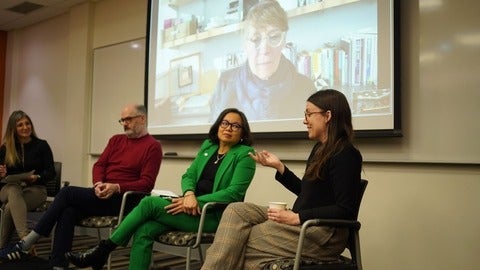
Future Cities Institute Managing Director Eryn Stewart joined a powerful conversation with one of the world’s most respected voices in climate and development: Sir Andrew Steer. The conversation was presented as part of the TD Walter Bean Lecture 2025. 

Speaking to a full auditorium of Grade 8-12 students, Sir Andrew shared why this generation has what it takes to shape the future of our cities, our communities, and our planet through bold ideas and grounded action. Drawing on a career that has spanned the World Bank, the World Resources Institute, and the Bezos Earth Fund, his message was clear: leadership starts now. 

Eryn brought a sharp and Future Cities Institute lens to the discussion, reflecting on what it means to build resilient cities and how young people across Canada are already doing that work through applied research, community partnerships, and new ways of thinking. 

Watch the full lecture: https://youtu.be/hIlQ3jcPXkQ  

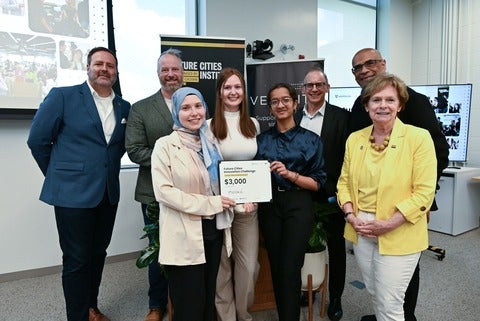
From affordable housing to AI-driven mobility, University of Waterloo students turned bold ideas into actionable solutions at the inaugural Future Cities Innovation Challenge. 

The inaugural Future Cities Innovation Challenge, co-hosted by Velocity and the Future Cities Institute, brought startup energy to real-world urban issues. 
 
Their solutions addressed real-world problems, from sustainable infrastructure to the ethical use of technology, bringing Waterloo’s Global Futures vision to life. The event showcased the power of student innovation in shaping healthy, prosperous, and sustainable cities. Explore six standout ideas that are helping build the cities of tomorrow.