News

Filter by:

Limit to news where the title matches:
Limit to items where the date of the news item:
Date range
Limit to news items where the audience is one or more of:

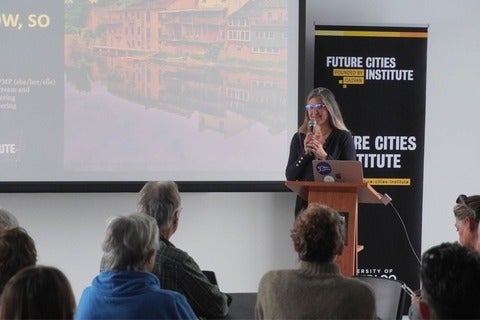
The Future Cities Institute was in attendance on October 15, 2025, at Bold Urban Futures: How to Build Healthier, More Resilient Communities, a packed evening of dialogue, connection and future-focused thinking in downtown Vancouver. 

Hosted at the TELUS Garden and part of the University of Waterloo’s Global Futures series, this special event brought together city-builders, University of Waterloo Alumni and partners working at the edge of change. 

FCI Director, Dr. Leia Minaker, joined an inspiring speaker lineup alongside Lisa Helps (Executive Lead, BC Builds at BC Housing) and Dr. Joyce Kim (Assistant Professor, Civil & Environmental Engineering and Cluster Lead on Housing at FCI) to explore how collaboration, innovation and evidence can help reimagine Canadian urban life. 

In a CBC News story, a CEO invites the community to help reimagine a mall in Saint John, New Brunswick, and turns to research voices like Pierre Filion, Master of Future Cities instructor and Waterloo emeritus professor, to unpack the urban questions behind this challenge. 

Pierre’s insights draw from his research on the decline of urban malls and their attempts to reinvent themselves. His perspective reminds us that thriving city centres depend not just on buildings, but on the people who fill them, residents, students, workers, and visitors shaping vibrant urban ecosystems.

FCI member Dr. Peter Crank has been awarded $78,000 from the Canada Foundation for Innovation John R. Evans Leaders Fund to support infrastructure for his new research project: Addressing urban (over)heating in a warming climate.
 
Through this project, Peter and supporting researchers, including FCI Director Dr. Leia Minaker, will generate critical data to help Canadian cities understand and reduce the health risks associated with rising urban temperatures. 
 
Their work will explore key links between: 
- Extreme urban heat and human health 
- Urban air quality and health outcomes 
- Urban green space and cooling potential 

The University of Waterloo Faculty of Environment welcomed Sir Andrew Steer as the 2025 TD Walter Bean Professor in Environment, bringing decades of global insight to a packed lecture on the future of our cities, communities, and ecosystems. The lecture was presented as part of the University of Waterloo’s Waterloo at 100 vision and in partnership with the Future Cities Institute. 

Following the lecture, FCI Director Dr. Leia Minaker moderated a wide-ranging conversation on the scale of the climate challenge and the opportunities for action across sectors.

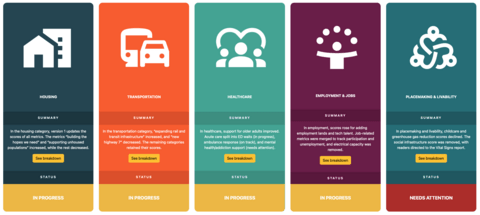
As Waterloo Region prepares to welcome one million residents by 2050, the Future Cities Institute has partnered with the Business and Economic Support Team of Waterloo Region (BestWR) to launch the Vision 1 million Scorecard, a first-of-its-kind academic–business collaboration. 
 
This public, data-driven tool tracks the region’s progress across five key areas: housing, transportation, healthcare, employment, and livability. Updated every six months, the scorecard highlights where the region is succeeding and where more focus is needed, helping guide investments and drive meaningful conversations across the region. 

As the academic partner, FCI is grounding the scorecard in data, equity, and long-term impact. With many regions facing similar growth challenges, this model has real potential to scale nationwide, and FCI is proud to help lead the way.

Sehaj Raj Singh joined the Future City Innovation Challenge, co-hosted by the FCI and Velocity, with a bold idea: make Canada’s permitting process smarter. He walked away with the top prize, new interdisciplinary teammates, and the attention of judge Frank Cairo, founder of the Future Cities Institute and a leader at CAIVAN.  

Now graduating, Sehaj is stepping into a new role as an Analyst in Land Development Engineering at Caivan Communities. Reflecting on the experience, he shared, “The Velocity Future City Innovation Challenge was hands down one of the most fulfilling moments of my undergrad... From being in the crowd to being on stage, I’m just glad I bet on myself.” A powerful example of how ambition, collaboration, and real-world challenges can shape the future.

At a recent event co-hosted by the University of Waterloo and TD Wealth, members of the Waterloo community gathered for a powerful conversation on Shaping Cities of the Future: Women, Leadership & Philanthropy.  

Moderated by Leia Minaker, our Director at the Future Cities Institute, the discussion highlighted the vital role women play in financial leadership and philanthropy. Leia guided a rich conversation that emphasized the value of trust-based giving, the power of intentional investment, and the many forms philanthropy can take, whether it be time, ideas, or financial support. 

From affordable housing to AI-driven mobility, University of Waterloo students turned bold ideas into actionable solutions at the inaugural Future Cities Innovation Challenge. 

The inaugural Future Cities Innovation Challenge, co-hosted by Velocity and the Future Cities Institute, brought startup energy to real-world urban issues. 
 
Their solutions addressed real-world problems, from sustainable infrastructure to the ethical use of technology, bringing Waterloo’s Global Futures vision to life. The event showcased the power of student innovation in shaping healthy, prosperous, and sustainable cities. Explore six standout ideas that are helping build the cities of tomorrow. 

Dr. Shams Anwar, a postdoctoral researcher with the Future Cities Institute, recently presented his work on sustainable mobility and resilient infrastructure at two major national conferences: the 247th ECS Meeting and the CSME International Congress–CFDSC–CSR 2025. 

His research explores the role of energy-efficient transport and urban systems in enabling the transition to low-carbon, climate-resilient cities. Emphasizing practical, impact-driven green technologies, Dr. Anwar’s work contributes to a growing body of applied research that informs infrastructure planning for sustainable urban futures.