Curling is hurrying hard to gold and a broader following
Every four years, the Olympics and Paralympics propel curling into the spotlight and researcher Heather Mair is working on building and sustaining a more diverse following
Curling in Canada has a strong and loyal following, but sees a boost in interest every four years, thanks in part to Team Canada’s Olympic and Paralympic curling success.
Dr. Heather Mair will be cheering on Team Canada curlers over the next couple of weeks. Mair is a professor in Recreation and Leisure Studies at the University of Waterloo. Her research includes two decades of work with Curling Canada. Among her projects is a large ethnographic study that investigated the role of curling clubs across the country, particularly in rural areas.
“Part of our work is to translate the experience of the game and the culture to people who didn't grow up with it or don't have a reason to come to a club,” she says. “As a sport, curling can be a bit impenetrable. It's a bit weird. I'll be honest, it's quirky. And it takes a little while for some people to embrace it.”
In December, Mair was named to two World Curling Congress’ commissions (Diversity, Equity and Inclusion and Sustainability), along with researchers and members from Brazil, China, Finland, Hungary, Korea, Nigeria and Thailand. The Diversity, Equity and Inclusion Commission’s responsibility is to propose strategies, policies, rules and recommendations that raise awareness of what diversity, equity and inclusion means across curling while supporting how these principles can be embedded into programs and initiatives across the sport.
An admittedly “terrible, but enthusiastic, curler,” Mair says the competition on the ice makes up a small part of her overall research.
“Growing up in a small village in New Brunswick, I certainly understood at a young age that curling and our local curling club played a role in bringing people together,” Mair says. “In the years since, especially working with Curling Canada, I’ve learned a lot about how and why curling connects communities.”
More than 2 million Canadians curl at least once annually. However, the sport does suffer from a perception that it is only played by white, more affluent, participants without visible disabilities.
Mair’s work strives to address issues that many amateur sports grapple with, including how to open the sport to non-traditional participants and be more accessible.
“For any sport to be successful, you need to build a vibrant grassroots system that provides opportunities key, not just for elite athletes, but for everyone,” Mair explains. “The Olympics and Paralympics provide a reminder for non-curlers about how fun and unique the sport can be, but between games, a lot of work needs to be done to connect with groups, especially those who don’t feel represented.”
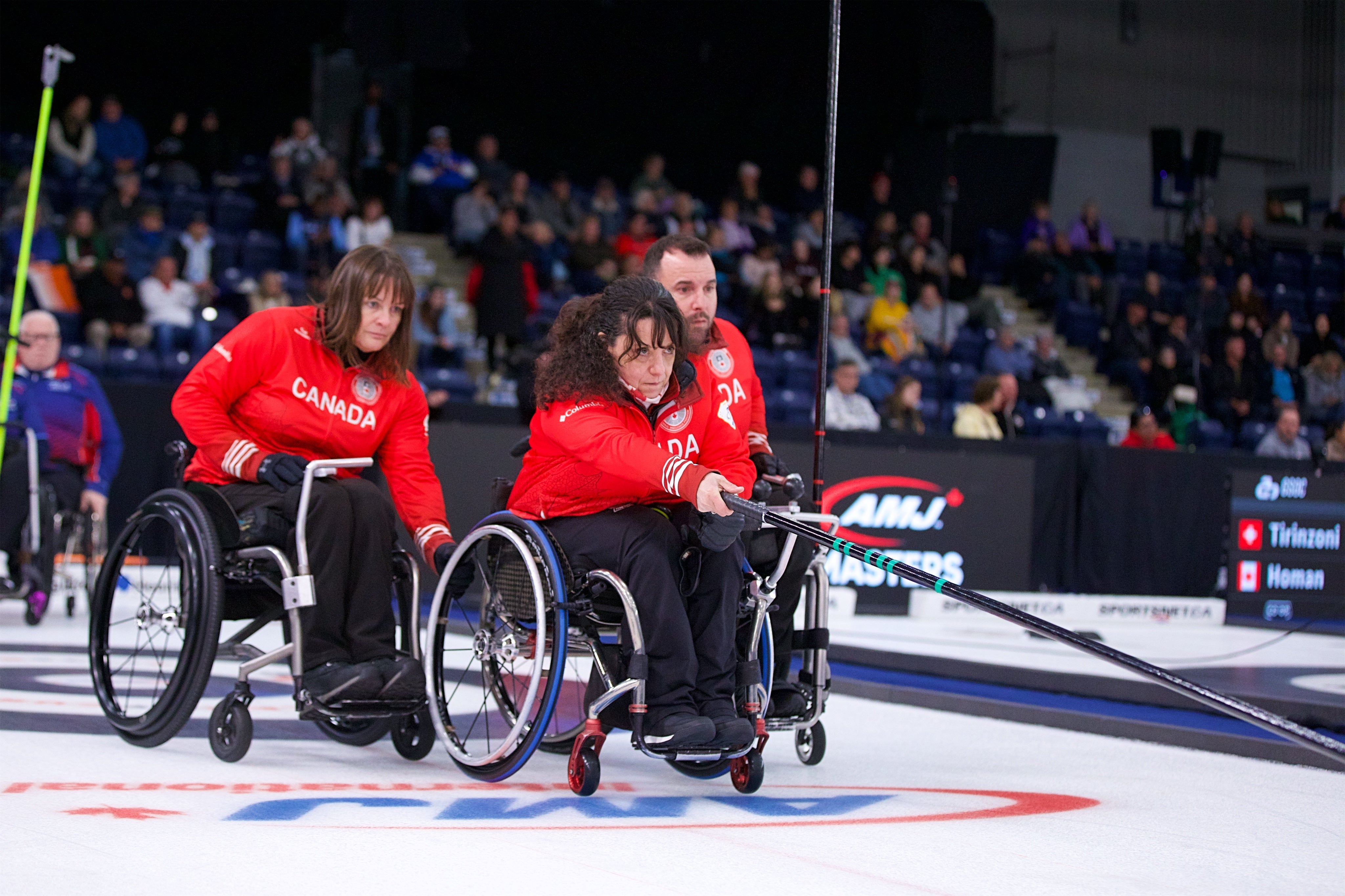
Team Canada's wheelchair curling team members Ina Forrest, Collinda Joseph and Jon Thurston in action.
Photo courtesy of Curling Canada (photographer: Anil Mungal)
Mair has watched closely as curling has grown in popularity around the world and sometimes worries about the balance between the values of local clubs alongside the professionalization of the sport.
“It’s never a bad thing to have role-models for participants, young and old, to emulate but as much as we should celebrate their achievements, we need to also celebrate curling clubs and the diversity of participants that truly reflect the breadth of the game.”
She says curling has been around for more than 150 years in Canada and during that time it has developed a strong community that has built a sense of belonging through vibrant social spaces for many across the country. It is why she continues to work at supporting the sport she loves.
“Obviously we’ll be rooting for Team Canada during the Paralympics, not just to win gold, but to encourage all Canadians to step into their local curling facility and explore the sport and the culture, which is truly special.”
Learn more about University of Waterloo Partners Transforming Curling collaboration and research.