Made by Waterloo: Tracking the tools that keep patients well
Velocity startup Technology Trace is helping hospitals spend less time searching for equipment and more time caring for patients
On some days, hospital staff can spend hours looking for a piece of equipment they know is somewhere in the building. A bed with a specialized mattress, a wheelchair left in an unexpected corner or a stretcher parked on a different floor. Every minute spent searching is a minute taken away from patient care.
Technology Trace, a Waterloo-based health-tech startup, is working to make those searches a thing of the past. The company has developed a medical asset lifecycle management platform that gives hospitals real-time insight into where critical equipment is located and how it is being used, helping care teams respond more quickly and plan more effectively.
“Hospitals are incredibly complex environments,” says Michael Becker (BASc ’98), CEO and co-founder of Technology Trace. “Equipment moves constantly, across departments and floors, and once that visibility is lost, people end up relying on guesswork. We wanted to give hospitals accurate information they can trust without disrupting care.”
A single hospital can manage thousands of mobile assets, from beds and wheelchairs to pumps, monitors and diagnostic devices. Yet many facilities still rely on manual counts or disconnected systems that do not share data across departments. When equipment appears to be missing, hospitals may rent or purchase replacements, even when suitable assets are already on site.
That lack of visibility has real consequences. Clinicians and porters spend valuable time searching hallways and storage rooms. Administrators struggle to understand whether equipment shortages are real or simply the result of poor tracking. Over time, those inefficiencies drive up costs, strain workflows and affect the patient experience.
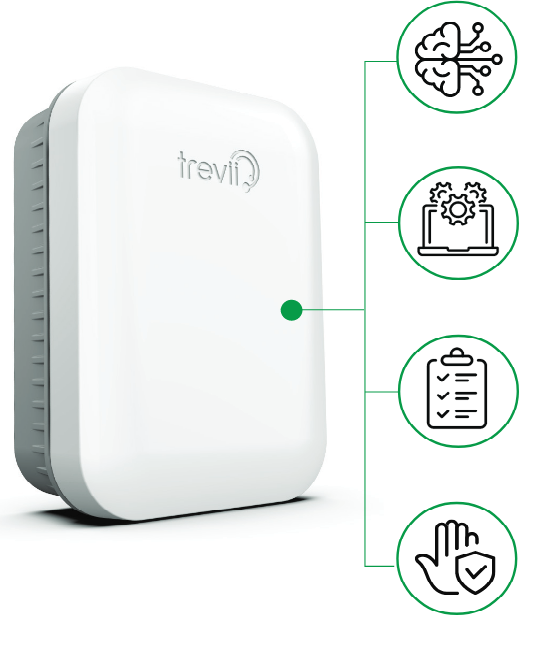
Becker and co-founder Daniel Fischer (BASc ’97) designed trevii, a small portable unit that securely relays real-time location information, specifically for health-care settings. The platform uses small, lightweight sensors attached to equipment, paired with a secure software dashboard. Together, they provide real-time location and utilization data across an entire facility, showing whether assets are in use, waiting to be cleaned or sitting idle.
“What really changes decision-making is utilization data,” Becker says. “It’s not just about knowing where something is but understanding how often it’s actually being used.”
That capability has been tested in real hospital environments. Technology Trace has worked closely with St. Joseph’s Healthcare Hamilton, where the platform was piloted to track high-demand equipment such as beds. Hospital teams were able to locate assets more quickly and gain a clearer picture of how equipment moved through the facility over the course of a day.
In one use case, the data revealed that a department was regularly renting bariatric beds it believed were unavailable. In reality, suitable beds were already on site but underused in another area of the hospital.
“They were spending significant amounts on rentals they didn’t need,” Becker says. “Once the data was visible, the solution was straightforward.”

Insights like these can translate into meaningful savings. By reducing unnecessary rentals, avoiding duplicate purchases and improving how existing assets are shared, hospitals can redirect resources toward patient care. Becker notes that even modest improvements in utilization, applied across large hospital systems, can result in millions of dollars in avoided costs over time.
Technology Trace has also collaborated with Waterloo Regional Health Network (WRHN), helping to validate its approach and connect with health-system partners focused on improving efficiency without adding operational burden.
The system is validated to Health Canada and U.S. Food and Drug Administration (FDA) standards and was built to integrate with existing hospital IT environments. It is also designed with privacy in mind: the sensors do not collect patient-identifiable information, ensuring sensitive data remains protected.
Technology Trace’s roots are firmly connected to the University of Waterloo. Becker and Fischer founded the company before reconnecting with the University through a Velocity Health event, where they recognized how Waterloo’s entrepreneurial ecosystem could support the company’s next stage of growth.
Through Velocity, Technology Trace has accessed mentorship, industry connections and funding opportunities that helped move the technology from pilot deployments to broader hospital adoption.
“We’re proud to be building this as a Canadian company,” Becker says. “Our goal is to grow here, create jobs here and develop technology that strengthens Canada’s health-care system.”
As health-care systems face rising demand and increasing costs, better use of existing resources is becoming essential. For Becker, the impact of Technology Trace ultimately comes down to supporting the people delivering care.
“If a nurse can find the right bed faster, or a porter can spend less time searching and more time helping patients, that matters,” he says.
By bringing clarity to an often-overlooked part of hospital operations, Technology Trace is helping ensure that the tools keeping patients well are exactly where they need to be when they’re needed most.